
Behind the Scenes of Repatriation: What Happens When an Indian Dies Abroad
Although the repatriation process is fairly structured, it is far from efficient, say experts.
advertisement
In October this year, 20‑year‑old Abhi Salaria had called his parents just a day before they received the tragic news of his death.
Even as they grappled with grief, the family endured a more than two‑week wait for his body to be repatriated from the US to their home in Gurdaspur, Punjab.
"When a sudden death strikes a family, they're completely lost. They don't know what to do," says Mohan Nannapaneni, founder of Team Aid, a US-based non-profit organisation which has been facilitating the repatriation of mortal remains to India since 2017. "It's especially a traumatic situation for a family living thousands of miles away."
So what really happens when an Indian citizen dies abroad, and how does a bereaved family navigate the painful stages of bringing the body back home?
Passport Missing, Family In a Fix
Salaria moved to Canada in April 2024 on the pretext of pursuing higher studies at Toronto's Fleming College. However, the 20-year-old had other plans. Just a couple of months after moving to Canada, he crossed over illegally into the US, allegedly via the 'Dunki' route.
He worked at a petrol pump and an adjoining store in Portland, Oregon for a few months, living just hours away from the Canadian border. Then, Immigration and Customs Enforcement (ICE) came knocking.
"When somebody goes to the US via the Dunki route, they're supposed to report to the police or ICE within two months of reaching there and then after one year," Santokh Singh, Salaria's uncle and a retired Colonel in the Indian Army, tells The Quint.
In October this year, the family were informed by Salaria's local guardian in the US that he had died allegedly by suicide.
Abhi Salaria.
(Photo Courtesy: Santokh Singh)
The news of his passing was a bolt out of the blue for Salaria's family, who were left to figure out the task of getting his body repatriated.
The first thing they did was contact the Indian Embassy. However, the Embassy's hands were tied since Salaria's passport was in ICE custody. The family sent a copy of his digital passport, but the Indian authorities needed a physical passport to expedite the process. The family, already in anguish over the sudden news, were in a fix.
More than two weeks passed before Salaria's body was finally repatriated.
Speaking of students alone, as many as 11 of them passed away in 2024—with the deaths coming out of nowhere due to shootings, suicides, and accidents. However, stakeholders claim the deaths could be far higher as many of them go unreported.
Media Spotlight Helps Expedite Repatriation
Mohammed Abdul Arfath's death was sudden, too.
A 25-year-old Master's student at Ohio's Cleveland State University, Arfath had been missing for around a month before his body was found by a lake in April 2024.
Mohammed Abdul Arfath had taken a loan to go to the US and pursue a degree in Information Technology at Ohio's Cleveland State University.
(Photo: Accessed by The Quint)
The news of Arfath being missing had been widely reported in India—something that Mohammed says helped expedite the repatriation.
"The Indian Embassy reached out to me when Arfath's body was in the medical examiner's office, and said they would take care of the body's transportation to India," Mohammed said while speaking to The Quint.
"I know from my conversations with officials at the Indian Embassy that they are concerned about any bad press. So they do what needs to be done to ensure that things don't go out of hand," he claims.
The Indian Embassy requires several documents (more on that later) to issue a no-objection certificate (NOC) to transport mortal remains back to India. By the time Mohammed arranged for all the documents, it was already the weekend. The Embassy still assured him that they would issue an NOC even if the documents reach them on Saturday or Sunday.
The Process
An Indian diplomat at the Consulate General of India in San Francisco, who wished not to be named, told The Quint that local law enforcement officials who find the body contact the Embassy first if the deceased is an Indian.
"We then confirm his or her Indian nationality and then contact their next of kin in India," he said.
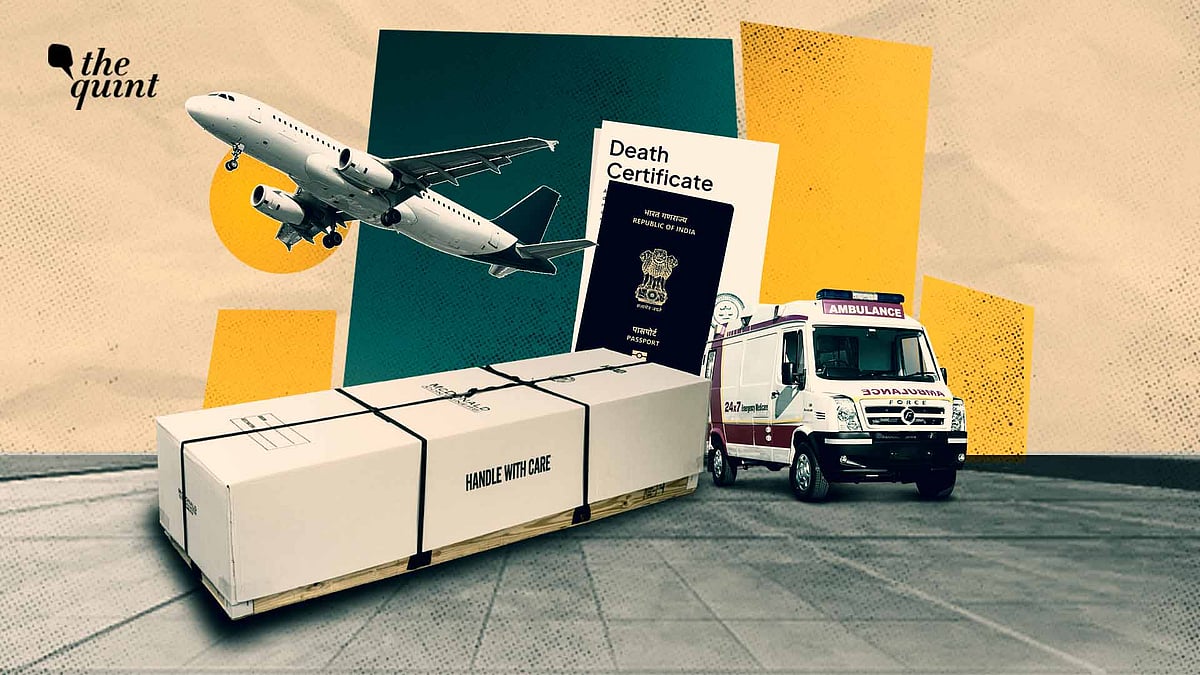
After an Indian citizen dies in the US, several stages follow before the body is repatriated to India:
1. First, the body is taken to the local medical examiner's office, where a post‑mortem is conducted and a death certificate issued.
2. A funeral home then gets involved, depending on the religious beliefs of the deceased. Once transferred, the body is embalmed and prepared for travel. The funeral home issues an embalming certificate and a non‑contagious disease (NCD) certificate. Their services can cost around $10,000 on average.
3. All these documents, along with the deceased's passport, are sent to the Indian Embassy, which issues an NOC authorising the transfer of mortal remains to India.
4. The NOC helps the airline to create the AWB (airway bill) for transporting the body.
5. On arrival in India, airport officials verify all required documents before allowing the mortal remains to enter the country. Once approved, the family must present digital copies of the necessary documents to claim the body.
To expedite the process, the Embassy usually engages with groups like Team Aid, one of the largest organisations in the US that essentially helps prepare all these documents.
The NGO's founder Nannapaneni says they have helped repatriate the bodies of over 3,000 individuals, mostly Indians, from the US since its formation in 2017. Originally from Andhra Pradesh and now based in Massachusetts, Nannapaneni partners with over 100 Indian-origin organisations based in the country and has around 3,000 volunteers to help in the process.
A Complex and Arduous Task
While repatriation of mortal remains may seem straightforward on the face of it, there are several bottlenecks that could plague the process.
"Some of the major problems we face (in issuing an NOC) include difficulty in identifying the body if it's in a highly decomposed state, local agencies demanding a DNA test to confirm the identity to let the body go from their custody, and if there's no friend or relative of the deceased in the US to help with the case," the diplomat told The Quint.
Beyond that, in most cases of repatriation, absence of a passport can become a major issue in transporting the body. On several occasions, the deceased's passport could be lost, damaged, or even confiscated by US authorities in case the person in question is an illegal immigrant (as in the case of Salaria) or has been penalised for a misdemeanour.
In such cases, the Embassy accepts the digital passport to issue an NOC, following which the body gets cleared for repatriation. However, a lack of coordination between Indian missions abroad and airport officials back home prolongs the suffering of families awaiting the mortal remains of their loved one.
A glimmer of hope to rectify this "wrongdoing" can be found in an official notification issued by the Union Ministry of Home Affairs (MHA) on 11 November. Having taken cognisance of airlines being unfairly fined for transporting a body without a passport, the MHA said that human mortal remains cannot be treated as a "passenger" under the Immigration and Foreigners Act, 2025, and should be considered "cargo" instead.
“Hence, the transportation of human mortal remains without an original passport cannot be considered as a violation under section 19 of the Immigration and Foreigners Act, 2025," the MHA letter reads.
However, it remains to be seen whether this notification will lead to action on the ground.
In the case of Salaria, as well as four other deceased Indians whose bodies were stranded in the US in October after their passports could not be obtained, the remains were repatriated only after Team Aid wrote to the authorities requesting for a special provision to be made.
However, due to the alleged stern rules set by Indian authorities, Salaria's body came back after 17 days of his death, instead of the five-six days it usually takes.
Karan Thukral, an immigration lawyer who has been engaged by many grieving families, says in case of a missing passport, the Indian Consulate should issue an emergency certificate or a one-way travel document to transport human remains.
"For this, supporting documents should be accepted, such as Aadhaar, PAN, or OCI (Overseas Citizen of India) card; Indian birth certificate; and family affidavits and identity proof of the next of kin," he tells The Quint.
In case passports or other documents are seized during criminal investigations, he adds, the Indian Consulate should coordinate directly with US authorities upon written representation by the legal counsel and next of kin.
Yet another issue pertains to the Indian government's requirement of an NCD certificate to allow a body into India. The rules in this regard were framed under the Indian Standard 10196, released in 1982.
However, Nannapaneni says that these rules are outdated. "These guidelines were framed almost 50 years ago. In any kind of death, even if it's a death by COVID-19, if the body is properly embalmed, it is non-contagious. But the Indian authorities are reluctant to change the regulations," he says.
The Quint has reached out to the Union Ministry of Health and the MEA. This article will be updated as and when they respond.
The speed at which documents were approved by Health Ministry officials in India was also a major bottleneck until a few years ago.
The airline transporting the body was required to send the death and embalming certificates issued by the funeral home to the ministry for approval. Nannapaneni alleges the officials back home "used to take several days to process the documents", leading to inordinate delays in the repatriation process.
That changed in August 2023 when former Foreign Secretary Harsh Vardhan Shringla took cognisance of the issue and set up a meeting between Nannapaneni and the Health Secretary.
"Now, the average time to approve the documents is just two hours. Some even get the approval within 15-20 minutes," Nannapaneni says.
How Is the Repatriation Process Funded?
There are several ways through which the repatriation of mortal remains can be financed. The family of the deceased can themselves pay the required amount, but if they can't afford the bill, the Embassy steps in.
"For economically poor persons, the Consulate provides funding through the Indian Community Welfare Fund and sends the body back to India on their own expense," the Indian diplomat tells The Quint.
The criteria to decipher who can be considered economically poor, the diplomat adds, is if the deceased was the only breadinner of the family or the family has credentials to prove that they are Below Poverty Line (BPL). "At the end of the day, every decision is taken as per ministry guidelines."
Arfath's cousin, for instance, tells The Quint he didn't have to pay a penny to any of the stakeholders involved in the repatriation process, including the funeral home.
However, if families don't qualify as per the Embassy's criteria, NGOs like Team Aid or diaspora groups get involved.
"Transporting bodies costs a lot of money. If after conducting a proper enquiry the Embassy finds that the family doesn't qualify, then we provide the funding," Nannapaneni says.
The benefactors, such as the families of Yash Kumar, who was shot dead in Chicago on 26 September, and influencer Anunay Sood, who died in Las Vegas on 4 November, tell The Quint that Team Aid helped them complete all the formalities at no cost.
Kumar's uncle Balraj Singh says the total repatriation cost was an estimated $9,000, which was covered through insurance. Similarly, Sood's brother-in-law Rohan Kochhar adds that Team Aid helped in identifying the appropriate funeral home, made flight arrangements, and took care of consular procedures.
Making the Process More Efficient
Although the repatriation process is fairly structured, immigration lawyer Thukral notes that it is far from efficient—often proving time‑consuming, document‑heavy, and reliant on coordination among funeral homes, state health departments, consulates, airlines, and local police authorities.
"Unlike some European and West Asian jurisdictions, India still lacks a centralised digital clearance system, making the workflow dependent on manual approvals and consular discretion," the lawyer says, suggesting various reforms to infuse greater efficiency into the process:
Issuance of a standard SOP for foreign repatriations
Digital identity verification integration with Indian systems (such as Passport Seva, DigiLocker, Aadhaar, OCI database)
A dedicated helpline cell under the MEA for families and funeral service coordinators
Waiver or simplification of issuing emergency certificate when identity can only be digitally confirmed
Removal of outdated documentary penalty provisions that cause unnecessary refusal by foreign authorities
Encouraging airlines to operate priority emergency clearance lanes for human remains
"These reforms will not only improve efficiency, but also preserve dignity for grieving families," Thukral asserts.
- Access to all paywalled content on site
- Ad-free experience across The Quint
- Early previews of our Special Projects
Published: undefined