'Earning in Rials, Spending in Dollars,' Say Iranians Amid Price Rise Protests
'The youth are fighting for their future, but given our living conditions I doubt we'll have one,' a protester said.
advertisement
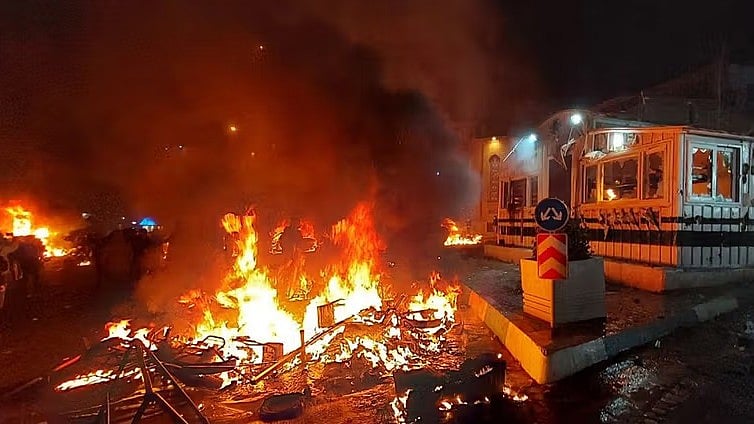
"The youth are fighting for their future, but considering our living conditions I doubt we'll even have one," Alireza Ebrahimi, an Iranian mechanical engineer from capital Tehran, tells The Quint as deadly protests in the country entered their 15th day on Monday, 12 January.
The last 24 hours have seen a dramatic escalation, with internet shutdowns imposed and security officials using tear gas and other means against demonstrators protesting against the falling value of the rial and an ever-expanding inflation rate, pegged to be around 40 percent. The protests have now been recorded in most of Iran’s 31 provinces, according to Al Jazeera.
'Ordinary Citizens Are Paying the Price, With Money They Don't Have'
Ebrahimi was among many who expressed frustration over the abysmal living conditions in the country—and the government's response to their demands.
"If we go out on the streets to ask for our rights, they threaten to kill us. We are left with no choice here," the 25-year-old adds helplessly.
He further says that the economic hardships aren't common to all Iranians, but only the weaker sections of society.
"The upper strata consists of the wealthy who remain completely indifferent. It makes no difference to them what is happening in the country," he says.
Another protester, who wanted to remain anonymous, explains how the falling value of the Iranian currency was impacing their standard of living.
“If I were to speak in general terms, it's like this: Our income is in rials and our spending is in dollars," he tells The Quint.
The demonstrations, which began on 28 December by a few local shopkeepers in Tehran, have now englufed the entire country. So much so that they are being pegged as the largest demonstrations since the killing of 22-year-old Mahsa Amini by the draconian Islamic Revolutionary Guard Corps in September 2022.
Al Jazeera, meanwhile, reported that several Iranian cities have also seen pro-government rallies, including in Tehran.
An Economic Crisis Years in the Making
The anti-government protests, however, were not sparked overnight, but have been in the making for quite some time, according to experts.
"When a country's currency is not backed by industries and employment generation, it is bound to collapse," Sujata Ashwarya, professor at Jamia Millia Islamia’s Centre for West Asian Studies, tells The Quint.
"What the Iranian regime is doing to prevent that collapse is mopping up the currency from the economy, which means people have less and less money in their hands to buy things. That becomes a vicious circle when you constantly mismanage your economy," she says.
She further adds that due to US sanctions, Iran has very few exports to boast of. "With Iranian oil unable to be sold, their currency is almost like ordinary paper," Ashwarya says, adding:
Senior journalist and West Asia expert Sanjay Kapoor agrees. When asked whether the Iranian government can restore its political legitimacy without providing economic relief, he explains:
Kapoor, however, adds that the problems in Iran aren't entirely of their making, but influenced by external actors as well.
"In Iran's case, the depreciation and inflationary spiral is caused by the US and its allies. Any kind of distress that Iran is facing is linked to its foreign policy. People may disagree with the foreign policy trajectory of Tehran, but they realise that it is unlikely to change as long as the clergy is calling the shots," he says.
Meanwhile, Iranian state television aired a speech by the country's chief cleric Ayatollah Ali Khamenei on Friday, 9 January, in a first during the ongoing protests. During the publicised address, Khamenei took aim at US President Donald Trump, who had vowed to take action against Tehran if they "shoot and violently kill peaceful protesters".
India Issues Advisory
In light of the protests in Iran, India's Ministry of External Affairs (MEA) put out a circular on 5 January for Indian nationals stranded in the country, asking them to avoid all non-essential travel.
"Indian citizens and PIOs (Persons of Indian Origin), currently in Iran, should exercise due caution, avoid areas of protests or demonstrations, and closely monitor news as well as the website and social media handles of the Embassy of India in Tehran," the MEA notice read.
An Indian national studying in Iran tells The Quint that she has been in regular touch with the Embassy regarding her safety amid the protests.
"We have personally received advisories from the Embassy here to avoid crowded areas," she says on the condition of anonymity. "I haven't made any plans to leave the country yet, but if the situation goes out of hand, then I would hope the Embassy will quickly evacuate us."