
Amid Fresh Unrest in Bangladesh, Will BNP's Call for Anti-Hasina Alliance Work?
The ruling party has appealed to anti-Hasina parties to unite against an "attempted return of fascism".
advertisement
The police station in Tungipara, the ancestral home of Bangladesh's ousted Prime Minister Sheikh Hasina, bore the marks of a night of violence. Burnt furniture, damaged computers, and shattered windows were scattered across the compound.
On the morning of Thursday, 19 November, two days after the violence, officers were seen sifting through the debris and picking out belongings from the quarters gutted by the fire. Outside, roads had been blocked with trees and electricity poles. At least 10 security vehicles had been set ablaze.
In nearby areas of Gopalganj, Hasina's home district, businesses remained closed, with residents assessing the damage. Jamal Hossain, a 55-year-old clothes vendor, told The Quint, "Sales have nearly stopped, so I am considering returning to my village."
The violence, which followed the arrest of suspected Awami League activists in mid-November, was among a series of attacks attributed to supporters of Hasina's banned party, Awami League, across Bangladesh.
Prime Minister Tarique Rahman has urged Jamaat-e-Islami and the National Citizen Party (NCP)—two of the BNP's main political rivals—to set aside their differences and cooperate against the Awami League.
The appeal comes nine months after the BNP won the February parliamentary election—and more than two years after a student-led uprising forced Hasina to flee to India, ending her 15-year run.
How Violence Spread in Hasina's Homeground
The violence in Tungipara began after police arrested eight people, including suspected Awami League and student-wing activists, on 17 November. Soon after, supporters gathered outside the police station demanding their release.
According to locals who spoke to The Quint, the protest escalated into clashes with security personnel, who allegedly used tear gas, sound grenades, and rubber bullets to deter the crowd that eventually numbered in several thousand.
Apart from the police station, the violence reached the residence of BNP lawmaker SM Jilani, where property was extensively damaged by fire. Shops, a BNP office, and a Grameen Bank branch were among other reported targets.
Further attacks were reported in Muksudpur and other parts of Gopalganj. In Pirojpur, a bus helper was allegedly killed after attackers, reportedly chanting Awami League slogans, set a vehicle on fire.
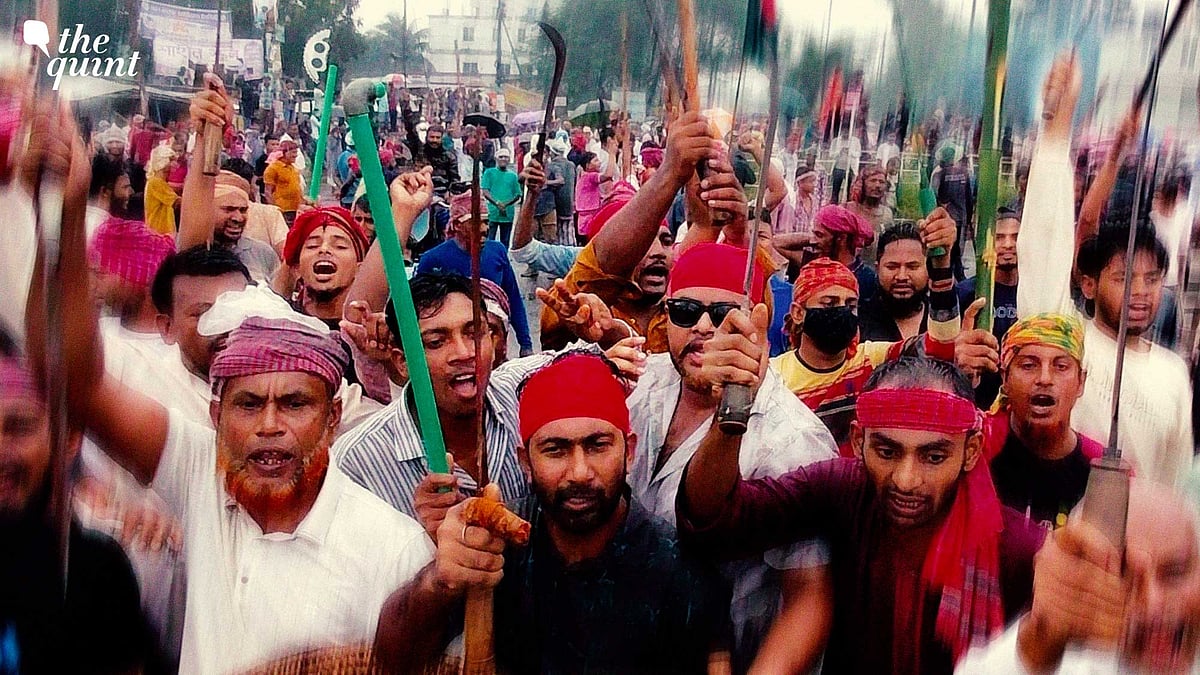
Awami League supporters photographed on 21 November, days after violence in Sheikh Hasina's political home turf in Bangladesh.
(Photo Credit: Special Arrangement/Abdul Goni/The Quint)
The attacks have occurred against the backdrop of a political transition that began with Hasina's departure on 5 August 2024.
Her government collapsed following weeks of protests that began over public-sector job quotas and developed into a nationwide movement against her administration. Hundreds were killed during the crackdown on demonstrators.
An interim government headed by Nobel laureate Muhammad Yunus subsequently took office and remained in power until February 2026. The BNP won the 12 February parliamentary election earlier this year, and Tarique, the son of former Prime Minister, Khaleda Zia, took office five days later.
The Awami League's political activities remain banned. Hasina, who has lived in India since her removal, was sentenced to death in absentia by Bangladesh's International Crimes Tribunal in November 2025 over crimes against humanity linked to the 2024 crackdown.
Her party rejects the proceedings and continues to demand a return to political activity.
Tarique Seeks Oppositional Unity
Addressing the Parliament on 18 November, Rahman urged parties that had opposed Hasina's government to unite against renewed violence and what he described as efforts to restore fascism.
He subsequently warned that the government would act firmly against arson, killings, and attacks on public property. The prime minister has also instructed BNP lawmakers to remain active in their constituencies and coordinate with local party organisations and the administration.
At a meeting with lawmakers, he said responsibility for responding to the violence should not rest solely with the home minister.
Senior figures from the BNP, Jamaat, and Awami League who spoke to The Quint indicated that those differences remain unresolved.
The BNP says political disagreements should not prevent cooperation. Jamaat wants the government to fulfil its reform commitments before a durable alliance can emerge. The BNP and its affiliated student, youth and volunteer organisations are preparing separate programmes throughout December, including rallies and processions aimed at countering Awami League activities. The Awami League, meanwhile, dismisses the initiative as an expression of fear and insists it will return to Bangladesh in December.
Speaking to The Quint, BNP Joint Secretary General Syed Emran Saleh Prince said the governing party expected the anti-fascist unity to survive disagreements among political organisations.
“We expect the anti-fascist unity to be maintained at all times, in line with the appeal made by our Prime Minister and parliamentary leader, Tarique Rahman,” he said.
Prince argued that differences over policy were an essential part of parliamentary democracy.
He said parties could disagree over governance while maintaining a common position on Bangladesh's independence and sovereignty.
Asked whether repeated criticism of Jamaat by ruling party politicians could undermine the proposed alliance, Prince acknowledged the differences but urged restraint.
Jamaat, however, has linked broader political cooperation to the government's implementation of the July National Charter. The charter emerged from negotiations during the Yunus administration and outlines constitutional and institutional reforms intended to prevent the concentration of executive power.
A referendum held alongside the February election endorsed the proposed reforms, but the BNP and its opponents remain divided over their implementation.
Where Jamaat and Student Leaders Stand
Jamaat, which leads an 11-party Opposition alliance, accuses the government of failing to honour commitments made during the transition. Its assistant secretary general, Hamidur Rahman Azad, has blamed the BNP for weakening the anti-Awami League political front, arguing that the government's decisions have encouraged Hasina's supporters.
Jamaat Secretary General Mia Golam Parwar told The Quint that implementing the charter and referendum verdict would help resolve the disagreements.
Parwar said Jamaat had announced a 40-day anti-fascist programme in the broader interests of the state and was cooperating with the government despite its disagreements.
Asked whether Jamaat chief and Opposition leader Shafiqur Rahman had made implementation of the reforms a condition for unity during a private meeting with the prime minister, Parwar declined to disclose details of their discussion.
“The essence of the discussion is that we view anti-fascist unity positively,” he said.
Nahid has also called for progress in prosecuting those responsible for the killings during the 2024 uprising. He has argued that an alliance against the Awami League cannot substitute for the constitutional reforms agreed during the transition.
Tarique is scheduled to meet an NCP delegation led by Nahid on 23 November as part of his consultations with opposition parties.
India Faces Growing Extradition Demands
The proposed alliance has drawn a dismissive response from the Awami League, whose leaders maintain that the party will resume political activities despite the ban.
Shafiul Alam Chowdhury Nadel, a senior Awami League leader, told The Quint that the BNP and Jamaat already had a history of political cooperation and questioned the need for a new alliance.
“The BNP and Jamaat have always had an alliance, and that alliance still exists. Their renewed call for broader unity is essentially a so-called initiative,” he said.
Nadel accused the parties of pursuing destructive politics over the past two and a half years, an allegation they reject.
“They are afraid of what will happen to them if the Awami League returns to Bangladesh. It is this fear that has prompted their call for broader unity,” he said. “None of this will work. We will return in December.”
The declaration comes as Bangladesh continues to seek Hasina's extradition from India, where she has remained since August 2024.
State Minister for Foreign Affairs Shama Obaed Islam reiterated that position on 22 November, saying India should hand Hasina over to face her sentence.
“India must send back the person who ordered killings, enforced disappearances and money laundering, just as it has to return other convicted criminals,” she said at a BNP youth-wing gathering in Faridpur.
She added that Hasina's place would be in Bangladesh's central jail and urged party workers to organise programmes throughout December.
(Faisal Mahmud is a Dhaka-based independent journalist covering news and politics.)
- Access to all paywalled content on site
- Ad-free experience across The Quint
- Early previews of our Special Projects
Published: undefined