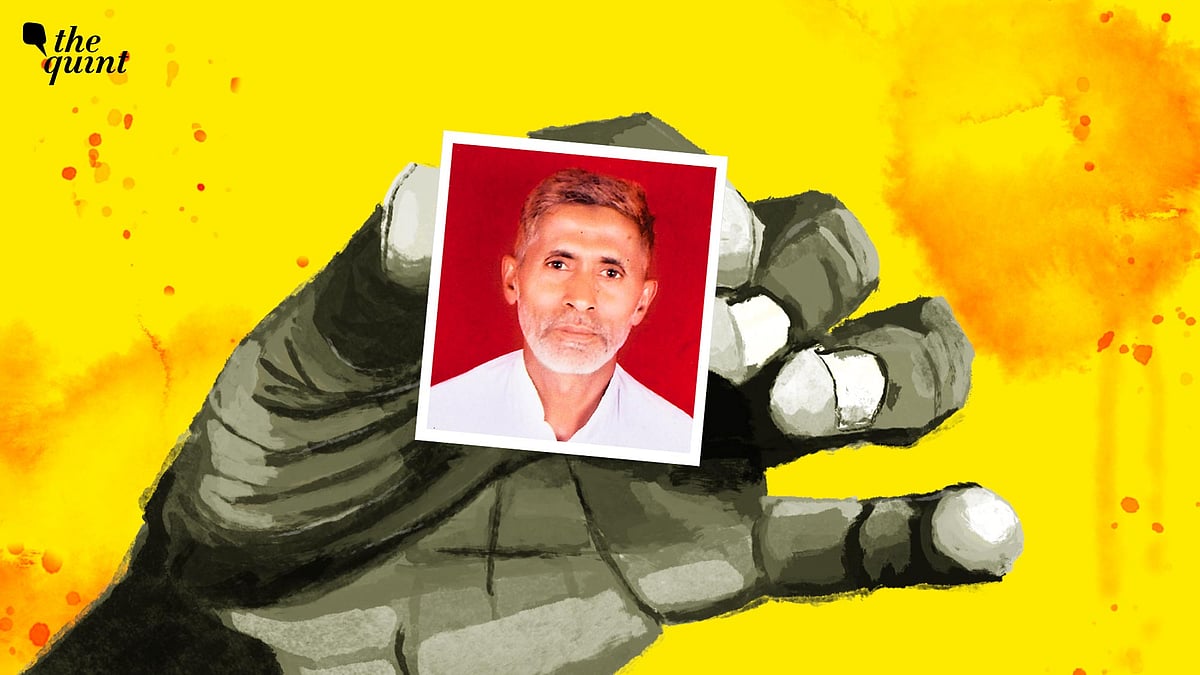
The Dadri Files: 10 Years of Grief and Impunity Since Akhlaq's Lynching
"Those who killed Akhlaq did it so brutally that anyone else can do it today with impunity," says Jaan Mohammad.
advertisement
(In-depth reportage such as this requires time, effort and a lot of risk. Exposing hate and communalism is a key focus area in The Quint's reportage. Become a member and help us do more such stories).
An abandoned house with hues of yellow, blue and red lies in eerie emptiness. A dua thanking (Allah) God for His grace, carved on the wall above the front door is still visible. But there is no grace anymore. The chipped paint of the walls, the darkened, dusty window tell only one story: It was this house where on 28 September 2015, a radicalised mob lynched Mohammad Akhlaq.
The mob entered the home of the 52-year-old in Bisahda, Dadri district of Uttar Pradesh and killed him, leaving the family in dread till date. A brutal murder on suspicion of storing and consuming beef, barely 50 kms away from the national capital.
The agony of a family. Listen to Jaan Mohammad, Akhlaq’s brother here:
This case and everything that followed cannot be read in isolation of the post-2014 India.
For even though it was not the first such lynching in Prime Minister Narendra Modi’s first term, it became the turning point in what followed in New India—marked by the rise of cow vigilantism and Hindutva mob militancy. A decade later, Yogi Adityanath's government sought to drop all charges against the accused but failed.
In this story, we chart the decade-long legal fight and obstacles in Akhlaq's case, the family's and this nation's collective memory of one of the most heinous hate crimes in PM Modi's first term and where it stands today.
The Quint has previously reported on Akhlaq’s case and stayed with the story, such as here, here and here.
In the past decade, Akhlaq’s family has patiently trusted the process and fought for Akhlaq. Justice evades them and the long-drawn legal fight is now a constant companion.
All the hearings in Akhlaq's case till December 2025.
(Photo: Aroop Mishra/The Quint)
Akhlaq was one of four brothers. He has a wife, Ikraman in her late 50s and four children. Mumtaz (32), Sartaj (30), Danish (28) and Shaista (26). In this story, The Quint charts the history and present of the case and spoke with Akhlaq's brother Jaan Mohammad and their lawyer, Yusuf Saifi to investigate and reconstruct the case.
The Quint is choosing not to disclose the location of the family for their safety. Scroll through the timeline for a glimpse into the some of the twists and turns of the case:
(Photo: Aroop Mishra/The Quint)
(Photo: Aroop Mishra/The Quint)
(Photo: Aroop Mishra/The Quint)
(Photo: Aroop Mishra/The Quint)
(Photo: Aroop Mishra/The Quint)
(Photo: Aroop Mishra/The Quint)
Beef, Bigotry, Bereavement
28 September 2015:
A local Hindu priest announced that a cow—considered sacred by many Hindus—had been slaughtered. An angry mob of 15-20 people dragged Akhlaq from his home and physically thrashed him to death.
But what happened to this Hindu priest?
Scroll to see what happened there.
(Photo: Aroop Mishra/The Quint)
(Photo: Aroop Mishra/The Quint)
The Murder
Jaan Mohammad, Akhlaq's brother, recounted the gruesome murder and the attack on Danish. Listen here:
Akhlaq's blood-soaked body was left on the road some meters away from his home.
Three days before Akhlaq was killed, it was Eid al-Adha (Bakrid). The family and their lawyer told The Quint that the mutton was distributed among the families and no ceremonious sacrifice (qurbani) was done as there was no need.
The same night, an FIR was filed at Jarcha police station in Gautam Budh Nagar.
The FIR included IPC sections such as:
(Photo: Aroop Mishra/The Quint)
The Preliminary Report
The confiscated meat from the spot was sent to a local veterinary doctor’s lab for a preliminary report. The Quint has exclusively accessed this report.
(Photo: Aroop Mishra/The Quint)
3 October 2015:
Two key persons — Vishal Singh Rana, son of Sanjay Rana, a local BJP leader associated with the party for over two decades and Shivam — were arrested along with six others.
On the same day, then UP CM Akhilesh Yadav gave a compensation of Rs 45 lakh to Akhlaq's family. This included Rs 30 lakh to Asghari Begum for the loss of her son and Rs 5 lakh each to his three brothers.
4 October 2015:
The then Home Minister Rajnath Singh called Akhlaq’s lynching “unfortunate” and said it should not be given any “communal colour.” Three days later, he said that strict action would be taken against those responsible.
7 October 2015:
PM Modi was briefed by the Home Ministry on Akhlaq’s lynching. This was done after the Home Ministry received a report from the UP government that Akhlaq was killed following allegations that his family had consumed the meat of a banned animal.
14 October 2015:
In an interview to a Bengali newspaper, Ananda Bazaar Patrika, PM Modi said, "It was an extremely sad incident. The BJP does not support such incidents. The opposition is playing communal card by blaming us with the Bihar election in mind."
17 October 2015:
Akhlaq’s family left the village. “On 17 October 2015, we all permanently packed up and left. I will not forget this date,” said Jaan Mohammad Saifi to The Quint, a couple of years ago.
22 December 2015:
The chargesheet was filed in Dadri lynching case. While the chargesheet was filed against 15 people, four names were added later.
What about the accused today? Where are they now?
(Photo: Aroop Mishra/The Quint)
Vishal, son of a BJP leader, Sanjay Rana and his cousin Shivam were named as main conspirators in the chargesheet.
The chargesheet named:
Rupendra, Vivek, Sachin, Hari Om, Sri Om, Sandeep, Saurabh, Gaurav, Ravin*, Arun, Rohit, Vinay, Anurag, Bheem and Punit.
(Photo: Aroop Mishra/The Quint)
*Ravin Sisodia (21) died of kidney and lung failure in October 2016.
His funeral was attended by then Union Minister for Tourism and Culture Mahesh Sharma.
(Photo: Twitter/X)
The Disputed Forensic Lab Report
31 May 2016:
Contrary to the initial report, a forensic report by a lab in Mathura stated that the meat sample collected from Akhlaq's house was 'beef.' The family still rejects this report.
(Photo: Aroop Mishra/The Quint)
(Photo: Aroop Mishra/The Quint)
(Photo: Aroop Mishra/The Quint)
1 June 2016:
Then UP Chief Minister Akhilesh Yadav also questioned the authenticity of the Mathura lab report.
“Where was the sample sent? Who received it? There was nothing objectionable in his (Akhlaq’s) house,” he said.
Attempt To Intimidate Family
Jaan informed The Quint that families of the accused had tried to put pressure on them to “settle” the issue and move on. When they refused, some neighbours tried to get a case filed against them. They succeeded.
14 July 2016: A local Surajpur court directed the Greater Noida Police to register a case of cow slaughter against Akhlaq and his family under the UP Prevention of Cow Slaughter Act, 1955.
15 July 2016: A case of cow slaughter against the family of Akhlaq, charging Jaan and several other members of his family, including his murdered brother, with cow slaughter. They deny the charge.
This case is still pending in a UP court.
Prior to this, some Bisahda residents had approached the court to put pressure on the FIR. It was filed on the basis of a petition by one of Akhlaq’s neighbours, Surajpal.
26 August 2016:
The Allahabad HC granted immunity from arrest to all members of Akhlaq's family except his brother Jaan till the conclusion of investigation in the case.
'Bail Par Bail'
11 April 2017:
Two accused-Arun and Punit-were granted bail on the condition that they will not tamper with evidence or delay the trial in any manner.
They were given bail as they were not named in the FIR, said the court.
31 July 2017:
Vishal Rana, prime accused in the case, was granted bail by the Allahabad High Court.
By this time, 15 of the 18 accused were out on bail.
2018: The case is stuck in a ‘fast-track’ court.
Despite 45 dates set by the court for the hearing since 2015, charges were still not framed against the accused.
31 March 2019: One of the prime accused in the case, Vishal, was seen sitting in the front row of a BJP rally addressed by Chief Minister Yogi Adityanath in Bishahra.
(Photo: Accessed by The Quint)
The Trial Finally Begins
March 2021: The charges were framed by February and trial in this case began on 26 March 2021.
As the case progressed, BJP leaders also did not leave the chance to further add fuel to the fire.
Then MLA Sangeet Som visited Bisahda and demanded action against Akhlaq. "Innocents are being framed," he said about the accused in the case.
June 2022: Shasita Testifies
“Dar Kathwa-Kathwa” (Be scared, Muslim)
Shaista, Akhlaq’s daughter had resisted the mob back in 2015.
On 14 June 2022, in a major breakthrough, Shaista testified and identified all the accused. The Quint has seen the document of her testimony.
(Photo: Aroop Mishra/The Quint)
2023: In her 80s, Akhlaq’s mother Asgari passed away, said Jaan.
Talking about the impact of that unfortunate night, Danish once told The Quint, “Whenever my mother and sister recalled the night, tears rolled down their cheeks. We haven’t yet overcome the shock.”
October-November 2025:
UP Govt’s Move for Akhlaq’s 'Killers'
Ten years on, the snail-paced trial is still at the evidence stage.
However, the UP government has sought to drop all the charges against the accused in this case.
To erase the lynching.
To erase Akhlaq.
To erase the possibility of justice.
Swipe to see the arguments given by the state to drop the charges against the accused and Advocate Yusuf Saifi's rebuttal:
(Photo: Aroop Mishra/The Quint)
(Photo: Aroop Mishra/The Quint)
(Photo: Aroop Mishra/The Quint)
14 December 2025:
A fast-track court in Surajpur gave time to lawyers from both the sides to prepare their case. Their arguments would be heard on 18 December, then the court would decide whether to accept or reject the UP government's application to drop the case.
23 December 2025:
In a setback to the UP government, Surajpur court rejected their plea to drop all the charges against the accused.
(Photo: Aroop Mishra/The Quint)
The Cost of Lynching: A Fractured Family and a Village
Hindus and Muslims lived together like brothers and sisters before the lynching, Akhlaq’s family has recalled several times.
Akhlaq’s was the only Muslim family living in his bloc. Surrounded by Hindu households of Thakurs and Rajputs.
But 28 September 2015 altered the course of their lives forever. The relations between the local Hindus and Muslims became strained as families of the accused wanted Akhlaq’s family to settle the matter.
Jaan is the only family member who continues to reside in Dadri. Haunted by the memory, acting as an impetus to fight for justice.
Back then, his other brother, Afzal and all the other family members lived there, “but the perpetrators of the crime only targeted Akhlaq which means that it was planned,” recalled Jaan.
“There are no tensions between Hindus or Muslims here now. After the lynching, some people tried to disrupt the social harmony among us. I had picked up Akhlaq's body and buried him so as to not create any scene or trouble,” Jaan told The Quint.
But the biggest regret in Jaan’s life remains this: How his family became scattered all over and was separated from him. The loss, the grief and separation has left an indelible mark on them.
A brutal murder forgotten.
A state’s attempt to undo a decade-long battle.
A family’s hope for justice severed.
And a man named Mohammad Akhlaq buried under a huge pile of towering hill of hate crimes this country has produced since then.
Of Akhlaq and many such Akhlaqs.
Jaan speaks about how Akhlaq's killing became ominous, a killing that heralded the rising communalism we witness in India today: