
Two Anti-Gyanesh Protests, Two Versions of Democracy? This is Not Done, Bro!
Four key aspects to understand why two police forces responded differently to two protests against Gyanesh Kumar.
advertisement
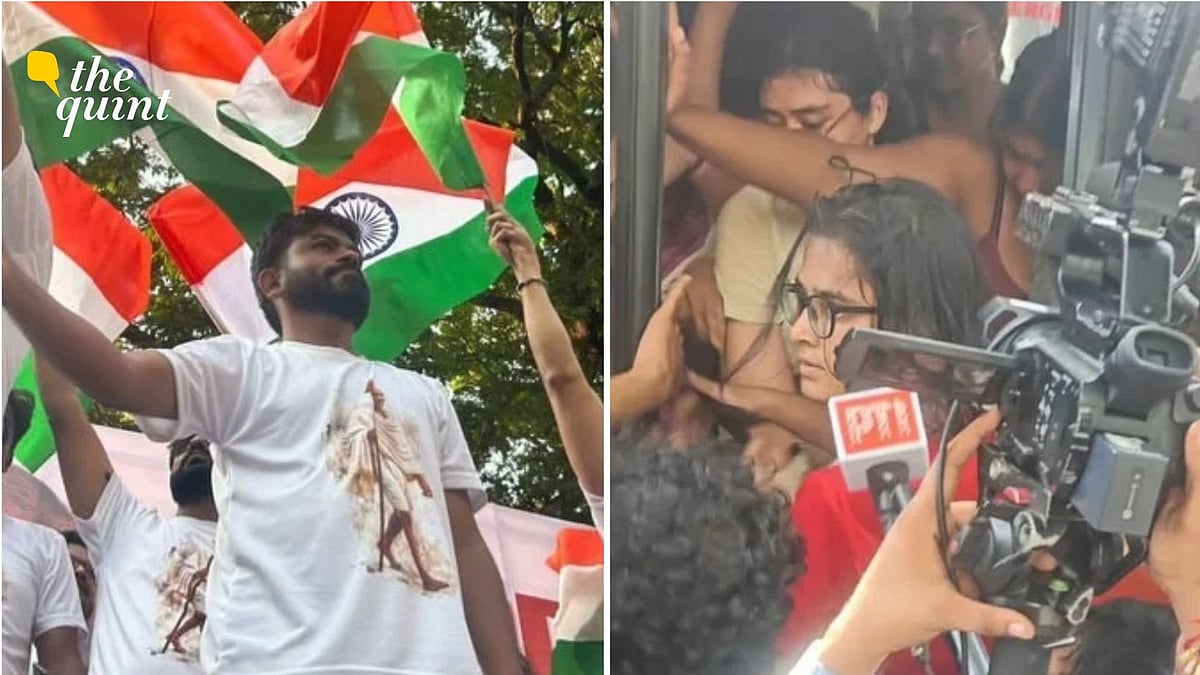
Two major protests took place in India on 2 October. Both protests had the same demands. Both were denied official permission. The leadership of both protests asserted that the call was for a peaceful Gandhian protest. And yet, one received full cooperation from the state, while the other faced a complete ban, a brutal police crackdown and mass detentions.
As the world celebrated the birth anniversary of the Mahatma, protesters in the national capital who gave a call for peaceful protests to demand the resignation of Chief Election Commissioner Gyanesh Kumar faced a violent crackdown. The protest called by the Cockroach Janta Party (CJP) in Mumbai, meanwhile, received complete cooperation from the police. The gathering of thousands concluded successfully without any reported incident of violence.
Thousands of security personnel on the ground, Metro station closures, route diversions, tear gas vans, water cannons and hundreds of buses across central Delhi to detain protesters: the Delhi Police could not have made it clearer that it was in no mood to cooperate. The Mumbai Police, meanwhile, not only held talks with Abhijeet Dipke and the CJP leadership but also facilitated the smooth flow of protesters thronging Shivaji Park.
(Photo: CJP)
While The Quint reported on both protests on-site, one need not have been on the ground to perceive the difference in the nature of the police response to the two protests. A beeline of social media personalities was seen thanking the Mumbai Police for their cooperation, while the CJP leadership, consisting of Abhijeet Dipke, Saurav Das and Ashutosh Ranka, openly criticised the brutality of the Delhi Police towards protesters on the same day that their Mumbai counterparts extended "full cooperation" to a protest making the same demands.
(Photo: The Quint)
The BJP's CJP Playbook
The handling of the CJP's protest call by the Maharashtra government followed the same playbook as that of the central Bharatiya Janata Party (BJP) leadership since the anti-NEET movement in June and July this year.
Any use of force against the group has led to adverse repercussions for the BJP. During the anti-NEET protests, the use of force against Sonam Wangchuk on 18 July catalysed the influx of protesters to Jantar Mantar. The Delhi Police's crackdown on protesters two days later added insult to injury, following which the movement reached the streets of the national capital in a way the city or this government had not seen in the longest time, drawing ordinary citizens across caste, class, religion, age and gender groups.
The privileged caste and financially upper-class urban voter has been believed to form a significant chunk of the BJP's support base, which no other political party or group in the country had managed to dent so far. The CJP commands significant support among the youth of these demographics, whom the BJP has been meticulous about handling.
(Photo: CJP)
Delhi Had Direct Political and Electoral Rivals
The protesters in Delhi, unlike those in Mumbai, comprised groups and outfits that are long-standing political rivals of the BJP. These groups command the ability to garner crowds, but mostly from their own ideological and political bases, which have hardly ever been BJP voter bases.
The protests saw participation from Aam Aadmi Party (AAP) leaders, including Atishi, Saurabh Bharadwaj, Sanjay Singh and Sanjeev Jha; the Indian Youth Congress, the youth wing of the Congress, and its student wing, the National Students' Union of India (NSUI); Rashtriya Janata Dal (RJD) MP Manoj Jha; and Left-affiliated student and youth organisations, including the All India Students' Association (AISA), led by its national president Neha Bora, the Students' Federation of India (SFI) and the Democratic Youth Federation of India (DYFI). Civil society activists, including Yogendra Yadav, advocate Prashant Bhushan and many others, also participated in the protests.
Failure of Mobilisation Due to Political Divide
Throughout the day, about 3,000–3,500 people assembled at Jantar Mantar, most of them affiliated with political outfits and students' unions. Just the AAP, Congress and Left combined could have managed to get far more people on the ground than showed up on Friday. However, the larger political differences within the INDIA bloc may have led to the failure of consolidated, mass mobilisation on the ground.
The AAP, for instance, which is no longer part of the INDIA bloc, serves as a good example of this lessened impact in Delhi. According to sources, the party pushed for significant mobilisation for the CJP, with its cadre attending the Mumbai event, while big names like Atishi, Saurabh Bharadwaj and Sanjay Singh marked the party's presence in Delhi. The NSUI, meanwhile, responded to the larger call for a protest against Gyanesh Kumar but, instead of assembling at Jantar Mantar, conducted its own march from the NSUI office, where its members were immediately detained.
The Larger Fabric of Delhi vs Mumbai Protest Culture
Both the Mumbai and Delhi Police denied permission for protests at Shivaji Park and Jantar Mantar, respectively. However, every measure taken by the Delhi Police made it clear that it had no intention of allowing the protests in the first place.
The Delhi Police refused permission for the demonstration at a "designated" protest site, despite permission having been sought days in advance. They imposed prohibitory orders under Section 163 of the Bharatiya Nagarik Suraksha Sanhita (BNSS), barring gatherings of five or more people throughout the New Delhi district. About 5,000 security personnel, including police, Rapid Action Force and ITBP personnel, were deployed across central Delhi to ensure the seamless detention of protesters. Tear gas vans and water cannon trucks were deployed at several points.
(Photo: CJP)
Hundreds of buses, too, were parked at several crucial locations, including Janpath, Tolstoy Marg, Ashoka Road and India Gate. Most telecom operators were asked to shut down internet services. Drones, riot-control gear and vehicles had already been deployed. CCTV cameras were installed across New Delhi, with arrangements to monitor footage from the office of the Deputy Commissioner of Police, while drones were kept as a possible additional surveillance measure.
Entry and exit were suspended at 11 Delhi Metro stations, including major Metro hubs such as Rajiv Chowk, Central Secretariat, Patel Chowk, Janpath, Mandi House and New Delhi. All roads leading to the Jantar Mantar protest site were barricaded and guarded by hundreds of security personnel.
In Mumbai, meanwhile, about 2,000 police personnel were deployed in and around Shivaji Park. Even though protesters were not allowed to enter Shivaji Park, they were allowed to assemble on the road adjacent to it, and a stage was allowed to be set up. The police refrained from stopping any protesters from reaching the venue and reportedly deployed more security personnel as the crowd swelled to about 9,000–10,000.
Maharashtra, as a state, has seen protests on a massive scale before as well: in 2017, with an estimated 3 lakh protesters mobilising for the Maratha Kranti Morcha; in 2018, with the farmers' protest that saw 35,000 people come together; and recently, in 2025, when 60,000 people showed up to support Manoj Jarange Patil in demanding Kunbi certificates to facilitate Maratha reservation in the state. None of these has any recorded instance of brutality or coordinated non-cooperation by the Mumbai Police force. One of the reasons this may be so is that the Mumbai Police, like the citizens they swear to protect, are also part of the larger Shahu-Phule-Ambedkar culture of organised dissent.
What's Next for the Anti-Gyanesh Kumar Protests?
From what transpired during the anti-NEET protests in June and July and the anti-Gyanesh Kumar protests in Mumbai and Delhi on 2 October, two facts are abundantly clear:
The CJP has the ability to mobilise youth on the ground for issues beyond its initial goal of education reform.
The larger political differences among major opposition parties are clearly impacting the ability of their youth wings to mobilise as many people on the ground.
However, during the anti-NEET protests that took place in June, before the resignation of Dharmendra Pradhan, most opposition political parties and their youth wings had extended support to the CJP's protest and its demands. This had led to a united front on the ground against the BJP, especially in the days leading up to the events of 20 July.
Adding to that was the appeal of the CJP leadership to the youth, irrespective of caste, class, gender and religious identities; the following of personalities and activists like Sonam Wangchuk and AISA president Neha Bora; and the role social media played in recording, disseminating and accelerating the protest.
The events of 2 October make it clear that all these forces must coincide once more for the ouster of Gyanesh Kumar, which, objectively, is a much bigger political risk for the Bharatiya Janata Party (BJP) than Pradhan's ouster was, for it brings under scrutiny the credibility of the ECI, the decisions related to SIR made under Kumar's tenure, the fairness of the Bihar and Bengal polls while the SIR process was underway, and the sanctity of the vote itself.
Now, it remains to be seen how events pan out before the CJP's call for protests on 10 October in the national capital.
- Access to all paywalled content on site
- Ad-free experience across The Quint
- Early previews of our Special Projects
Published: undefined