Mass Detentions in Delhi as Protesters Demand CEC Gyanesh Kumar's Resignation
Protests demanding Gyanesh Kumar's resignation are being held at Delhi's Jantar Mantar and Mumbai's Shivaji Park.
advertisement
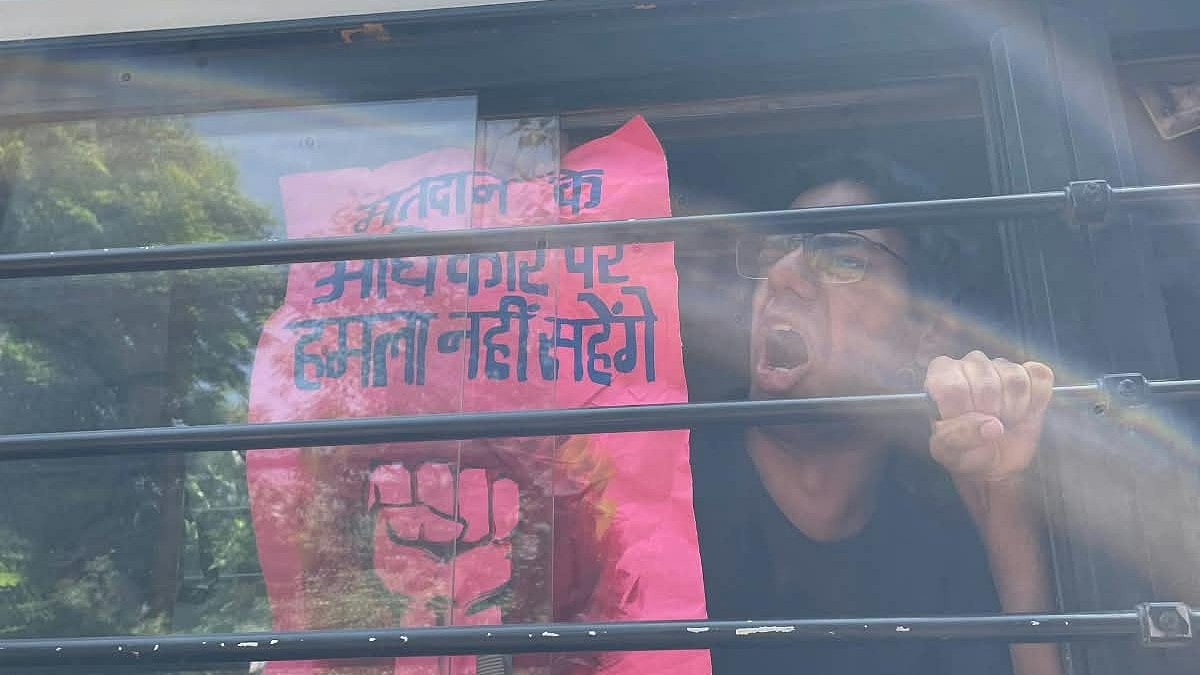
Hundreds of protesters took to the streets on Friday, 2 October, demanding the resignation of Chief Election Commissioner (CEC) Gyanesh Kumar, as demonstrations in Delhi and Mumbai coincided with Gandhi Jayanti. Police denied permission for gatherings in both cities, detained demonstrators in the national capital and imposed extensive security restrictions.
In Delhi, hundreds of people were detained while attempting to gather at Jantar Mantar. Those detained included former Delhi Chief Minister Atishi, activist Yogendra Yadav, All India Students' Association (AISA) president Neha Bora and former Delhi minister, AAP Delhi unit chief Saurabh Bhardwaj and RJD's Manoj Jha. Police transported protesters to multiple police stations in buses.
The demonstrations follow allegations concerning the Election Commission's handling of the Special Intensive Revision (SIR) of electoral rolls and reports of internal disagreements within the poll panel.
The protests were organised separately by student and civil society groups in Delhi and the youth-led Cockroach Janta Party (CJP) in Mumbai. Both groups have demanded Kumar's removal, alleging that the Election Commission's actions have undermined electoral transparency and voting rights. The Commission has rejected allegations of political bias.
Delhi: Mass Detentions and Metro Station Closures
Police erected multiple layers of barricades along routes leading to Jantar Mantar, including Tolstoy Marg, Janpath Road and Sansad Marg, to prevent protesters from reaching the designated demonstration site.
Prohibitory orders under Section 163 of the Bharatiya Nagarik Suraksha Sanhita (BNSS) were imposed in the New Delhi district, restricting unauthorised assemblies of five or more people.
At least 12 Delhi Metro stations were affected by closures, including Rajiv Chowk, Central Secretariat, Janpath, Patel Chowk and Mandi House. Internet disruptions were also reported around Jantar Mantar.
Despite the restrictions, protesters assembled in groups and raised slogans before being detained. AAP leaders, Congress workers and activists belonging to AISA and other student organisations participated in the demonstration. Police prevented demonstrators from proceeding towards Parliament Street and Jantar Mantar, while approximately 50 to 60 people continued protesting around Janpath.
AISA actist Neha Bora managed to escape from a police bus after protesters blocked the vehicle.
The protest had been announced earlier by student leaders and civil society representatives, including Bora, advocate Prashant Bhushan and Jha, who called for action against Kumar over alleged irregularities in electoral-roll revisions.
A day before the demonstration, AAP leaders Atishi and Sanjay Singh had also appealed to people to assemble at Jantar Mantar. However, Delhi Police refused permission for the gathering.
Mumbai: CJP Announces 'Jail Bharo Andolan'
In Mumbai, the Cockroach Janta Party, led by Abhijeet Dipke, called for a 'Jail Bharo Andolan' at Shivaji Park in Dadar, beginning at 4 pm on Friday.
The group decided to proceed with its protest despite Mumbai Police denying permission to use the ground. Police cited restrictions governing Shivaji Park, concerns over noise and traffic congestion, and access to nearby hospitals. Organisers were advised to identify an alternative venue and submit a fresh application.
CJP members and civil society activists were reported to have gathered at Shivaji Park earlier in the day, where a heavy police presence was deployed. However, the scale and outcome of the main 4 pm demonstration were yet to be established at the time of publication.
CJP has demanded Kumar's resignation, a halt to the SIR exercise, restoration of the January 2025 electoral rolls and the repeal of the 2023 law governing appointments to the Election Commission. It has also sought greater transparency in the appointment process.
The organisation has announced plans to extend its agitation to Goa, Bengaluru, Kolkata, Ranchi and eventually Delhi.
Why Are Protesters Demanding Gyanesh Kumar's Removal?
The protests follow an investigation published by The Indian Express on 23 September, which reported that Election Commissioners Sukhbir Singh Sandhu and Vivek Joshi had formally recorded objections at least 14 times over 10 months to decisions and actions involving electoral rolls, voter registration and the Commission's digital systems.
According to the investigation, the two commissioners questioned several decisions and raised concerns over actions allegedly taken without their knowledge or approval.
The revelations intensified criticism of Kumar's leadership and prompted renewed demands for his removal from student organisations, civil society groups and Opposition parties.
The controversy also centres on the SIR exercise, which protesters allege has resulted in the wrongful deletion of eligible voters from electoral rolls.
The Election Commission has denied political bias and maintained that the revision is intended to remove duplicate, deceased and ineligible voters. It has also rejected suggestions of a breakdown within the Commission, maintaining that differences of opinion are part of normal internal deliberations.