
Congress, CJP and Left Need Each Other, It's Going to be a Long Haul
Congress, CJP and Left bring different things to the table. All of them must remember the base of anti-BJP politics.
advertisement
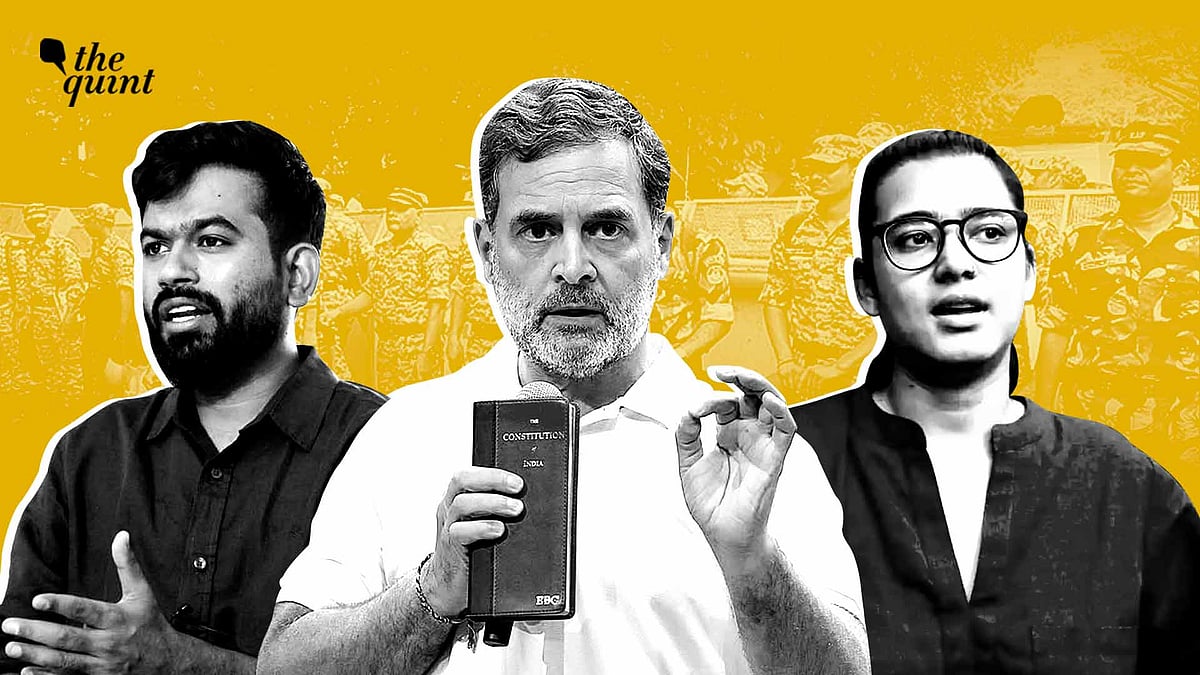
The Congress and the Cockroach Janta Party seem to have made peace for now. Rahul Gandhi strongly condemned the arrest of CJP leaders Ashutosh Ranka and Saurav Das. CJP convenor Abhijeet Dipke put out a tweet thanking Gandhi. Gandhi had also invited CJP leaders for his tea meeting with Opposition leaders. While Dipke couldn't make it as he was at his native place following his grandmother's demise and the other two leaders were under arrest, the gesture did signal a thaw in relations.
This was in contrast to the situation earlier in October when the Congress and CJP more or less stayed away from each other's protests.
So far, so good. The question is: can the Congress and CJP work together going forward? Do they even need to? What's likely to happen next?
Congress, CJP and Left Bring Different Things to the Table
Congress, CJP and the Left student unions have the same larger aim: defeating the BJP and bringing an end to the Modi government's rule. Dharmendra Pradhan and Gyanesh Kumar are just targets within this larger aim.
But within this larger movement, Congress, CJP and the Left unions bring very different things to the table.
CJP
The CJP gives a neutral, non-political image that makes it easy for lay citizens to become part of the movement. This was evident during the protests against Dharmendra Pradhan.
Congress, Left unions and other student bodies aligned to Opposition parties had been protesting against paper leaks for years, but it is the CJP which managed to mobilise the apolitical youth on a large scale nationally, which culminated in Pradhan's resignation.
The reason why the police crackdown on 10 October, the day of CJP's protest against Gyanesh Kumar, was particularly harsh, is that the government wanted to instil fear in the minds of lay people. It wanted to scare away the kind of people who came for fun or out of curiosity during the Pradhan protests. Letting right-wing goons run amok was driven by the same aim: scaring protesters and making them aware of the possible consequences.
Left Unions
It is in the face of such a crackdown that the importance of Left student unions comes to the fore. The ability of Left unions to consistently put their own lives and bodies at risk in front of police violence sets them apart.
Even during the agitation against Pradhan, there was a period before Wangchuk's hunger strike when the CJP's protest seemed to be waning. At that time, the Left students kept it alive.
In this protest, no doubt Left unions, particulary AISA, have gained from the presence of a charismatic and courageous leader like Neha Bora. But Bora's emergence isn't just due to individual charisma, it is also a product of organisational support and training.
Congress
In the end, the CJP or the Left unions' efforts won't achieve much if the main Opposition party doesn't do its job. Whether the BJP is to be defeated in elections or through a mass movement, it cannot happen without the largest Opposition party.
The 12 October protest also showed the importance of organisational strength. Neither the police nor right-wing goons could unleash violence in the face of thousands of workers belonging to the Congress, Samajwadi Party, RJD and other Opposition parties.
This kind of organisational strength can only come from the mainstream Opposition.
Template of JP, Anna
11 October was the birth anniversary of a man who led the largest movement against authoritarian rule in independent India: Jayaprakash Narayan or JP. There's a lot that the three strands of the anti-BJP movement can learn from JP. The JP movement too started as a students' movement against corruption and unemployment in Bihar and Gujarat but soon became a nationwide movement against the Indira Gandhi regime.
A socialist-turned-Gandhian, JP was seen as a saintly figure who was above politics. This enabled him to lead a diverse coalition: the anti-Emergency movement included socialists, RSS, former Congress leaders, Akalis, Jamaat-e-Islami, CPI-M etc.
A similar template was used by the India Against Corruption movement in the form of self-styled Gandhian Anna Hazare. It became a coalition of people from different sides of the political divide, centrists like Arvind Kejriwal, Kiran Bedi on the right and Prashant Bhushan and Yogendra Yadav on the Left. The movement is also said to have had the tacit backing of the RSS.
The BJP at that time was headed by Nitin Gadkari. While it had been carrying out protests against the UPA government, it hardly received any traction. It is the Anna agitation that created space for an anti-UPA wave that eventually led to Narendra Modi becoming PM.
Can the CJP play a similar role for the Opposition against the BJP by politicising the 'apolitical' sections?
CJP's political importance shouldn't be underestimated. Amid Rahul Gandhi's expression of solidarity with the CJP, two posts on X weren't noticed as much: from former Andhra CM YS Jaganmohan Reddy and Bharat Rashtra Samithi working president KT Rama Rao expressing solidarity with the CJP.
While KTR has been critical of the Modi government in the past, the same can't be said about Reddy. It is interesting that the CJP provided a pretext for the otherwise safe-playing Reddy to make a statement against the Modi government.
But the base for the present anti-SIR movement is very different than from the primarily middle class India Against Corruption movement.
Communities With Skin in the Game
There's one thing that the Congress, CJP and Left unions all need to understand. In their fight against the BJP, their main support comes from communities who have been at the forefront of resisting the BJP and who have also suffered most in terms of police crackdowns: Muslims, Sikhs and Ambedkarite Dalits.
The Gyanesh and Pradhan protests are able to get critical support because the anti-CAA protests and the farmers' protests showed a blueprint of resistance.
The strongest support for any anti-BJP mobilisation will come from communities with skin in the game, who stand to lose the most. It is important that those leading these protests recognise this.
What Happens Next?
Pradhan was an easy target because he was just a cog in the wheel, someone who the Modi government could easily replace without any significant political cost. His being unpopular with even a section within the right-wing ecosystem, made him even more dispensable.
Gyanesh Kumar is not the same for two reasons.
As CEC, he lies at the core of the Modi government's main source of legitimacy: its electoral successes.
Second, he supervises a core ideological project of the BJP and RSS: "cleansing" of electoral rolls of what they call "unnatural demographic changes".
Therefore, it's far tougher for the government to throw Gyanesh Kumar under the bus.
There's also the legal obstacle that Kumar can only resign or be impeached in Parliament. He can't be removed by the government.
The BJP government has also made it clear that it won't hesitate in escalating the use of police violence and detentions. However, even this is a risky strategy. On one hand, the BJP doesn't want to create a situation in which lay citizens feel emboldened enough to protest and criticise the PM. On the other hand, a violent crackdown on such protesters may end up pushing them towards the Opposition.
- Access to all paywalled content on site
- Ad-free experience across The Quint
- Early previews of our Special Projects
Published: undefined