
'Want to Wait Before Sending Cadre': Is Bhim Army Keeping Away From CJP 2.0?
Activists say for marginalised groups, the legal processes that follow detentions, is where the difference lies.
advertisement
"Two police constables deleted my videos and broke my mic. They then detained me after abusing my caste," Vivek Jatav, 24, tells The Quint.
Jatav, a resident of Faridabad, Harayana, had anticipated that Delhi would become a fortress on 10 October, the day of the Cockroach Janta Party (CJP) protest at Jantar Mantar. So he left his home early in the morning of 9 October and reached Delhi, having made arrangements to stay at a "safe" location at night before joining the protest the next day.
He never reached Jantar Mantar, in fact no one did. As per his, and scores of other protesters' and mediapersons' accounts, police had put up barricades extending upto nearly five kilometres of the protest site.
He was on his way to area, trying to enter from the direction of Karol Bagh, when he claims he saw some police violently assaulting and detaining some people.
Vivek was back near the protest site on 12 October.
(Photo: Special Arrangement/The Quint)
Jatav says that the police got more violent after they heard that his surname was Jatav.
The Quint has reached out to Delhi Police on Jatav's allegations. Their response is awaited. Jatav claims that after nearly three hours, the driver (a man in plainclothes) let the two slip away after they pleaded with him and promised to not return.
Jatav spent the night at the New Delhi Railway Station where some other protesters and independent journalists had also taken shelter. From there, he put out a video on his Instagram page, narrating the incident.
Jatav, who says he is a member of Nagina MP Chandrashekhar Azad's Bhim Army, was back at the protest on Monday, 12 October. He spoke to The Quint from near the Parliament, where he was waiting for the Congress-INDIA bloc rally to start. He eventually joined thousands of other protesters who marched up to the Supreme Court, demanding action against Chief Election Commissioner Gyanesh Kumar over alleged Special Intensive Revision (SIR)-related discrepancies in voter rolls.
Bhim Army Staying Away from CJP 2.0?
Bhim Army, however, was more or less missing from the 10-11 October protests in Delhi, when thousands of people, including mediapersons and lawyers, were reportedly detained. Azad himself was put under house arrest inside his Sansad Marg residence.
On social media, however, some pointed out that the Bhim Army and their distinct, blue flags and scarves were distinctly missing from "CJP 2.0". Many also called for the Bhim Army to hit the streets after Abhijeet Dipke, a Dalit leader himself, was detained from the flight from Mumbai, moments after he landed in Delhi on the morning of 10 October.
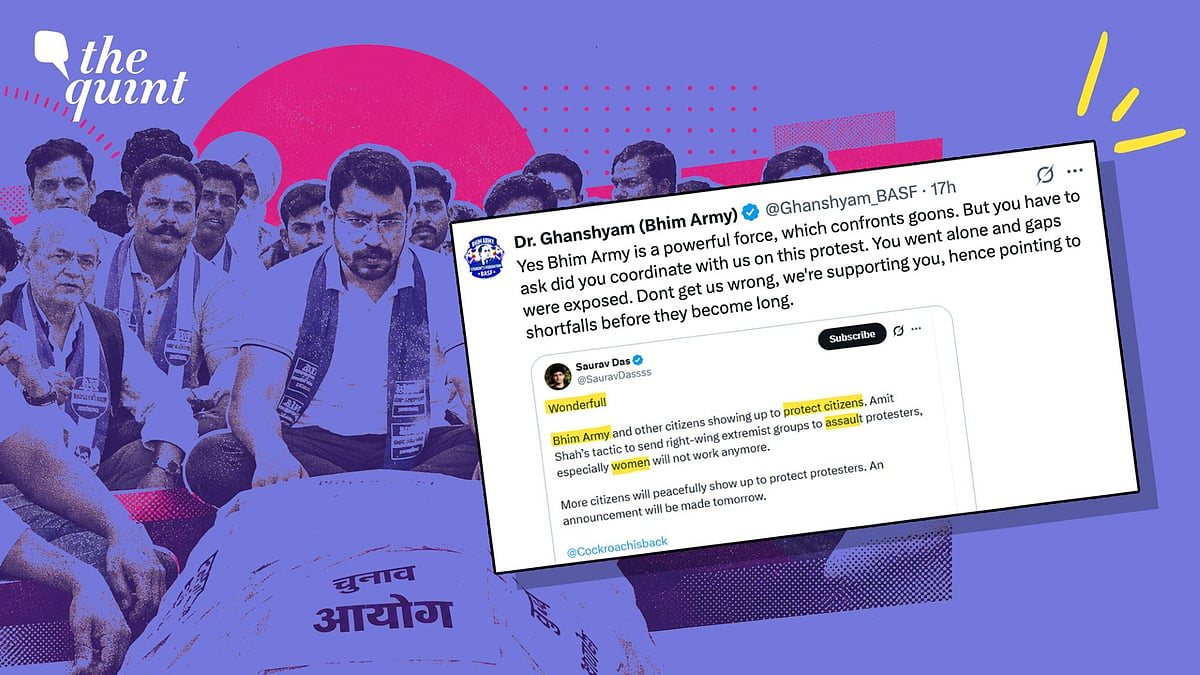
An X user wrote, "It is time for the Bhim Army to come out in massive numbers" if Dipke wasn't released. A Bhim Army representative, Dr Ghanshyam, however, responded to the tweet, stating,
In another tweet, Ghanshyam states that the decision to stay away was a conscious one. "On (the) question of why our cadres didn't participate openly yesterday: We noticed tactical mistakes on part of CJP; broadcasting their location, travel plans & assembly points. It's like they wanted to get detained. We did NOT want our cadres to be part of this poorly planned event and be detained in bulk," he wrote on X.
He further adds, "We support the demand of opposition parties & CJP in greater transparency by the Election Commission of India. We also had several companies of Bhimsainiks held in reserve, but did not commit them because the grounds never came."
Sunny Gautam, Bhim Army district leader from Saharanpur, Uttar Pradesh, confirms that the Bhim Army teams were ready in reserve and just waiting for a go-ahead from Azad.
"We support the CJP and the movement against Gyanesh Kumar. This is not just about us or them; this is a bigger movement about saving democracy in the country," Gautam tells The Quint.
On the question of why Bhim Army did not join the 10 October protest, Gautam reminds that Azad did try to join the protest but was put under house arrest by Delhi Police. ational Core Committee Member
Insiders and observers, however, note that when it comes to the Bhim Army, the only word that counts is Azad's, irrespective of what sections or certain members of the group state online or offline. The Quint tried contacting Azad, but is yet to get a response.
His aide, Jatin Goariya, former National Core Committee Member of the Azad Samaj Party, nevertheless, concurred that the Azad Samaj Party as well as Bhim Army had decided to "wait and watch the protest unfold this time, before formally sending in cadres."
Goraiya also adds that CJP did not communicate any information or invitation ahead of 10 October. Observers note that a "schism" between Azad and the CJP had been visible in July itself.
"If you remember, Azad initially joined the CJP protest when Sonam Wangchuk was also on hunger strike. But later, he visibly distanced himself from that space, and started his own protest beneath the statue of Dr BR Ambedkar inside the Parliament complex," academic Ravikant Kisana tells The Quint.
However, there has been no official statement from Azad, and so, Bhim Army's position in the matter remains open to interpretation.
Doubly Vulnerable
Activists, however, state that such a call does not mean that Dalit-Bahujan people are not or should not be part of larger dissent movements. In fact, the community's socio-political discourse is steeped in the language of dissent.
Dalit-Bahujan activists note that what mass protests do is highlight privilege. Anti-caste activist and content creator Aleena says that it isn't just protests, the Dalit-Bahujan community is more vulnerable everywhere else too. Protests merely amplify the role of privilege.
Despite all that, Aleena notes, people participate in protests.
"I want to be very clear that this is not an argument against Dalit-Bahujan people protesting. That would be unjust. Our vulnerability cannot become a reason to deny us political agency," she tells The Quint.
The activist, however, cautions against "romanticising bravery".
"It's the structural vulnerability they're forced to fight. I want us to ask why we are repeatedly expected to survive conditions that others are better protected from," she says, adding:
Kisana points out that for marginalised groups, what comes after the detentions, the legal processes that follow the immediacy of the detentions, is where the difference lies.
"Protesters from marginalised groups need to plan two steps ahead as the protest may end but their legal liability may not," Kisana adds.
Former student activist and Jawaharlal Nehru University student Apeksha Priyadarshini points out that it is not unusual for persons from marginalised groups, castes, religions and genders to feel doubly vulnerable in protests, especially when there is no organisational body backing them up.
Aleena, however, points out that the responsibility for providing a safety net for the vulnerable should lie not only with the CJP leadership, which includes Dalit-Bahujan persons like Dipke, themselves facing online and offline caste-based rhetoric and abuse due to his caste identity.
She notes: "People with more structural privilege are more politically responsible to the fellow protesters—the CJP and beyond should be tasked with the job too. Solidarity isn't simply sharing same opinions or shouting same slogans. The collective work should ensure that Dalit-Bahujan people do not have to bear those risks alone. That must not be a gap in solidarity."
- Access to all paywalled content on site
- Ad-free experience across The Quint
- Early previews of our Special Projects
Published: undefined