
'BJP Betrayed Us': Bengal's Matua Hindus Branded 'Infiltrators' After SIR Purge
Many Matua Hindus—incidentally voters of the BJP in recent years—now find their names deleted from the voter list.
advertisement
(At The Quint, we continue to give voice to those who would otherwise go unheard. If you find value in our work, support us by becoming a member.)
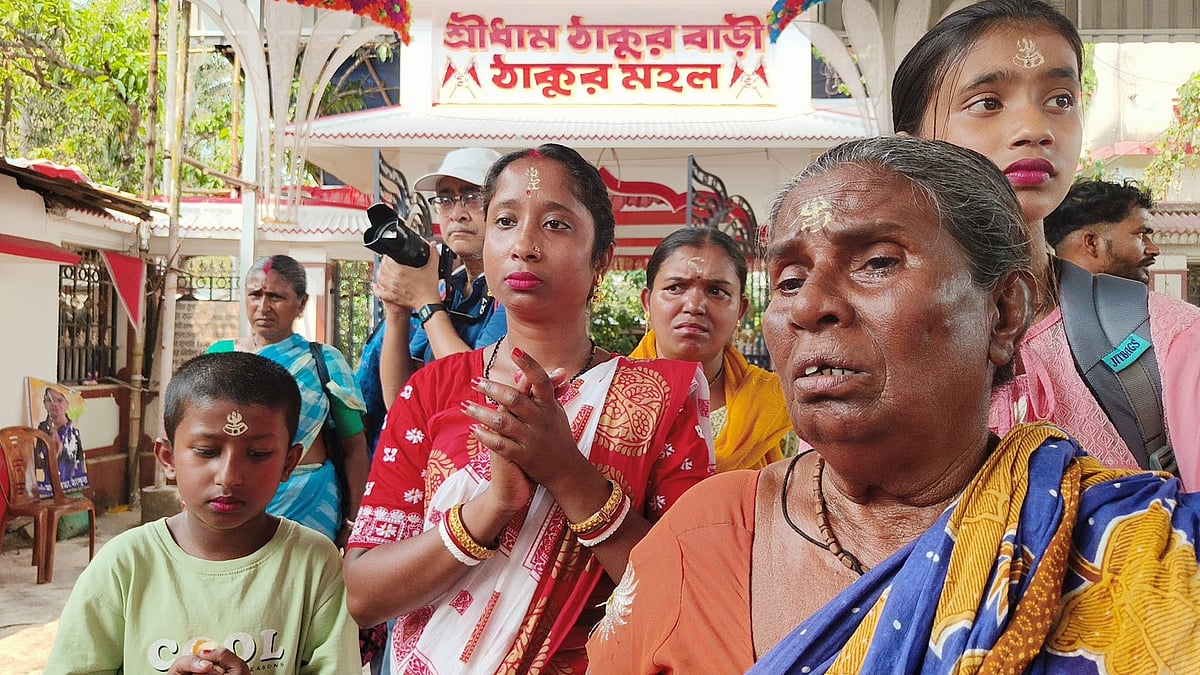
The words 'The Exile' are painted in bold English letters at the entrance of the Thakurbari temple in Thakurnagar, the "heartland" of the Matua community in West Bengal, located about 65 km from Kolkata.
"Exile is something all Matuas understand. We are all refugees from erstwhile East Pakistan, after all. It has been part of our identity. And it remains so, today more than ever, amid the SIR process which is turning udbastu (refugee) Matuas into onuprobeshkari (infiltrators)," says Mamatabala Thakur, Rajya Sabha MP from the Trinamool Congress (TMC) and the Matua community's religious matriarch, as she points at the red letters.
Rajya Sabha MP and Matua community's matriarch Mamatabala Thakur at Thakurbari, Thakurnagar, the ancestral seat of the refugee Matua community.
(Photo: Rakhi Bose/The Quint)
Located within the Gaighata Assembly constituency (SC) in North 24 Parganas district, Thakurnagar is home to the Matua community's oldest family, the Thakurs, who trace their lineage back to the radical reformist, anti-caste Hindu saint, Harichand Thakur, the founder of Matua dharma.
With the constituency all set to vote in the second phase of West Bengal Assembly elections 2026 in the shadow of the complicated SIR—or Special Intensive Revision—of electoral rolls, questions over exile, identity, home, and belonging have once again become central to the community's discourse.
'Foreigners in Own Home': The Unmapped Matuas
Roughly 30 km from Thakurbari, in Uttar Panchpota village in North 24 Parganas, Pronab Mondal has remained buried under a heap of documents and paperwork since 16 December last year, when the ECI published its first SIR list (ASDD or Absent, Shifted, Duplicate, Dead).
Now, with the ECI's final supplementary lists released on Tuesday, 7 April, Mondal—the now 29-year-old who was born in West Bengal—remains "deleted".
Pronab Mondal, 29, finds his name deleted from the voter roll.
(Photo: Rakhi Bose/The Quint)
Yet, Mondal's name featured among the 155 persons whose names were deleted from the voter rolls in the ECI's final lists from booth nos 177 and 178 of Bagdah Assembly constituency (SC), a local booth level officer (BLO), requesting anonymity, confirmed.
"Across these two polling booths, the initial voter list totalled 1,900 names. Subsequently, 66 names were deleted, and 18 were added—resulting in a figure of 84. Following the adjudication process, 83 names were added and 72 were deleted—bringing the final count to 155," the BLO said.
Bagdah will vote in the second phase of polling on 29 April.
Brandishing a file full of his own papers—birth certificate, ration card, voter ID, Aadhaar, PAN card, SC certificate, matriculation certificate, and a graduation certificate from Kalyani University, he adds:
Pronab Mondal lays out his documents, which he keeps neatly in a school bag and carries with him at all times now.
(Photo: Rakhi Bose/The Quint)
"Even if I accept the loss of my voting right, will I get any official job or even be considered for equal pay in daily wage work without a valid voter card? We cannot perceive what the future will be like for us," Mondal, whose family recently built a two-storey house and is now burdened with debt, asks.
A People in Exile
The Matuas are a 'Namashudra' SC community, though not all Namashudra castes are Matuas. Once referred to as "Chandals", the Matuas as well as other Namashudra sects and SC/ST communities that lived further inland, away from the Bengal-Bangladesh borders, were severed from mainland India in post-Partition communal strife.
Many Matuas still remain in Bangladesh.
"If you look at the history of migration from East Pakistan to West Bengal, in the first wave of migration or during the post-Partition period in the 1950s, the more resourceful, connected, upper caste Hindus primarily crossed over first and took up spaces in urban centres or cities. The lower castes came in later phases, and without the luxury of financial or social connections to make it to Kolkata or elsewhere, these communities settled down in border areas of Gaighata, Bongaon, and other regions," researcher Ashin Chakraborty tells The Quint.
They also procured local documents such as ration cards, PAN cards, and even voter IDs, making them citizens of a kind. And yet, not all have citizenship documents, the legal requisite for being labelled an Indian citizen. This can be attributed to the changes in India's citizenship laws over the years that govern who is and who isn't a citizen.
Chakraborty, along with lead researcher Dr Sabir Ahmed, is part of Kolkata-based SABAR Institute that has been mining SIR data for ethno-socio-political insights. As per their findings, while critics raised alarm about deletion of Muslims from voter rolls as part of the BJP's "Hindu Rashtra" project, it was indeed all vulnerable communities, including marginalised caste or class Hindus like the Matuas, and women, that have been disproportionately affected by the SIR.
Marginalised caste or class Hindus like the Matuas, and women, that have been disproportionately affected by the SIR.
(Photo: Rakhi Bose/The Quint)
The findings, published in a study titled The Hidden Algorithms of Exclusion, noted that in the first phase of SIR, the unmapped (ASDD) lists primarily affected marginalised Hindu communities and were not correlated with high Muslim demographics.
The highest rates of unmapped voters (10-14.5 percent) were found in SC-reserved constituencies like Gaighata and Bagdah. This largely affected the Matua community and Namashudras. The reasons for the high rates of deletion were given as voters being labeled "permanently shifted" or "dead."
Incidentally, Muslim-dominated belts like Malda and Murshidabad had the highest number of mapped voters in the first list, as Muslims were well-tallied in the 2002 voter list.
Following the initially released unmapped list came the "logical discrepancies" phase, one of the more controversial parts of the SIR process in Bengal. Ahmed notes that this move was brought in to further act as a "surgical tool for exclusion, disproportionately targeting Muslims far beyond their population share".
"Now, the lists in Malda-Murshidabad changed with many Muslim names coming under adjudication due to various technical issues," Ahmed explains.
In Hindu-dominated belts, however, it was again the vulnerable castes and communities that increasingly came "under adjudication" or were "deleted" altogether, including those who had previously been mapped. For the Matuas, who had so far been assured that "no Hindu name will be cut from the voter list", the numbers were not reflecting well.
D-Voters: From 'Doubtful' to Deleted
Hridoy Mondal from Ashoknagar in Habra Assembly constituency's ward no 22, whose name had been "under adjudication" in the first list, has now been deleted in the final supplementary list.
Not just his but the names of about 200 people in his ward—that had been "under adjudication" after the second list—have since been deleted. Only five voters remain eligible to vote in his ward, he states. Hridoy, who runs an electronics business, has filed an appeal under ECINET, but has not got a response yet.
Also a Matua like most in his neighbourhood, Hridoy's family migrated to Bengal in the 2000s. But unlike the communities in the border villages, Hridoy's family lived in a working class, semi-urban, more politicised region.
The CAA was, in fact, specifically passed keeping in mind Hindu communities like the Matuas.
The CAA office in Thakurbari sporting notices for "Hindu card" and "Matua card" applications.
(Photo: Rakhi Bose/The Quint)
But Hridoy's father got rejected as his documents did not add up per the requirements of the CAA. According to reports, the number of pending CAA applications in West Bengal is at 50,000.
Others applying for citizenship under the CAA tell The Quint that the process is even more complicated than the SIR.
"Most of us don't have these as not all came through official channels or would want to reveal their past," Majumdar tells The Quint. "Second, even when one does apply, the date of hearing never gets listed. I had applied online before the first list was released in December."
Four members of his household, including his sons and himself, have lost their vote since the application, and "still no hearing," he says.
Beyond voting rights, the community has other tangible concerns like the government benefits through various state and Central schemes.
A Litmus Test For BJP's SC-Hindu Outreach
At least 20 Assembly segments in North 24 Parganas and the adjacent Nadia districts in South Bengal are known for significant Matua presence. Other analysts put the Matua influence as a valid electoral factor in at least 45 of Bengal's 294 seats. In previous interviews, the All India Matua Mahasangha, the statutory body of the Matuas, has put the number of Matuas in West Bengal to be exceeding 10 million.
Analyst Sibaji Pratim Basu points out that in the 2019 Lok Sabha elections, with the Communist Party [CPI(M)] allying with the Congress, a large chunk of the Left voters among the Matuas shifted to the BJP, encouraged by promises of citizenship. The shift played a key role in the BJP getting a bigger slice of the polling pie in Bengal in non-Muslim belts.
While the BJP had 10.3 percent vote share in the 2016 Assembly elections, winning three out of 294 seats, the 2019 Lok Sabha election saw a 40.6 percent vote share for the BJP, with the party winning 18 out of 42 Lok Sabha seats, attributed largely to the "Modi wave".
"The BJP managed to revive a dormant memory, or create one, of communal angst among the Matuas, many of whom had come to India to escape religious persecution of some form," local journalist and founder of EastPost, Soumo Mondal, tells The Quint.
The party maintained a 39 percent and above vote share in the 2024 Lok Sabha elections, though it lost six seats from 2019's tally of 18.
Mamatabala, who lost the Bongaon seat to the BJP in 2019, points out that it was the other non-Matua SC, and non-SC Hindu voters in the Matua belts, who contributed to the BJP retaining the seats post 2019, and that the Matua vote has been shifting, even if large sections did continue to vote for the saffron party. Now, the 2026 polls will be a litmus test for the BJP's SC-Hindu outreach in the state.
"The community started to see that the BJP was only dangling citizenship as a carrot in front of our eyes. People are realising now that it's a sham," Santosh Adhikary, a Matua community leader from the independent political outfit Guruchand Sena Dal, tells The Quint.
He adds that while his family has the migration certificates and citizenship documents aquired over the years, his youngest son's and daughter's names have come "under adjudication".
He adds that his party has also fielded candidates in this election independently, because the community needs to come out of the "TMC-BJP binary" and stand as a united force in itself. "But the issue of citizenship continues to hold people back. Many still feel the BJP will give them citizenship and save the day," he posits.
TMC MP Mamatabala Thakur nevertheless reminds that the question of citizenship is a trick to begin with.
"We are an avarna community, and the Scheduled Castes and Scheduled Tribes are the indigenous people of India. It has taken us centuries to be considered as equal citizens and wards of the State. By taking away our right to vote and questioning our citizenship, the government is sending us back into slavery," Thakur tells The Quint.
An Unending Trial
As per the ECI’s final supplementary list, 45.22 percent of the 60,06,675 names "under adjudication" have been “deleted”. In the first district-wise data on deletions shared by the election body, the Matua-dominated Nadia district has the most number of deleted voters, at 77.86 percent.
Other Matua-populated districts like Hooghly, Purba and Pashchim Bardhaman, and North 24 Parganas have seen high voter deletions as well.
On 7 April, the electoral rolls for specific Assembly constituencies going to early polls were frozen by the Supreme Court after the nomination deadline, which can limit the ability to make immediate changes to voter rolls.
Since most SC/Matua-dominated seasts are voting in the second phase, the voters in these seats still have some time to appeal their SIR status. But for many, the trial seems unending—and the result uncertain.
- Access to all paywalled content on site
- Ad-free experience across The Quint
- Early previews of our Special Projects
Published: 08 Apr 2026,01:35 PM IST