
Even as Scores Lose Voting Rights in Bengal, Matua 'First Family' Feud Rages on
'Both BJP and TMC assured us we'd be safe from SIR, but now no one is helping," an elderly man alleges to The Quint.
advertisement
The elderly Sushil Kumar Biswas has been toiling outside the offices of the Bharatiya Janata Party (BJP) and Trinamool Congress (TMC) leaders in West Bengal's Thakurnagar for days now. With the Election Commission of India's Special Intensive Revision (SIR) of voter rolls underway in the poll-bound state, Biswas found his name on the "waiting list"—or "under adjudication".
Having crossed over to India first in 1971 and living in Thakurnagar permanently since 1978, Biswas tells The Quint,
Sushil Kumar Biswas, who has lived in Thakurnagar since 1978, was listed 'under adjudication'.
(Photo: Rakhi Bose/The Quint)
Biswas is not sure how the 2002 list is relevant today.
"Both parties had assured us we would be safe from the SIR, especially the BJP. But now, no one is helping," the elderly man laments.
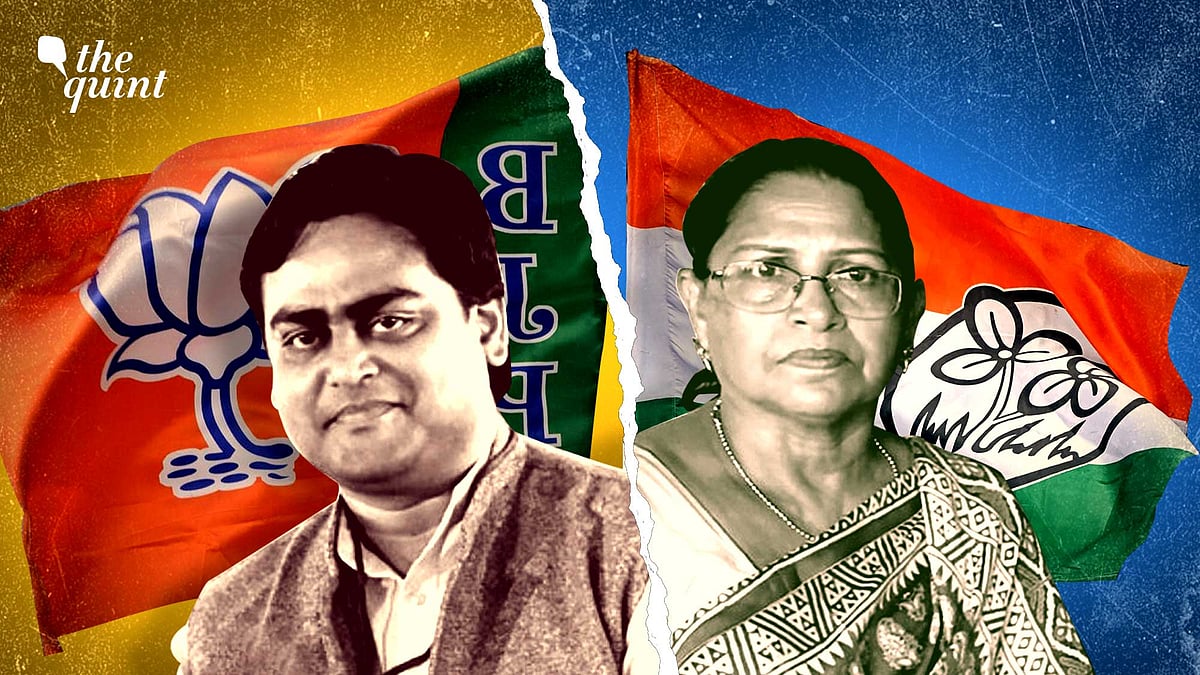
Inicidentally, in Thakurnagar, leaders of both parties belong to the same family—the Thakurs. On one side is the TMC's Rajya Sabha MP Mamatabala Thakur, the community's religious matriarch and the Thakur family's "daughter-in-law". On the other is Shantanu Thakur, the BJP's Lok Sabha MP from Bongaon (SC) constituency and the family's "grandson".
"While the family fights over political control of the Matuas, ordinary people like us suffer as we do not know whom to turn to," says a Thakurnagar local, resquesting anonymity. "We cannot be against either parties, at least here." For more on the impact of the SIR purge on Matua Hindus, read this ground report.
Women at the Helm Among Matuas
Even as Biswas trawled outside the makeshift TMC office in Thakurnagar, Mamatabala's hands were full in the last week of March when she spoke with The Quint.
The Thakurbari premises were brimming with the colours and sounds of the annual 'Boruni Mela', a significant religious time for the Matuas, said to derive its name from the phrase: "Hari-naam-e Matowara", meaning intoxicated or maddened in devotion.
"Women have a very high position among Matuas. It is part of our custom to educate every girl child... women have a right in paternal property, and a say in politics," Mamatabala tells The Quint.
Mamatabala Thakur disposing of her duties as the religious matriarch of the Matua community in Thakurbari, Thakurnagar.
(Photo: Rakhi Bose/The Quint)
"When Didi (Mamata Banerjee) took up the Matua cause in 2011, many here were thankful and inclined to join the TMC. She has been a personal role model as well," she states.
However, over the past few years, the BJP has gained ground among the community. Activist and local journalist Soumo Mondal explains why.
But while the Matuas are now realising that "unconditional" comes with its own pre-requisites, Mondal states that the citizenship promise was not all that attracted the community to the saffron party. It was Shantanu, the great-great-grandson of the Matua founder Harichand, joining the BJP, which helped turn the tide.
Matua women leading the rituals at Baruni Mela in Thakurbari, Thakurnagar.
(Photo: Rakhi Bose/The Quint)
The 'First Family' Tree
The Matua religion emerged as a reformist movement against the strictures of caste, with its first Thakurbari in Orakandi, in present-day Bangladesh in the 1860s.
With the Partition of India in 1947, the Thakurbari in Orakandi was shifted to Bongaon, in what was the the Jessore area of Bangladesh. The Jessore road remains an arterial sinew of the shared past of Bengal and Bangladesh, still connecting the region to Kolkata on the west and Bangladesh on the east.
Pramatha's wife Binapani Devi became the religious matriarch, revered as 'Boro Ma' of the Matua Mahasangha.
Mamatabala is the daughter-in-law of Pramatha and Binapani. Mamatabala was married to Kapil Krishna Thakur, who was the Bongaon MP from the TMC till 2014, when his untimely death propelled Mamatabala to the seat.
Shantanu is Pramatha and Binapani's grandson and son of Manjul Krishna Thakur.
Mamatabala alleges:
A poster of Shantanu Thakur at the community centre in Thakurnagar. Both his and Mamatabala's homes are located in the vicinity.
(Photo: Rakhi Bose/The Quint)
As of now, the Matua Mahasangha remains divided between the TMC (led by Mamatabala) and the BJP factions (led by Shantanu).
However, in November last year, tensions emerged between brothers Subrata and Shantanu, with the former allegedly forming his own faction within the BJP's Matua faction. Subrata had told the media at the time that a "third faction" was sorely needed within the Matuas, to truly express the political aspirations of the community and become heir to Harichand's legacy.
The All India Matua Mahasangha remains a contested entity, with both Mamatabala and Shantanu leading a faction each. The address and registration details for both factions, however, remains the same.
(Photo: Rakhi Bose/The Quint)
Ticket Politics Amid Citizenship Angst
With the saffron party giving a ticket to Subrata from the Gaighata seat, insiders claim that Shantanu's supporters have not been actively campaigning for Subrata. Yet, in another twist, the BJP has also fielded Shantanu's wife Soma Thakur from the Bagdah (SC) Assembly constituency, to fight the TMC candidate, Madhuparna Thakur, the daughter of Mamatabala.
And yet, his statement on 22 December regarding the possible deletion of 1 lakh Matua voters as a "sacrifice for a good cause" to ensure the deletion of "50 lakh Rohingya, Bangladeshi voters" seems to have impacted the Matua people voting for the BJP in past elections.
Santosh Adhikary, a Matua community leader from the independent political outfit Guruchand Sena Dal, alleges, "The Shantanu Thakurs and their ilk have made the Matua people into a business commodity. They have finished all political aspirations of the community by turning us into pro-TMC and pro-BJP vote banks. But no party truly cares about the people."
Adhikary's party, a TMC-leaning faction, was created to fill that gap. But he feels the community is still a long way from political self-actualisation. "They are getting brainwashed by promises of citizenship by a national party, even though it was the TMC that started wooing the community first in contemporary times," he adds.
Who Will Come to Matuas' Rescue?
At present, both party leaders—Shantanu and his family, and Mamatabala along with her family—reside in the same vicinity, in different sections of Thakurbari premises. But beyond the walls of the Thakurbari, the common Matua people are feeling increasingly unrepresented by either.
A deleted Matua voter stands in front of a BJP wall mural. She says she had voted for the saffron party in 2021.
(Photo: Rakhi Bose/The Quint)
Bhonita Biswas, 80, from Bagdah, whose name was deleted from the final voter list, says that while the leaders fight, people like her are having to jump through hoops to prove they are legitimate Indians.
Even though both parties have left the people on their own, the elderly man Biswas maintains they remain the "only hope".
"I will vote for whichever party that accepts me as a voter," he offers.
- Access to all paywalled content on site
- Ad-free experience across The Quint
- Early previews of our Special Projects
Published: undefined