
From Akal Takht to Temple Politics: Is AAP Rewriting Its Punjab Strategy?
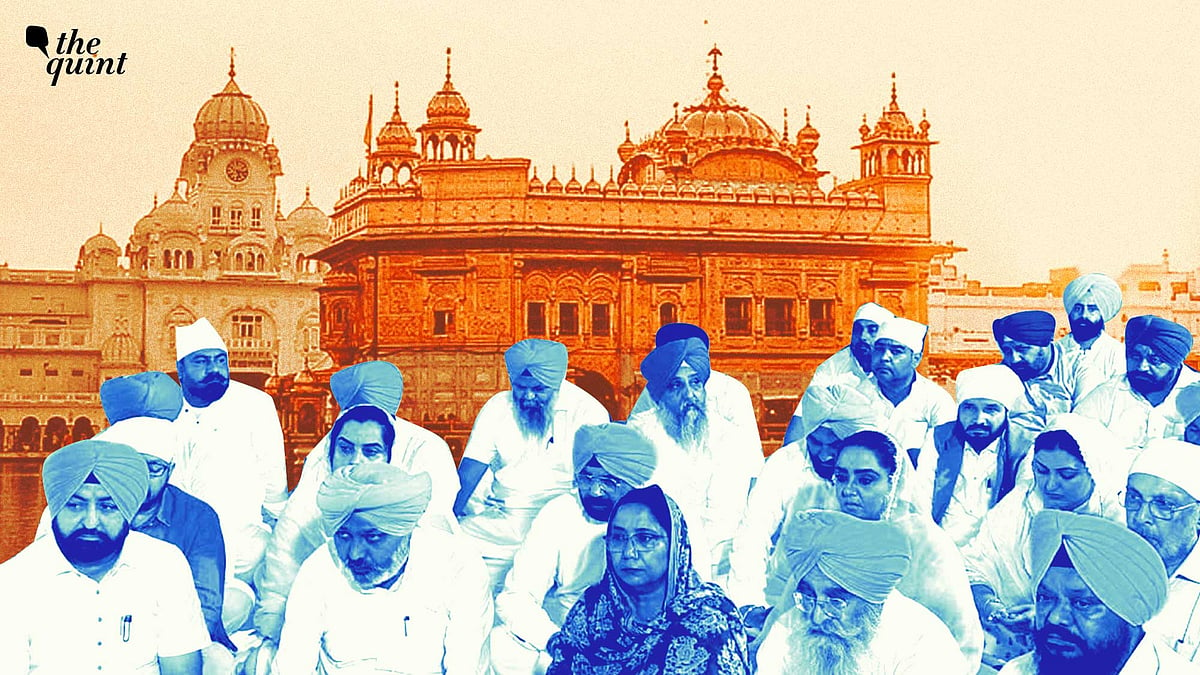
AAP is under the Akal Takht's scanner over the Sacrilege Bill and an alleged video of Punjab CM Bhagwant Mann.
advertisement
30 June marks the Prakash Purab of Guru Hargobind Sahib, the sixth Sikh Guru, who established the Akal Takht ("Throne of the Timeless One”) in 1606 and introduced the concept of Miri and Piri—the integration of spiritual and temporal authority—after the martyrdom of his father, Guru Arjan Dev Sahib Ji. The Akal Takht has since stood as the symbol of Sikh sovereignty, the seat from which Sikhs have governed their own religious and political affairs. It has also been a recurring target of those who saw sovereignty as a threat.
The Sacrilege Bill Under the Akal Takht's Scanner
Today, the AAP government finds itself on the wrong foot because of the Jaagat Jot Sri Guru Granth Sahib Satkar (Amendment) Bill, 2026, which it passed on 13 April 2026 and which provides for punishment of up to ten years for sacrilege.
Congress MLA Sukhpal Singh Khaira raised concerns that the bill shifts responsibility for Guru Granth Sahib Saroops onto the SGPC. The bill defines a custodian as "any individual, institution, or Gurdwara Committee to whom a Saroop of Jaagat Jot Sri Guru Granth Sahib has been formally supplied and/or who is responsible for the protection of the Saroop(s) and observance of prescribed Sikh Rehat Maryada." It also directs the SGPC to maintain electronic records of all Saroops in the public domain, raising concerns that information relating to ordinary Sikhs and institutions could become publicly accessible. Khaira argued this potentially alters the role of the SGPC and the government is putting the accountability on the Sikh institution and even affects the traditional authority exercised by the Sikh institutions.
Questions Over the Legislative Process
This raises several important questions.
1) Why was the bill not properly read by MLAs, including those from the ruling party?
2) Why was it not discussed thoroughly in the Assembly? Why was there such urgency in passing it?
3) What precedent does this establish if legislation can be passed without legislators fully understanding its contents or even the terms defined within it?
This situation reflects a concerning gap in legislative functioning, where political messaging and optics appear to be taking precedence over substantive work.
It also raises questions about the AAP government's seriousness regarding Sikh issues, particularly sacrilege—an issue that contributed significantly to the decline of previous governments, including the Akali Dal and Congress. Both failed to deliver justice to Sikhs on sacrilege incidents. During the congregation, when inquiries were made about the ongoing cases against Dera Sirsa accused members, MLA Inderjit Singh Nijjar said that he did not know much about them, which further reflects the government's lack of seriousness on these issues. Now, even the bill they have brought has to be amended within a month after the Akal Takht pointed out its concerns.
The Sikh Issues Still Awaiting Action
During its tenure, AAP has largely focused on governance related issues and populist measures in Punjab but has avoided addressing deeper structural issues.
Critical issues such as Sikh political prisoners, riparian rights, BBMB disputes, sacrilege cases, centralisation of Punjab institutions, including the row of Chandigarh and Panjab University, farmers' concerns, and the drug crisis remain largely unaddressed. Instead, the government appears focused on projecting administrative efficiency.
A Political Pivot Towards Hindu Outreach?
At a time when AAP is facing questions about its legitimacy among Sikhs and Sikh institutions, it has simultaneously begun making a series of announcements directed towards the Hindu community.
The Bhagwant Mann Video Controversy
The pattern sharpens further with the Bhagwant Mann video controversy. A video allegedly showing the Chief Minister throwing liquor on images of Sikh Gurus was examined by the Akal Takht and declared authentic, while Mann insisted it was AI-generated and fake. On 15 June, the Akal Takht described him as "Guru-dokhi" and "Panth-virodhi" and called upon the Sikh community to boycott him.
Then, on 24 June, Gurugram Police arrested two men for allegedly forging forensic reports intended to establish that the video had been AI-manipulated. A complainant further alleged that senior Punjab Police officials pressured him and offered ₹10 lakh to sign off on fabricated reports. AAP has dismissed the case as politically motivated, but it has deepened rather than dispelled perceptions of a cover-up. Throughout the controversy, AAP leaders have accused the Jathedar of acting at the behest of the Badals, while the party's IT ecosystem has increasingly targeted Sikh institutions. In a recent press conference, the Chief Minister maintained that the video was merely a mask-generated fabrication.
The irony lies in the timing of the events that have unfolded over the past few months. At a moment when AAP's relationship with the Akal Takht appears increasingly strained, Kejriwal arrived in Amritsar with a series of announcements aimed at the Hindu community. Whether this is intended to consolidate support among Punjabi Hindus or whether Kejriwal seeks to project himself as a true Sanatani in contrast to the more radical politics of BJP Hindutva, only time will tell. What is evident, however, is that a government that appeared clueless about its own anti-sacrilege legislation is now investing considerable political capital in Hindu religious initiatives. Even though Punjabi Hindus have historically not voted as a consolidated bloc in the way Hindu electorates often do elsewhere in India.
What This Means for AAP's Politics
The politics of religion that AAP has long criticized in the BJP now appears to be taking root within AAP itself , with AAP increasingly borrowing from the BJP's political playbook. As Punjab moves towards the next Assembly elections, these developments risk setting troubling precedents regarding the government's legitimacy, its relationship with Sikh institutions, and its own evolving politics of religion.
As Punjab moves towards the next Assembly elections, the paradox is plain: a government that is in direct confrontation with Akal takht is now going to build a temple. Whether that fools anyone in Punjab or nationally, remains to be seen.
- Access to all paywalled content on site
- Ad-free experience across The Quint
- Early previews of our Special Projects
Published: undefined