
Activist Parvinder Jhota's Killing Leaves Punjab's Anti-Drug Fight Under Trial
Jhota’s killing has revived memories of Punjabi singer Sidhu Moose Wala's murder in Mansa, writes Harsimran Kaur.
advertisement
In Mansa, the killing of anti-drug activist Parvinder Singh Jhota has left behind more than a grieving family. It has raised questions about the response to alleged drug sales, the police investigation into his death, and the authorities scrutiny of a firearm licence held by the man accused in the case.
Jhota, 42, was shot dead on 13 October during a confrontation with medical-store owner Ashwani Kumar, an incident that unfolded during a Facebook Live broadcast. A day later, as the investigation continued, anger over the killing spilled onto the streets, with part of Kumar’s house demolished by the district administration, and his medical store damaged and set on fire by a crowd.
For Jhota’s family, however, the immediate demand remains justice and answers about whether the complaints at the heart of his anti-drug campaign were adequately addressed.
Protesters stage a dharna in Mansa, demanding a thorough investigation into the killing of anti-drug activist Parvinder Singh Jhota.
(Photo: Harsimran Kaur/The Quint)
From the Boxing Ring to the Anti-drug Campaign
Before he became known as an anti-drug activist, Jhota was a boxer. During his time at Lyallpur Khalsa College in Jalandhar, he earned the nickname ‘Baba Boxer’ and competed at the national level.
His father, Bhim Singh, a retired Army serviceman, remembered him as a talented sportsperson who had the potential to build a career in boxing.
His work brought him into public confrontations with people he accused of selling drugs. By 2023, he had become a recognisable face of the anti-drug campaign in Mansa and neighbouring areas.
Questions Over the Investigation
The circumstances surrounding Jhota’s killing have come under renewed scrutiny, with protests over the incident leading to action against police officials in Mansa.
The Mansa City-2 Station House Officer (SHO), Inspector Beant Kaur, was suspended on administrative grounds on 15 October, following allegations of police negligence.
The police account of the motive has also changed. Bathinda Range DIG Harjeet Singh had initially said a preliminary investigation pointed towards old personal enmity between Jhota and the accused Kumar.
However, following objections from protesters and members of the action committee, the DIG apologised for his remarks and retracted the statement. The circumstances and motive behind the killing remain matters for the investigation to establish.
A member of Jhota’s team who was present at the scene disputed the suggestion that the killing arose from personal enmity.
According to Vaibhav Chaudhary, Senior Superintendent of Police, Mansa, the police arrested Kumar on 14 October, a day after Jhota’s killing. He added that another accused, Vipin Garg, was also arrested on the same day.
Both were produced before a court, which granted the police seven days’ remand for further investigation. The police also said that Kumar’s wife, Neelam Rani, had been named as an accused in the case and has been arrested by the police.
Jhota’s family has demanded a Central Bureau of Investigation (CBI) probe and action against the officials it holds responsible. His father has also refused to perform the last rites until the family’s demands are addressed.
Demolition of Ashwani Kumar’s House and Shop
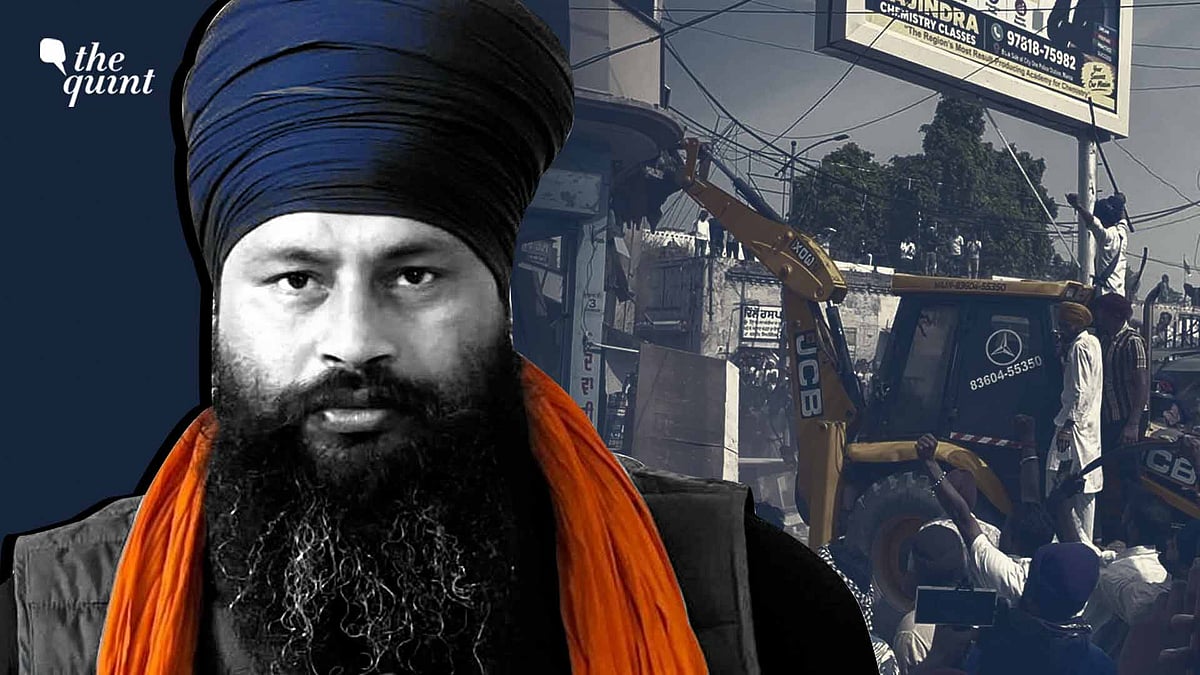
A day after Jhota’s killing, the Mansa district administration demolished part of Kumar’s house, citing a complaint regarding unauthorised construction. Meanwhile, an angry crowd demolished the remaining portions of Kumar’s medical store near the main railway crossing and set it on fire.
A JCB demolishes Ashwani Kumar’s shop in Mansa after Jhota’s murder.
(Photo: Harsimran Kaur/The Quint)
The demolition of the house was described by the authorities as action against unauthorised construction, while the destruction of the shop escalated amid public anger over Jhota’s killing.
Kumar's neighbour said the action taken against his property was justified, claiming that the family had little interaction with other residents of the neighbourhood. According to the neighbour, after Jhota exposed the alleged drug trade, residents of the street and locality had socially boycotted Kumar and his family.
“We would not even attend their family’s celebrations or mourn with them during times of grief,” the neighbour said, describing the extent of the social boycott.
How Was a Firearm Licence Issued?
The Mansa district administration issued a firearm licence to Kumar despite five police cases being registered against him. Three of these cases reportedly involved alleged violations of orders issued by the District Magistrate.
Whether the licence was issued under pressure from a political figure remains a matter for investigation. The Additional Deputy Commissioner of Mansa issued the licence on 21 August 2024, following a recommendation from the district police.
According to the available records, Kumar held two licensed firearms: a 7.62 mm pistol and a 12-bore gun. The licence was valid from 21 August 2024 to 20 August 2029. Kumar allegedly used one of these licensed firearms to kill Jhota at his medical store in Mansa.
Official records reveal the weapon license endorsement.
(Photo: Harsimran Kaur/The Quint)
The licence also authorised Kumar to purchase up to 50 cartridges at a time, subject to an annual limit of 100 cartridges. The recommendation submitted by the Mansa SSP for the licence reportedly mentioned the five police cases registered against Kumar.
It also cited FIR No 66, registered at Mansa City-2 police station on 4 April 2024, as the basis for the threat perception cited in support of his application.
The SSP recommended the issuance of the licence on 9 August 2024, under reference number 91/NAL. The Additional Deputy Commissioner subsequently issued it on 21 August 2024.
From Sidhu Moose Wala to Parvinder Jhota
Jhota’s killing also brings back memories of another high-profile murder associated with Mansa, that of Punjabi singer Sidhu Moose Wala, who was shot dead in May 2022, shortly after the Aam Aadmi Party government came to power in Punjab.
Manik Goyal, a member of the committee formed after Jhota’s killing, said the incident raised wider concerns about law and order and the drug menace in Punjab.
Drawing a comparison with the period since singer Sidhu Moose Wala’s murder, Goyal said several people had been killed in the intervening years. He alleged that the circumstances surrounding Jhota’s killing were being manipulated and maintained that the issues of public safety and drug trafficking needed to be addressed.
A Father’s Demand for Justice
For Bhim Singh, the investigation is not simply a criminal case. He has accused the authorities of failing to address the drug problem against which his son had campaigned and has demanded accountability.
Parvinder Singh Jhota’s father, Bhim Singh, demands justice for his son’s killing.
(Photo: Harsimran Kaur/The Quint)
Jhota’s father said the family had been working to stop the sale of drugs in Mansa and had no personal enmity with the medical store owner.
Jhota’s wife and two sons now face a future without him. His father has said that the family wants justice—and that he intends to continue the fight against drugs.
Jhota’s mother and sons mourn his death.
(Photo: Harsimran Kaur/The Quint)
The family’s demands have also become part of a wider public response to the killing, with protests and calls for a more thorough investigation. The incident has prompted political criticism of the Punjab government’s handling of law and order and its anti-drug campaign. The ruling party, meanwhile, has pointed to the police’s preliminary assessment of personal rivalry.
A Medical Store Repeatedly Raided
The regulatory history of the medical store linked to the killing raises another set of questions.
According to Mansa Drug Inspector Naresh Kumar, the premises had been raided nearly 10 times over four years and the store’s licence had been suspended three times. Police sources claimed that intoxicating substances had been recovered from the shop on three occasions. But the store’s licence had not been cancelled.
The issue extends beyond one shop. Certain prescription medicines have legitimate medical uses but can also be misused when sold or diverted outside regulatory requirements.
The Questions That Remain
According to figures from the Narcotics Control Bureau (NCB)’s 2025 report, Punjab accounted for 2,086 kg of heroin seizures in 2025, out of a national total of 3,567 kg. That was about 58 percent of the country’s total reported heroin seizures.
The state also recorded seizures of 8,95,508 bottles of codeine-based cough syrup in 2025, the highest among states, according to the same report.
The NCB has warned about the risks associated with the diversion of pharmaceutical opioids and other medicines, including buprenorphine, tramadol and alprazolam, through non-compliant pharmacies.
For Jhota’s family, the fight now is for justice. But his killing has also raised questions that go beyond one murder: whether complaints about alleged drug sales were acted upon effectively, whether the firearm-licensing process was properly scrutinised, and whether those who take on the drug menace at the local level can expect protection.
The answers will depend on what the investigation establishes and whether the authorities are willing to account for their decisions.
For now, Jhota’s death has left behind a family seeking justice and a community confronting difficult questions about the cost of standing up against drugs in Punjab.
(Harsimran Kaur is a journalist based in Punjab, reporting on politics and governance.)
- Access to all paywalled content on site
- Ad-free experience across The Quint
- Early previews of our Special Projects
Published: undefined