Conflicts around caste and religion in India often begin as small sparks, localised, seemingly contained, before spreading outward like fire through dry grass. Yet, there are moments when these conflicts descend from above, by institutions and power structures, engulfing society in one sweeping blaze.
In both cases, what is revealed are the fault lines long simmering beneath the surface.
The University Grants Commission (Promotion of Equity in Higher Education Institutions) Regulations, 2026 belong firmly to the latter category.
The regulations have been widely celebrated by the Scheduled Castes (SC), Scheduled Tribes (ST), and Other Backward Classes (OBC) civil society groups and political actors as a long-overdue corrective, an expansion of the regulatory framework that foregrounds institutional accountability in addressing caste-based discrimination in higher education.
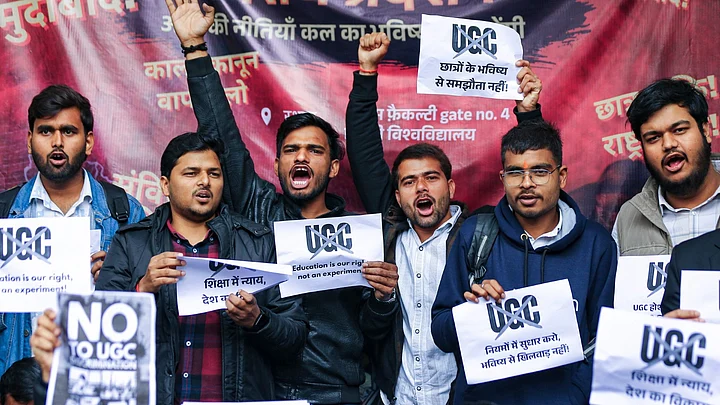
At the same time, they have provoked intense backlash from upper-caste groups across the ideological spectrum.
These groups argue that the regulations unfairly target them, render them vulnerable to false complaints, and conspicuously exclude them from the category of victims of caste discrimination.
Within a week, opposition to the UGC regulations on caste discrimination has surged across digital platforms and public spaces and become a national debate. From Karni Sena, Shubhankar Mishra, and Abhinav Pandey to Ram Sampath, Sai Deepak, and Priyanka Chaturvedi, the upper-caste society has suddenly all become a singular Savarna interest group, pushing the narrative that their existence and future are in crisis.
Hundreds of OBC seats go unfilled in universities and caste atrocities against Dalits occur routinely, but these issues have never triggered the kind of outrage or mobilisation by the same Savarna united front who at all other times keep harping about the welfare of Hindus. Now, suddenly, they have all become Savarns, and then there are others.
But this reaction is not a surprise. Upper-caste resistance to redistributive or protective measures in North India has surfaced repeatedly in modern Indian history, most notably during the anti-Mandal agitations of the 1990s, and again in 2006.
The backlash against Dalit-Bahujans during that period was so intense that sociologist Gail Omvedt described it as a “twice-born riot against democracy,” while civil rights activist K. Balagopal termed it “anti-Mandal mania.” Large sections of upper-caste society projected the moment as apocalyptic, deploying derogatory symbols and remarks to ridicule Dalits and OBCs. Protests included acts such as publicly polishing shoes and declarations refusing to marry those perceived as “quota beneficiaries.”
Yet, the present moment is distinct.
BJP and the Politics of Caste Identity
The UGC regulations have emerged under a Bharatiya Janata Party (BJP)-led government, long regarded by many upper-caste Hindus as their natural political home, one that safeguards their caste pride, economic interests, and religious chauvinism.
What emerges now is not gradual disenchantment, as was the case with the Congress, accused of appeasing minorities, and viewed with ideological suspicion, but a sudden, visceral sense of betrayal by Modi and BJP.
For years, it mattered little that the BJP expanded electorally by incorporating non-upper-caste constituencies, venerating their icons and staging symbolic cultural gestures, so long as these moves remained compartmentalised.
The UGC regulations have unsettled this compartmental politics that BJP has managed all this while in order to take contradictory constituencies and interest groups. The fractures now can’t be contained at least at the discursive level. They are perceived as evidence that the BJP is now serving Dalit and OBC interests at the expense of upper castes, even as the BJP-Rashtriya Swayamsevak Sangh (RSS) combine remains, for many, the final horizon of imaginable political alternatives.
Compounding this unease are reports of discontent within Brahmin lobbies in Uttar Pradesh, grievances against the Yogi Adityanath government over perceived “Thakurvad,” and public disputes among Shankaracharyas and Brahmin seers. With the 2027 Uttar Pradesh elections looming, this moment marks a critical juncture for the upper-caste Hindu public in North India.
Rather than revisiting the technical details of the regulations, which are already widely available, let's assess the nature of the caste conflict itself: How and why different social groups interpret it as they do, and what its implications are for the BJP and the Opposition parties in the months ahead.
The Nature of the Caste Conflict
All caste communities in India perceive themselves as distinct cultural groups, taking pride in their identities while situating themselves within hierarchies that operate both nationally and regionally.
Yet, not all castes are willing to articulate this hierarchy openly in the arena of public politics. Groups such as Brahmins, Bhumihars, and Thakurs may assert pride and dominance in everyday social life, but in electoral politics they seek alliances, acutely aware of their numerical limitations. This contradiction, dominance without demographic strength, shapes their public political behaviour.
Politically assertive castes among Dalits and OBCs such as the Chamars and Yadavs experience their contradictions differently, they might be aware of their numerical strength but are also conflicted about their position in the hierarchy. They want to extend their political assertion to establish and assert themselves in different spheres of society which always seems incomplete.
In everyday life, upper castes often exercise power through exclusion, hierarchy, and at times, overt violence. In public politics, however, they prefer a flattened vocabulary of “interest groups,” presenting themselves as merely one group among many. Dalits and OBCs, particularly in North India, do not form a seamless collective; they are riven by internal hierarchies and tensions, both among themselves and with upper castes.
The crucial difference is that Dalit and OBC groups acknowledge hierarchy in both everyday life and public politics, even as they contest it.
Upper caste lobbies keep the language of hierarchy dormant or mellow it down in public politics. They project themselves as well wishers for all the Hindus but activate their caste pride and hierarchy talks immediately when they perceive a threat.
At such moments, they regroup as the Savarn Samaj, asserting dominance while ridiculing, mocking, and delegitimising Dalit and OBC claims in public. This tipping point is what defines and constitutes Savarn Samaj consciousness of those who might otherwise act as disparate groups.
In short, the antagonism and delegitimising of SC/ST and OBCs brings them together to act as a united Savarn Samaj like nothing else. They are always deep inside aware of this consciousness and separation from the lower castes and moments like this elevate that consciousness to an aggressive public identity.
Yet at the same time, a section of them know that the caste hegemony that they want to maintain has to be legitimised not through a language of hierarchy which they practice in everyday life but through exaggerating imagined victimhood narratives.
The discourse veered into hysteria—assertions of a Savarna existential crisis, a student demanding poison from the Prime Minister rather than implementation in universities, and comparisons of equity centres to “Gestapos” policing Savarna students. It is these narratives that are used to create an atmosphere of crisis as well as consolidate the Savarn Samaj. The language of caste hierarchy in everyday lives now turns into caste neutrality within universities through these victimhood narratives, insisting that castes be treated as equal and interchangeable groups when institutional protections are proposed.
Upper castes, by contrast, keep the language of hierarchy dormant in public politics, activating it only when they perceive a threat. At such moments, they regroup as the Savarna Samaj, asserting dominance while ridiculing, mocking, and delegitimising Dalit and OBC claims.
Savarna Victimhood and Caste Neutrality
This twisted logic fuels demands either to dismantle the regulations or to include upper-caste students within the ambit of caste discrimination. Yet the experiences of Dalit and OBC students tells a different story. When they enter elite urban universities, they encounter environments—where power is concentrated among upper castes in administration, faculty positions, and student demographics.
Biases, both subtle and explicit, permeate classrooms, hostels, public spaces, and bureaucratic processes. Many students are unable to articulate these experiences, knowing that naming caste or identifying with a lower caste identity can invite ridicule, isolation, or further discrimination.
Where student politics is vibrant and marginalised students participate visibly, conversations around caste are possible. Where it is absent—as in IITs, IIMs, and medical colleges—silence prevails. The mere invocation of caste often fractures campuses into antagonistic camps, making conflict inevitable.
Interpretative frameworks for identifying and addressing caste discrimination will have to evolve through practice, particularly via Equal Opportunity Centres. This will be a slow and uneven process, given that caste discrimination does not follow a single script, nor addressing it can be of one kind. Regional contexts further complicate matters. In many southern state universities, power dynamics between upper castes and politically assertive OBCs—and between OBCs and Dalits—operate differently from those in the North.
Sensitivity to these regional caste configurations will be essential. Beyond regulatory mechanisms, universities must cultivate environments that encourage community and fellow feelings through sustained collective activities.
Over time, such efforts can reduce conflict and foster mutual understanding. In a society where Brahmin and Rajput youths in large numbers take pride in the fact their forefathers did not allow the Dalits and OBCs to walk in front of them and have contempt towards the latter, the hope of a fraternity in institutional spaces seems like a distant utopia but efforts must be taken.
Including upper-caste students within the framework of caste discrimination, however, would only erect new barriers for Dalit and OBC students seeking redress.
Caste is about power and across higher educational institutions it is the upper castes who hold it and to place them as equal to SC/ST and OBCs will be an affront to social justice.
In fact, 3(b) of the regulations allows any aggrieved person to complain against different forms of discrimination, which means even individuals from upper castes too can complain and there is no barrier. However, they cannot claim caste discrimination from SC/ST and OBCs. However, they cannot claim caste-based discrimination from SC/STs and OBCs.
This understanding is grounded in history: upper-caste identities have long functioned as sources of power and privilege over subordinated groups, rather than as sites of humiliation, as has been the case for SC/STs and OBCs.
Indeed, this historical power and prestige is often openly acknowledged and even celebrated within upper-caste society. Furthermore, the total stipulated members in the committee are ten but the committee asks for representation of SC/ST and OBCs, women and persons with disability. This means upper caste members can be part of the committee. There is no provision which would make it a one sided decision from only members of SC/ST and OBCs.
To already hypothesise that the regulations will act against them is more a hysteria and a savarna anxiety over losing power in these spaces. Despite the SC/ST POA, upper castes/dominant castes go scot free after committing violence against Dalits and Adivasis by maneuvering the criminal justice system and instilling fear through pressure groups. One can only imagine what happens if they are allowed as an equal party to such a law.
Furthermore, the share of upper castes is disproportionately high in the administrative and faculty positions in most reputed higher educational institutions and that already ensures a safeguard for them and thus the hypothetical situation of crisis does not hold true.
Every time there is a need for a change or reform in Indian caste society and norms, upper caste society has reacted in a similar manner through paranoia.
Be it about extreme forms of untouchability, women’s education or temple entry for lower castes in the first half of 20th century, upper castes have a terrible track record in responding to basic reforms. They had to be challenged through relentless campaigns, and today people like Sai Deepak hold the same past as a glorious civilisation. One does not need to go to the past to look for events, listen to the Shankaracharyas, high pontiffs who get upset about anyone challenging the orthodox regressive Varna order.
What Lies Ahead for the BJP and the Opposition
With the announcement of the caste census followed by the UGC regulations, the BJP is positioning itself as attentive to Dalit and OBC concerns.
Unlike the “Constitution under threat” narrative that harmed them in Uttar Pradesh in the 2024 elections, these developments do not carry immediate mass electoral consequences. The majority of Dalit-Bahujans remain outside the ambit of higher education.
Yet, in parts of North India, social media debates, televised protests, and public outrage may be interpreted as upper-caste hostility—an interpretation that politically assertive Dalit-Bahujan groups can mobilise to their advantage.
The BJP currently faces resentment from sections of the upper castes, but political memory is short, and the party has repeatedly demonstrated its ability to redirect attention through new issues. A shift of upper-caste votes to the Samajwadi Party appears unlikely. Thakurs largely stand behind Yogi Adityanath, relations between Thakurs and Yadavs remain tense, and the Bahujan Samaj Party (BSP) does not present a compelling alternative for them at this moment. Brahmins, although disappointed with the BJP, do not seem like going anywhere else, except few MLAs who might switch sides.
Electoral dynamics in West Bengal and Tamil Nadu will remain largely unaffected. In Tamil Nadu, except IIT Madras and Jain- and Brahmin-dominated colleges in Chennai, conflicts in higher education primarily play out between OBC and SC students, while in West Bengal, caste—whether through the census or university politics—has yet to emerge as a significant public issue.
The Opposition’s relative silence reflects strategic caution—and few parties wish to alienate upper-caste voters in Uttar Pradesh who they think might vote for them. Figures like Chandrashekhar Azad remain exceptions to this, speaking openly in support of the UGC regulations, knowing well that his support comes from a section of Dalits and Muslims.
Yet, this caste conflict in public politics will not easily recede. The processes unleashed by the caste census—and the debates it provokes—will continue to surface new controversies. Like embers beneath ash, these tensions endure, waiting for the next gust of political wind to fan them into flames.
(Sumit Samos is a researcher and anti-caste activist and his research interests are Dalit Christians, cosmopolitan elites, student politics, and society and culture in Odisha. This is an opinion piece, and the views expressed above are the author’s own. The Quint neither endorses nor is responsible for the same.)