
Karnataka to Revive Student Union Polls After 37 Years: What it Would Look Like
Before the ban, Karnataka has produced many leaders whose political and ideological roots began on college campuses.
advertisement
After 37 years, college campuses across Karnataka are set to come alive with political activity again.
The Congress government has decided to restore students' union elections in all higher education institutions from the academic year beginning in June, a move which was banned by its own party in 1989.
This was followed by Chief Minister Siddaramaiah’s announcement in his 2026-27 budget that students’ body polls would be held across the state.
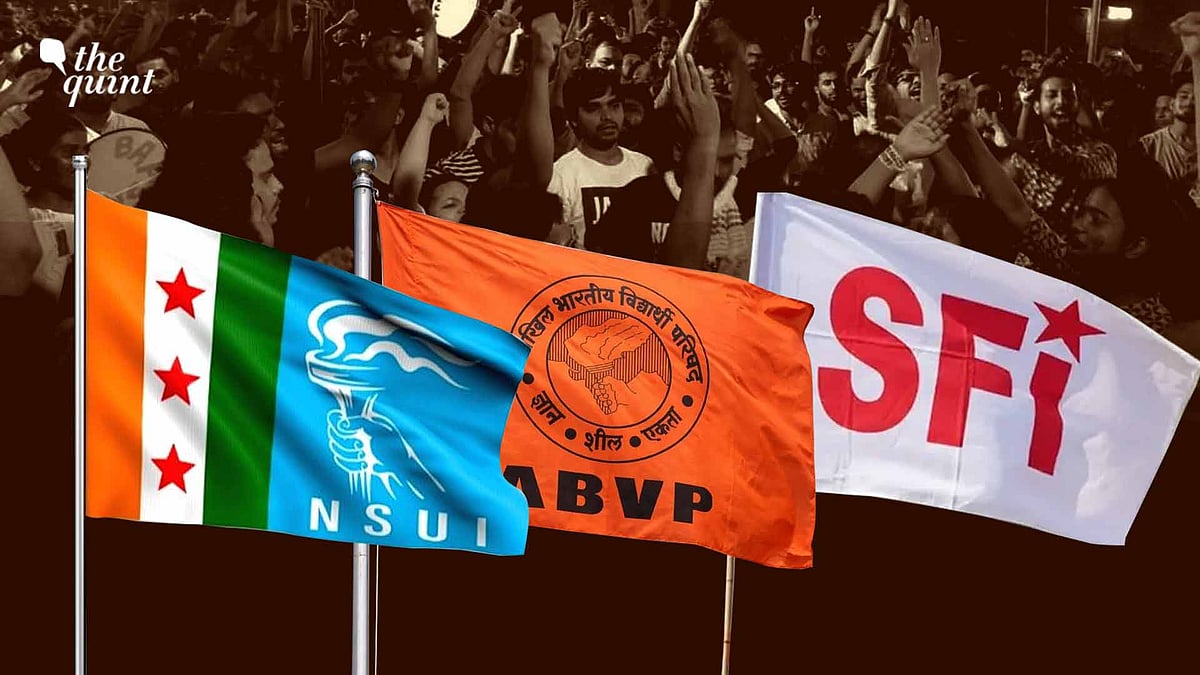
Assuring that the government was serious about the issue, Patil and Higher Education Minister MC Sudhakar held consultations with representatives of students’ wings of political parties, including the National Students’ Union of India (NSUI)-affiliated to the Congress; the Akhil Bharatiya Vidyarthi Parishad (ABVP) of the Bharatiya Janata Party (BJP); and the Students’ Federation of India (SFI) of the Communist Party of India, among others.
The response from all the students’ bodies was surprisingly unanimous. All were in favour of bringing back elections to campuses, though the ABVP raised certain conditions at the meeting.
Why Did Karnataka Ban Campus Politics?
Karnataka is among the many states that can boast of having groomed some of the best leaders whose political and ideological moorings began on the college campuses.
Within the Congress, Siddaramaiah, Shivakumar, and legislators like BK Hariprasad, Saleem Ahmed, and Rizwan Arshad began their political careers as student leaders. In the BJP, Union Minister Shobha Karandlaje, legislators BY Vijayendra and CT Ravi, former MLA Aravind Limbavalli, and Karwar MP Vishveshwar Hegde Kageri followed that trajectory.
According to Hariprasad, his election to the Bangalore University council, which gave him control over colleges affiliated to Bangalore University, and his work, appreciated by Indira Gandhi and her son Sanjay Gandhi, were not liked by some, who got the elections banned.
"After I campaigned for Indira Gandhi in the Chikkamagaluru Lok Sabha bypoll, I was called by Sanjay Gandhi in 1979. For the first time, I boarded a flight to New Delhi paying an airfare of Rs 600, and during the meeting, Sanjay Gandhi asked me what I wanted to become," Hariprasad recounted to The Quint.
The 1989 ban was attributed to increasing violence on the campus and political interference. The students' unions were replaced by nominations or informal bodies. However, some colleges affiliated to Mangalore University continue to hold students' union polls to this day, citing the varsity's autonomous status.
Opposition and Clash Over Eligibility Rules
ABVP state organising secretary Basawesh Kori justified the riders his students' body placed at the consultation meeting.
The ABVP insists that candidates contesting the polls must be students of the same college, have at least 75 percent attendance, have no police cases against them, and have cleared all previous years’ exams.
These pointers have been opposed by the NSUI, who claim that mere merit or zero police cases cannot be the criteria for contesting the polls.
State BJP spokesperson S Prakash said his party has not taken a stand on the government's decision. "Let the government roll out its plans, though the ABVP has welcomed it with conditions,'' he added.
Political analyst Harish Ramaswamy, who was the founder vice-chancellor of Raichur University, now renamed as Adikavi Sri Maharishi Valmiki University, advocated holding students' union polls.
However, he added:
What Rules Will Set the Framework for Campus Polls?
Speaking to The Quint, Sudhakar said, "The SOPs for this will be based on the former Chief Election Commissioner JM Lyngdoh-led panel's recommendations on students' union polls submitted in 2006."
The Lyngdoh Committee was formed in 2005 to scrutinise students’ union elections after a dispute between private colleges in Kerala and the University of Kerala reached the Supreme Court.
The committee refrained from prescribing any minimum marks for candidates, but stipulated that they must not have any academic arrears in the year of contesting the election.
The committee also laid down age limits. The age for contesting elections should be between 17 and 22 years for undergraduate students, with appropriate relaxation for professional courses that often run for four to five years. For postgraduate students, the maximum age is 24 to 25 years, and for research students, it is 28 years.
Candidates should have the minimum percentage of attendance prescribed by the university or 75 percent, whichever is higher. They should not have a criminal record—that is, they must not have been tried or convicted of any criminal offence or misdemeanour—and must not have been subject to any disciplinary action by university authorities. The maximum permitted expenditure per candidate is Rs 5,000.
Political Influence and the Future of Campus Polls
Ruling out the possibility of direct political interference in campus polls, Sudhakar said it remains to be seen to what extent political ideology should be allowed, adding that concerns over the distortion of history also need to be addressed.
Ramaswamy said, "It’s impossible to foresee a scenario where the students' union functions are held without the intervention of politicians or political parties. But if a statute of leadership test is approved by the state government, then their influence will be restrained. In sum, introducing elections undoubtedly helps the growth of good leadership among the students, but civilising this leadership is a challenge, no doubt.''
(Naheed Ataulla is a senior political journalist based in Bengaluru.)
- Access to all paywalled content on site
- Ad-free experience across The Quint
- Early previews of our Special Projects
Published: undefined