
Disability Day: 'Don't Give Us Your Sympathy, Give Us Our Rights'
"Despite being a PhD scholar, people look at me as a 'bechara', and don't judge me based on merit."
advertisement
Every year, as the International Day of Persons with Disabilities comes along, my social media is filled with colourful posts. Special assemblies are organised in schools, panel discussions are held in universities, and glossy videos on inclusion are put out by companies. Those who hardly speak about disability suddenly put out quotes about accessibility and equality.
I will say this unequivocally: that sight is intriguing.
Having begun my schooling in the early 2000s, I hardly saw disability being discussed. Disability as a term was missing from the everyday vocabulary of our institutions. So, when I now see students debating accessibility or colleges holding events around disability rights, it feels like something is finally starting to change.
But I'm not interested in the day itself. I want to talk about disability as an everyday negotiation, as a lived experience for millions in India formed through environments that are neither designed nor willing to accommodate them.
It appears on the public bus with a broken ramp.
In a college that admits a blind student, yet refuses to provide the reading material in accessible formats.
In a hospital that assumes every patient can fill out forms themselves.
Working in an environment that loves "inspirational stories" but is reluctant to provide reasonable accommodation.
'Sympathy Still Replaces Rights'
There are two types of accessibility challenges.
First is the lack of a ramp, a lift, a wheelchair, a complex structure of the building, and so on. All of these things are evident, and everyone knows about them. If anyone knows the ABC of disability, they can see these challenges.
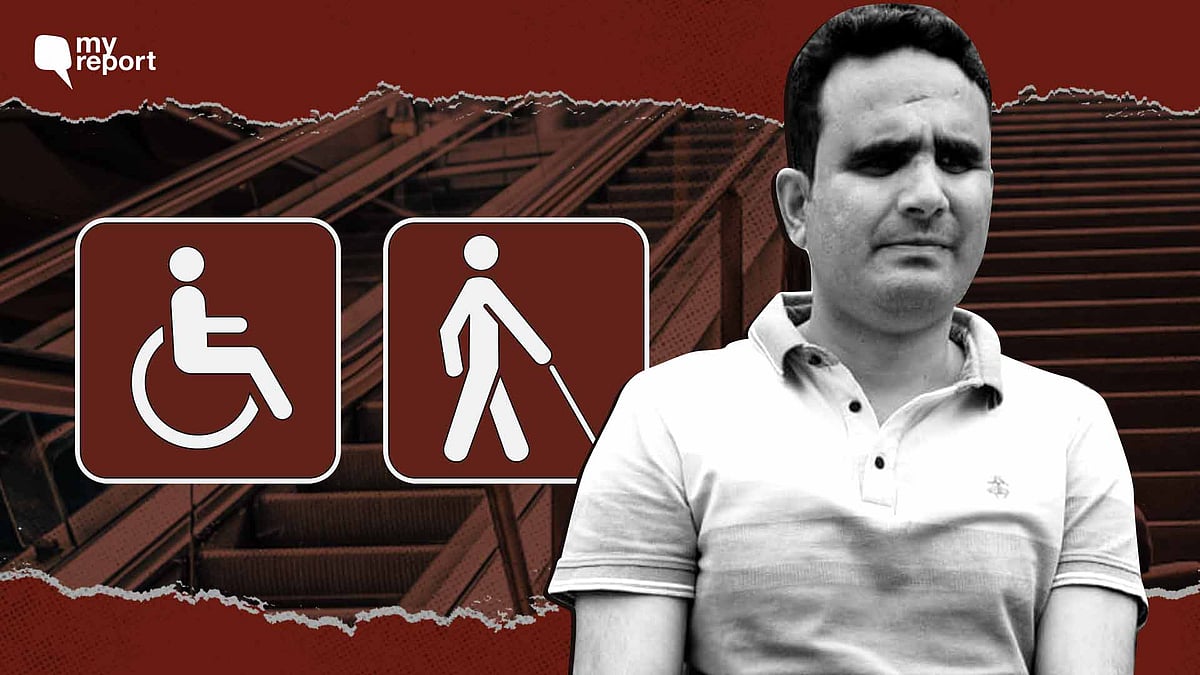
But what is not evident are the social issues. For example, I am visually impaired, and so are many of my friends in the community. I am a well-known scholar and have my research papers published, but the problem comes when I interact with society.
Society hasn't been able to look beyond accessibility as an issue of a lack of physical infrastructure. Accessibility needs to be understood in a broader context.
'Charity Still Replaces Justice'
In the recent case involving Samay Raina and others—where the accused had made insulting and deeply insensitive remarks about disability—the Supreme Court asked them in the last hearing to undertake fundraising for persons with disabilities (PwDs), engage in charitable acts, and invite disabled individuals onto their show as a form of social responsibility until the next hearing.
While this direction may appear corrective on the surface, it is essential to recognise that the incident was not merely an individual lapse but a reflection of how society at large continues to perceive and trivialise disability.
A casually cracked joke that seems harmless to one person can amount to deep mental harassment for a disabled person, leaving behind humiliation and psychological injury that are extremely difficult to recover from, and no charity, apology, or expression of guilt can reverse that hurt.
What disabled people need is to be treated like equals—from the courts, the state, society, families, and public figures—and a guarantee of rights, protection, inclusion, dignity, and social and legal justice, not charity.
Charity is not what the law demands. The Rights of Persons with Disabilities Act, 2016 is unequivocal: disability rights are constitutional rights. Section 3 enforces equal dignity, integrity, and non-discrimination for people with disabilities.
Yet, large parts of the government machinery, as well as most educational and corporate institutions, continue to address disability through the prism of welfare.
'The Emotional Labour Of Disability'
Beyond the physical barriers lies the emotional labour to constantly explain your needs, justify why accessibility isn't a favour, and navigate subtle forms of exclusion: it's the friend who stops inviting you because "it may be difficult for you," the employer who doesn't shortlist you because "we are not equipped", and the institution that tells you accommodation will "take time."
It's the exhausting contradiction of being hyper-visible as an "inspiring story" while invisible as a person with rights.
Change begins when disabled people become decision-makers. If India is serious about going beyond symbolic recognition of disability, the change must be structural rather than ceremonial.
'The Real Change We Would Like To See'
First, persons with disabilities must be central in policymaking. 'Nothing About Us Without Us' cannot stay a slogan. Advisory boards, committees, educational planning bodies, and councils for urban design must all hold disabled individuals in positions of actual influence.
Second, accessibility needs to be a foundation. Not beautification, not add-on compliance, not moral goodwill. Accessibility in transport, digital services, education, housing, and public infrastructure must become a baseline expectation, integrated into design—not retrofitted.
Third, educational institutions must treat disability in their institutions as an issue of social justice no differently than caste or gender. Or young people must understand disability rights as a political question, not a charitable cause.
While RPwD Act gives the chief commissioner for PwDs some powers, more enforcement mechanisms with accountability are urgently needed for the law not to become just symbolic.
I am not against celebrating Disability Day. In fact, it is meaningful to witness conversations that were absent in my own childhood. We need a society that sees disability on the other 364 days of the year.
Because true inclusion does not start with a speech or an event.
It begins with the inclusion of disability in how we design our cities, run our schools, shape our workplaces, and envision our future. The failures are not technical; the failures are political. They reflect what a society chooses not to see.
(The author is a PhD scholar at Jawaharlal Nehru University, New Delhi.)
(All 'My Report' branded stories are submitted by citizen journalists to The Quint. Though The Quint inquires into the claims/allegations from all parties before publishing, the report and the views expressed above are the citizen journalist's own. The Quint neither endorses, nor is responsible for the same.)
- Access to all paywalled content on site
- Ad-free experience across The Quint
- Early previews of our Special Projects
Published: undefined