
'I Didn't Fail Medicine. I Was Among the 88% Failed by Broken FMGE System'
NBEMS should release our response sheets and answer keys so we can verify our scores, writes an MBBS graduate.
advertisement
My name is Rucha Magare. I am a 26-year-old foreign MBBC graduate from Satara, Maharashtra. I come from a middle-class family that took out a loan to fund my medical education, the kind of loan that takes a decade to repay, because they had one dream: that their daughter would become a doctor.
That dream took me to Lincoln American University in Guyana. My medical training was assessed by local Guyanese doctors and American-trained faculty through both multiple choice questions (MCQs) and objective structured clinical examinations (OSCEs), the same clinical skills assessment format used to certify doctors across the world. I passed.
Separately, I sat for the Professional and Linguistic Assessments Board (PLAB) Part 1 examination, the licensing exam that allows foreign-trained doctors to practise in the UK. It is based on a healthcare system entirely different from the one in which I trained, and I cleared it on my very first attempt.
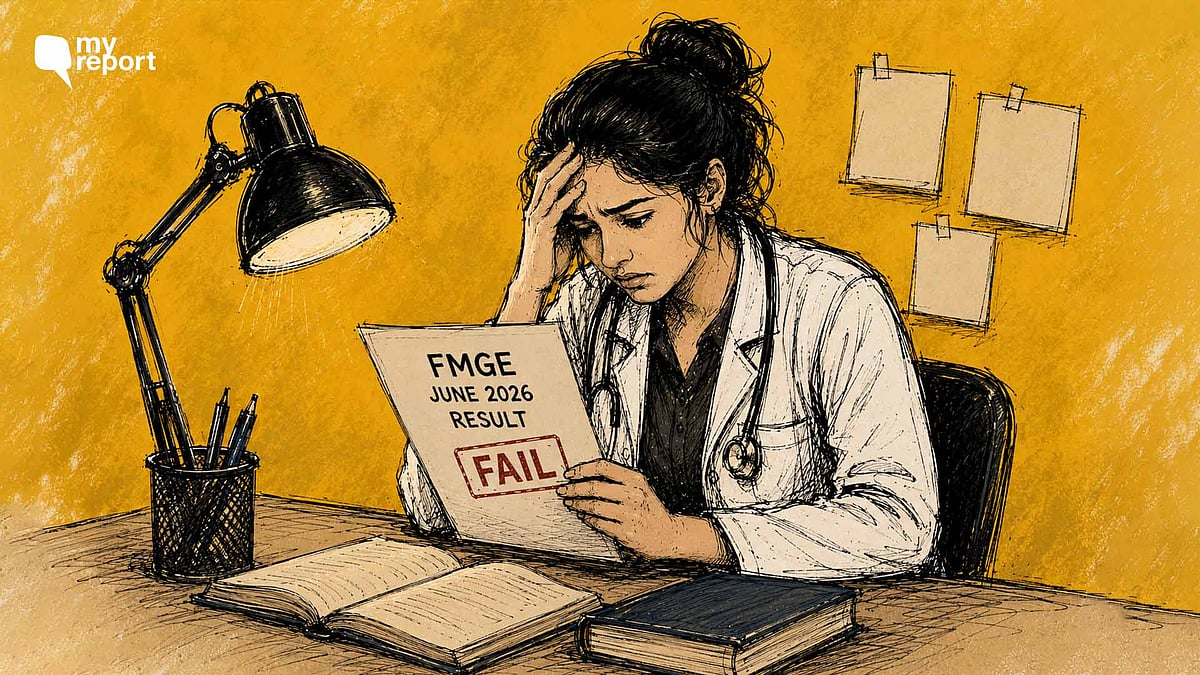
And yet the Foreign Medical Graduate Examination (FMGE)—a screening test for foreign graduates to practise in India, built on the exact same syllabus I have already proven I know—has failed me three times.
The only explanation I can find is not my knowledge. It is a broken system.
'Seven Marks And No Way to Check Them'
For my third attempt this June, I studied 10 to 12 hours a day. I skipped dinner on purpose, deliberately, so hunger would keep me awake past the point my body wanted to sleep.
Six months of that discipline moved my score from 140 to 147. Seven marks. Three marks less than the pass mark.
I am not claiming that hours of study should translate into marks on some fixed exchange rate; that isn't how learning works, and I know that.
There is nothing against which I can check my own performance. I cannot go back and see which questions I got wrong, whether a technical glitch cost me a mark I should have had, or whether my preparation itself had a genuine gap.
'I Am Not the Only One'
Then I started asking myself a simple question: Was it really just me? I began looking beyond my own result and digging into the numbers from previous FMGE sessions. What I found made me realise this wasn't just my story.
The more I looked, the harder it became to believe that tens of thousands of aspiring doctors had suddenly become less competent overnight.
The number of candidates scoring in the 200s and above, the strong performers, collapsed to just 130 this session, down from 892 in December 2025 and 1,273 in December 2024.
'Sudden Change In Exam Paper'
The paper itself changed without warning. The official FMGE information bulletin, the document every candidate relies on while preparing, clearly stated that the exam would have 300 questions to be answered in 300 minutes, giving us a minute for each question. There was no mention of video-based questions anywhere.
Yet, when we sat for the exam in June, we were suddenly faced with around 28 video-based questions. Each clip lasted between 14 and 40 seconds, and the platform often took another 15 to 20 seconds just to load and close the video.
National Eligibility-cum-Entrance Test for Postgraduate (NEET-PG), run by the same board, gave candidates advance notice before its own format shifted from 200 to 180 questions. We got zero warning before 28 undisclosed video questions were dropped into our paper. That's why we have started calling ourselves 'NBEMS experimental rats.'
'Crores Collected And No Explanation'
Each of us paid Rs 6,195 to sit this exam. With roughly 38,000 candidates, NBEMS collected over Rs 23 crore from this single session. An RTI response showed the board spent about Rs 24 crore conducting NEET-PG 2024 for 2.2 lakh candidates across multiple shifts.
Could that money not have been used to improve the quality of the examination? Candidates at several centres complained about poor facilities.
At some centres, air conditioners were not working. At others, computer mice and other equipment malfunctioned. There were numerous logistical issues throughout the examination, yet many candidates feel these problems were never adequately addressed.
More than 5,000 candidates have already compiled grievances through a shared Google Form, including reports of over 15 candidates from the same center and attempt returning identical marks with no connection to one another, a coincidence that is very hard to explain when nobody outside NBEMS can see the underlying data.
'This Is Not Just About Money'
I have been unemployed since April 2024. At 26, I am still financially dependent on my parents, who are repaying the loan they took to fund my medical education. I have a medical degree, but I am not allowed to practise. Every day, I carry the weight of expectations that do not stop just because an exam went wrong.
This is not just about paying another Rs 6,195 to take the exam again. It is about losing another year of my life. Another year without an income. Another year of watching my mental health suffer while friends move ahead in their careers and people keep asking me the same question: "When will you finally start working?"
Mental health advocates working with foreign medical graduates will tell you the days after FMGE results are among the most crisis-prone this community faces. Many of us are on antidepressants and beta-blockers because of what this exam does to us, attempt after attempt.
Anurag deserved a fair examination. Each one of us does. NBEMS has never addressed what its own failures cost us mentally, and it owes us that answer.
'We Aren't Asking For Favours'
We are asking for a fair examination. That begins with transparency. NBEMS should release our response sheets, answer keys, and question papers so we can verify our scores.
It should conduct an independent review of the June 2026 FMGE, assess how the undisclosed video-based questions affected candidates' performance, and investigate examination centres where serious lapses were reported.
Given the documented irregularities, we have also urged the board to support a reduction in the qualifying cutoff for this session to 35-40 percent.
Future changes to the examination pattern must be announced well in advance, just as they were for the NEET-PG.
Finally, NBEMS should stop asking candidates for their previous FMGE roll numbers, a practice many repeat aspirants believe unfairly disadvantages them.
Legal experts and student groups argue that the June 2026 FMGE raises serious constitutional concerns. They contend that introducing undisclosed changes and allowing widely varying examination conditions may violate Article 14, which guarantees equality before the law.
If our demands are not met, we will be protesting at Jantar Mantar in New Delhi on 3 August to make sure our voices are heard.
(The Quint has reached out to the NBEMS regarding the issues raised by the author. This article will be updated with their responses as and when they revert. Meanwhile, on 24 July, the Supreme Court sought responses of the Centre, the National Medical Commission (NMC), and the NBEMS on a plea by other foreign medical graduates which also highlighted all the issues raised by this author.)
(All 'My Report' branded stories are submitted by citizen journalists to The Quint. Though The Quint inquires into the claims/allegations from all parties before publishing, the report and the views expressed above are the citizen journalist's own. The Quint neither endorses, nor is responsible for the same.)
- Access to all paywalled content on site
- Ad-free experience across The Quint
- Early previews of our Special Projects
Published: undefined