
'Ending 10‑Min Delivery Race is a Win, But Gamification Still Dictates Gig Work'
'Gig workers' incomes aren’t driven by choice but by incentives, targets, and time slots they don’t control.'
advertisement
Ending the 10-minute promise on delivery platforms is a step in the right direction, but the reforms in the gig economy shouldn't stop there.
From organising with delivery workers to running consumer campaigns in Delhi NCR, I’ve come to understand the extreme demands delivery apps place on workers.
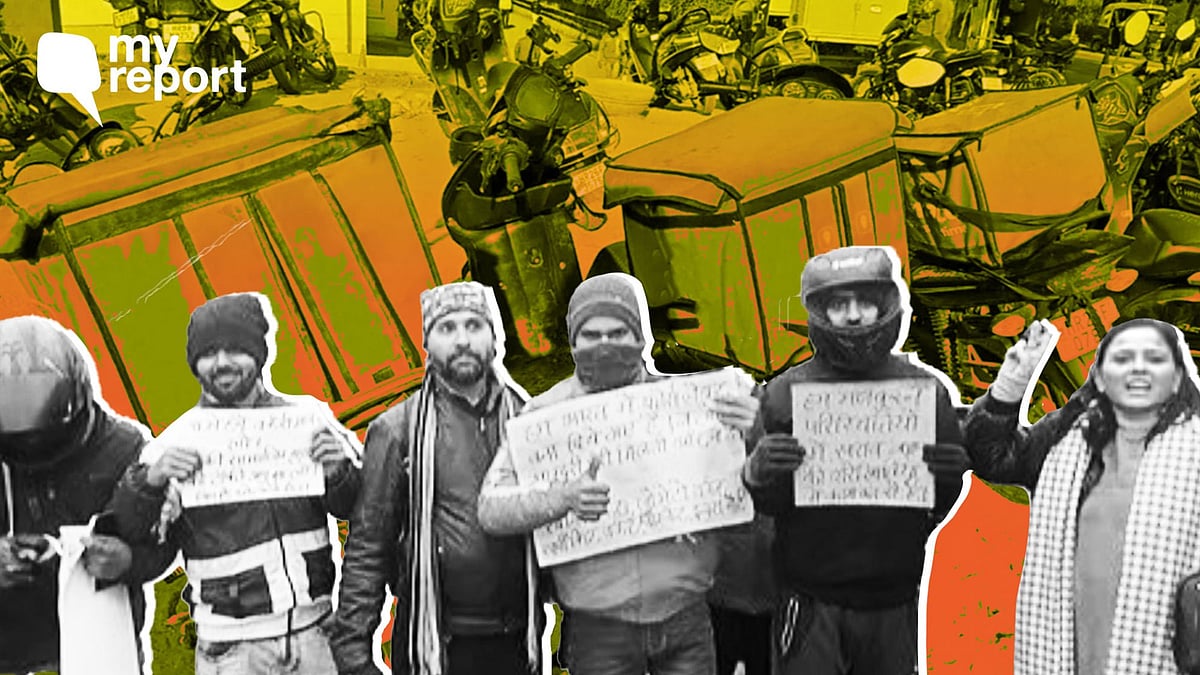
Even after the rollback of the 10-minute limit on 13 January, Tuesday, when I spoke with a few workers, they described their work "in numbers"—how many orders they need to complete, how much time they lose on the road, and how close they are to the minimum earnings required to unlock an incentive.
Explaining these calculations that they make on a daily basis, one delivery partner, Shivam*, told me,
'Incentives Are Not Extra Pay'
The promise that delivery platforms sell to gig workers is flexibility—log in when you want to work, log out when you don’t want to work. But the ground reality is different. In reality, this flexibility exists only on paper.
Delivery executives I spoke to say that incentives are not extra pay. Incentives, instead, is the system through which they are forced to stay logged in longer because basic pay alone just isn't enough. These incentives can shift daily, vary by hour, and are set up to expect near-perfect performance.
To receive an incentive of a few hundred rupees, he first has to earn much more than that, which often means working 10-11 hours continuously. A single delay due to potholes, traffic, wrong navigation, or a customer not responding to a call can disrupt the entire calculation.
What is important here is not just the number of hours an executive puts in, but how those hours are disciplined. There is no visible countdown clock forcing riders to speed.
Yet, ratings, incentives, and non-transparent penalties ensure that workers feel constant urgency.
'Gamification Of Labour'
This is where work begins to feel like a game, often referred to as the gamification of labour. Platform work is organised through points, targets, incentives, and ratings. Time is divided into slots, and executives are pushed to go faster, stay logged in longer, and avoid mistakes—like chasing scores in a game, reinforced through the branding of workers as "ninjas."
It may look playful on the screen, but the impact is real. Miss a target and pay drops. Make one mistake and future work can be reduced.
Yet, they are often paid the same amount for delivering multiple orders as for a single order. In one case, Manish was paid only Rs 19.30 for delivering two orders together.
Workers express concern that while the rollback will bring some relief, such pressure of the job won't really changed.
This is where technology shows its real impact. What platforms call "optimisation" often means shifting costs onto workers. Time spent travelling to a store, waiting for orders to be packed, or returning to a hub after delivery is usually unpaid.
Executives also cover fuel costs, phone data, and vehicle maintenance themselves. Accidents, injuries, and fatigue are treated as personal problems rather than outcomes of fast delivery models.
Platform companies often respond to criticism by claiming that gig work is temporary or meant only as additional income, sometimes described as "pocket money".
This does not match the reality on the ground. Most delivery workers I meet with depend on gig work as their primary source of income. Many support families, pay rent, and manage debt through platform earnings.
'This Isn’t Real Job Creation'
Despite the “job creation” in the name of gig economy, basic labour protections remain missing.
Workers are pushed to work long hours, but do not receive overtime pay. They are constantly monitored, but without transparency. Penalties are imposed quickly, often without explanation or any mechanism to appeal. Accounts are blocked, shifts are removed, and access to work is cut off—often automatically, without human review. This is control without responsibility.
From an organising perspective, what stands out is how the bargaining power has been steadily eroded. Gig workers are kept outside industrial relations laws, meaning they cannot negotiate collectively or challenge unfair practices.
The language of innovation has normalised the absence of these protections. Fast delivery is celebrated as progress. And as the middle class reaps convenience, gig workers suffer.
'We Desperately Need Regulations'
Ultimately, the issue is regulation. Platforms tightly control how work is assigned, timed, and paid, yet deny responsibility for workers’ welfare. Algorithms decide who gets work and who waits, who earns enough and who does not. If artificial intelligence requires regulation in finance, healthcare, and governance, there is no reason labour platforms should be exempt.
Workers are not asking for charity. They are asking for recognition—for the fact that their labour sustains billion-dollar companies, that speed should not come at the cost of safety, and that dignity cannot be handed over to an app. What delivery workers want is simple: clear and transparent pay, reasonable working hours, protection from unfair penalties, and to be treated as workers, not disposable inputs.
The rollback of the 10-minute delivery promise is only the first step. Without structural changes, the pressures that define fast delivery will continue.
(*Names of delivery executives have been changed to protect identity.)
(The Quint has reached out to the Union Ministry of Labour and Employment regarding the issues raised by the author. The article will be updated as and when a response is received. The Quint has also reached out to major delivery platforms to seek their response on the next steps following the government’s rollback of the 10-minute delivery directive. Their responses will be added to the article when received.)
(The author works on advancing the rights of platform-based gig workers through the Gig Workers Association (GigWA). He holds a postgraduate degree in Development from Azim Premji University.)
(All 'My Report' branded stories are submitted by citizen journalists to The Quint. Though The Quint inquires into the claims/allegations from all parties before publishing, the report and the views expressed above are the citizen journalist's own. The Quint neither endorses, nor is responsible for the same.)
- Access to all paywalled content on site
- Ad-free experience across The Quint
- Early previews of our Special Projects
Published: undefined