‘Designed to Keep Us Hooked’: Lawyer Couple Take Social Media Addiction to Court
"We need to stop treating it merely as a matter of individual use or parental responsibility," says Kartika Sharma.
advertisement
"As a mother of a young child, this has always been a concern for me," advocate Kartika Sharma tells The Quint.
Last week, Sharma, along with her husband and fellow lawyer and professor of law at Haryana's BML Munjal University, Dr Vikas Kathuria, filed a Public Interest Litigation (PIL) in the Delhi High Court seeking the constitution of an expert committee to examine and establish guidelines and prescribe measures to prevent addiction-causing design features in popular social media apps.
"Social media addiction is no longer an alien concept. It is a common phenomenon present in almost every household in the country. And it cuts across age, income, and geography ie young or old, rich or poor, urban or rural—we are all experiencing its effects," Sharma says, adding:
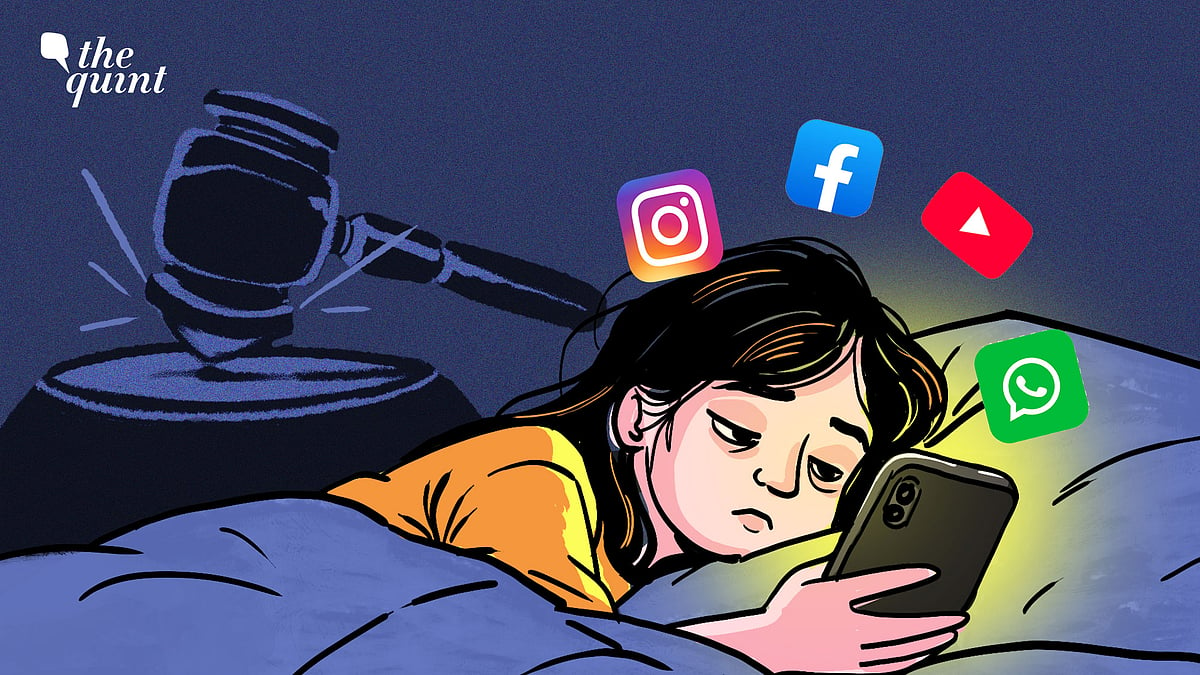
Social media addiction has been discussed extensively in recent years, particularly among children and young people. Doctors and child psychologists have warned about its ramifications, and several countries have responded with new laws aimed at curbing its unrestricted use. Social media companies themselves have introduced features aimed (at least ostensibly) at curbing compulsive use.
The Background of the Petition
Australia became the first country to ban social media for children under 16 last year. The country also recently moved to allow social media users to opt out of algorithm-driven content. Since then, more than 40 countries have either implemented similar policies or are toying with the idea.
"What particularly brought this issue into focus was the litigation in the US, where evidence and internal material concerning the design practices of social media companies came under judicial scrutiny, followed by Meta’s reported settlement with US states for approximately $17 billion, and an arrangement to tone down the addictive designs admittedly used by them," says Sharma.
Meta itself has denied these allegations, saying "social media addiction doesn't exist".
How Do You Measure Harm?
Apart from seeking checks on addiction-causing features on social media, the PIL also calls for accountability for the harm already caused.
However, this raises the difficult question of how the harm caused by social media addiction can be quantified and, more importantly, how do you create a workable framework to hold platforms accountable for it?
"That is precisely why we have not approached the issue as though there is a simple formula by which individual harm can be calculated," says Sharma, adding, "As a law professor, my husband has been researching the intersection of technology and law, including the engagement-maximising and addictive designs employed by social media platforms for some time now."
The impact of social media, particularly on mental health and behaviour, is indeed well documented and backed by mounting research.
Speaking to The Quint previously, Anurag Shukla, a research scholar at IIM Ahmedabad whose research involves the intersection of technology, education, and its real-life implications, had said, "It is also a matter of public health concern, and how it is going to harm children physically and mentally is not restricted to the kind of content they are privy to."
Studies have shown how excessive time spent online is linked to higher instances of obesity, decreased happiness, mental health issues, decreased quality of sleep, and an increased risk of depression among young people.
Back in 2021, an article in The Wall Street Journal also exposed internal studies conducted by Facebook that found the app triggered body image issues in young girls. The company, however, has refused to make this data public.
The larger question is one of accountability. If a business model is designed to maximise engagement and there is credible evidence that certain design choices can cause widespread harm, the PIL argues that there must be "a meaningful conversation about who bears responsibility for that harm".
The Petition is Not Seeking a Ban
Now, it’s not as though there have been no attempts to regulate social media use in India before, particularly among children. In March 2026, Karnataka became the first state to propose restricting social media access for children under 16. Earlier this year, Andhra Pradesh Chief Minister N Chandrababu Naidu also announced that the state would introduce similar regulations for children below 13.
However, this PIL "is not about banning social media, shutting down platforms, or preventing people from using them," Sharma clarifies. "The concern is with the design architecture that is deliberately built to maximise engagement and keep users on these platforms for as long as possible."
"The petition also seeks that the court lay down guidelines to prescribe measures to prevent addictive designs such as infinite scroll, autoplay, notifications and other design features that may contribute to compulsive use, particularly among children and young people, and recommend appropriate safeguards," she adds.
When asked what exactly these safeguards should be, Sharma says that it's best left to experts.
"What matters now is that there is an informed public and judicial conversation about it. If the court considers the issue worthy of examination, an expert process can help determine what safeguards are actually necessary and proportionate."
‘Not Just a Matter of Parental Responsibility'
Much of the conversation around the impact of social media on children has focused on what parents can do, like setting rules, limiting screen time, and keeping their children off these platforms. Sharma, however, believes this approach risks shifting the responsibility away from the platforms themselves and placing it entirely on parents, and sometimes young people themselves, to resist something that is pervasive in our current world and deliberately designed to be addictive.
The hope, she adds, is that this PIL will "lead to a serious, evidence-based examination of these design practices in India and, ultimately, to safeguards that protect users, particularly children and young people, without unnecessarily restricting access to technology or legitimate use of social media."
While the petition is not aimed at parents, its success is likely to come as welcome news to many parents.
Speaking to The Quint previously, Jyotsna Mohan Bhargava, a parenting columnist, author of Stoned, Shamed, Depressed: An Explosive Account of the Secret Lives of India's Teens, and mother of two girls, had said, "Our kids are at the mercy of Big Tech unaccountability, and it is really up to us to make sure we don’t fall for it."
"The idea is to ensure both prevention of future harm and a meaningful framework for addressing harm that has already occurred," Sharma concludes.