'System' Review: A Promising Courtroom Drama Undone by Generic Twists
Jyotika shines as a seasoned stenographer in a legal drama where strong female leads battle a flawed system.
advertisement
A privileged rookie lawyer teams up with a court stenographer to fight cases and seek justice for the underprivileged. System follows Neha Rajvansh (Sonakshi Sinha), a sincere but inexperienced public defender who has a lot to prove to live up to her name. Her father, Ravi Rajvansh (a functional Ashutosh Gowariker), is a hotshot advocate known for representing the wealthy and well-connected.
To earn her place at his side, he expects her to grind it out as a ‘sarkari vakil’ and gives her a target: win 10 cases.
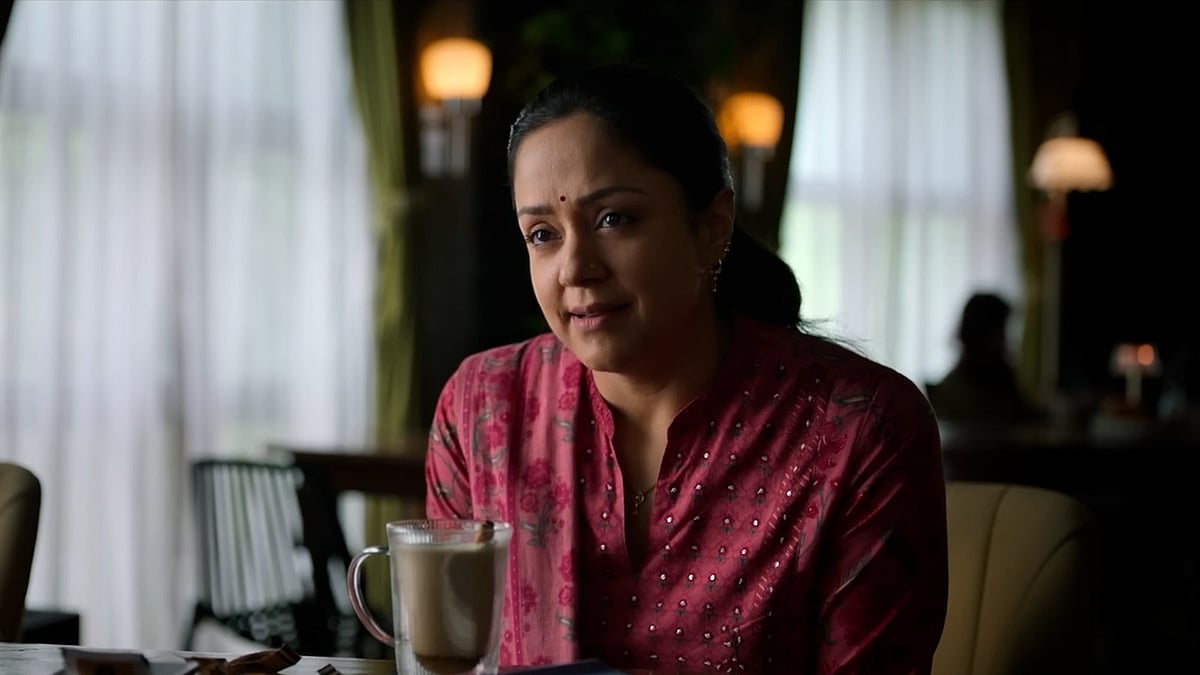
To get there, Neha finds an unlikely ally in court stenographer Sarika Rawat (an excellent Jyotika).
An overlooked, invisible, underestimated clerk who blurs into the background—the ultimate underdog. You can easily see it serving as a great premise for a legal procedural: the lawyer and the stenographer teaming up to crack one case an episode.
An Uneven Tale Of Two Halves
System, from writers Harman Baweja, Arun Sukumar, Ashwiny Iyer Tiwari, and Tasneem Lokhandwala, begins as a film of two halves. Not just in terms of contrasting the lives of its two lead characters and their vastly different worlds (Sarika’s sweaty commute on packed buses and trains is intercut with Neha’s oversized car and palatial home), but also in terms of competence and calibre.
Sarika is the sole breadwinner for her family of a young daughter and wheelchair-bound husband. She’s also having an unapologetic affair with a cop. Jyotika is a joy to watch. She imbues Sarika with a lived-in interiority. You can feel her carrying the weight of what came before.
Sonakshi is watchable and endearing enough, but Neha is the less interesting, more generic character.
(Photo Courtesy: YouTube)
I’m also not sure why the writers insisted on framing her as a wet-behind-the-ears rookie lawyer if they weren’t going to cast a younger actor. Or, then again, why make her a rookie lawyer at all? Either way, the fact remains that Sarika blends in while Neha stands out. Sarika feels like a person; Neha feels like a “character”.
Then there’s the matter of my villain origin story—the noticeably irritating, pronounced background score. It’s particularly jarring in the early stretches of the film, where we get bafflingly out-of-place, heavy-handed stock music masquerading as background score that insists on confusing us about the tone of the film.
The first time we see Neha walk into court, for example, we get oddly plucky, playful, almost rom-com-esque music that fails to read the room. Later, when Neha’s boss tells her he might pull her from a case because of her poor performance, we get what sounds like the top result after searching “sad music” on YouTube.
The Hindi Streaming Problem
Still, numerous rough edges aside, this is a film you want to root for because of its inherently underdog energy—a tale of two women who decide to fight for the little guy and take on titans within a fractured justice system.
Even so, the route the film takes involves a head-scratching murder case that is anything but compelling, involving a dead influencer, a greedy builder who may have been sleeping with her, and a nine-year-old tragedy. Instead of crafting a genuinely interesting murder trial and investigative thriller, the writers opt for long stretches of bland, dull family melodrama rooted in a room-temperature father-daughter story.
Still, you persevere, rooting for a female friendship story and a scrappy duo going up against cocky, arrogant men who love the sound of their own voices. But Ashwiny Iyer Tiwari’s film eventually goes off the rails with a bizarre “muchwow” twist that mistakes confusion, chaos, and disorientation for smug, “they’ll never see it coming” cleverness.
Algorithm-friendly, declining-attention-span desperation dictates that a promising premise and a familiar but well-told story aren’t enough. Cohesive, sophisticated storytelling must instead be sacrificed at the altar of random shock value and dopamine hits designed to wrench your attention away from your phone.
Ashwiny Iyer Tiwari has given us gems in the past that shine because of their specificity. Bareilly Ki Barfi remains one of the most crackling comedies of the last decade. Her SonyLIV series Faadu was a thoughtful, evocative tale of love and greed that deserved more appreciation. ZEE5’s Breakpoint, which she co-directed with husband Nitesh Tiwari, remains among the finest docuseries to emerge from the Hindi streaming landscape.
(Suchin Mehrotra is a critic and film journalist who covers Indian cinema for a range of publications. He's also the host of The Streaming Show podcast on his own YouTube channel. This is an opinion piece, and the views expressed above are the author’s own. The Quint neither endorses nor is responsible for the same.)