'Drishyam 3' Review: Mohanlal Wraps Up the Final Chapter, but Not the Suspense
'Drishyam 3' is a worthy continuation of Georgekutty’s journey. I can’t think of a greater compliment!
advertisement
"I thought we agreed to put this behind us," a character says, defeatedly, to another in Jeethu Joseph's Drishyam 3, the apparently concluding chapter of one of the most thoughtful trilogies (and remarkably consistent series of thrillers) to emerge from modern Indian cinema.
With the smashing Drishyam 2, which released directly on streaming during the pandemic, Joseph evolved a clever, unputdownable thriller into a ghost story. That is to say, a story about the ghosts of the past and how they haunt us.
It became a story about a life of fear, and the weight of guilt and trauma plaguing Georgekutty (Mohanlal continues to carefully craft one of Indian cinema’s most enjoyable recent creations), his wife Rani (Meena George), and his daughters Anu (Esther Anil) and Anju (Ansiba).
About the weight of pain, loss, and rage on Geetha Prabhakar (Astha Sharath) and her husband (Siddique), the parents of Varun, the sexual predator whom Georgekutty’s family killed in self-defence, which set everything in motion.
About the weight of ego and shame on the police who’ve been made a mockery of, considering Georgekutty’s story has now become the stuff of legend. A kind of open secret, considering most people seem to largely know what happened and that Georgekutty ‘got away with it’.
The second film even ends with a judge acknowledging to Inspector General of Police Thomas Bastin (Murali Gopy) that, even though they know he did it, without sufficient evidence, Georgekutty remains a free man—and that “both families deserve justice but will never get it”.
An Unputdownable Thriller
In terms of further fanning the flames of his legend, it doesn't help that Georgekutty is now a successful movie producer whose first film, also titled Drishyam—loosely based on what happened to his family—is a smash hit across the country, a cheeky nod to the roaring success that the first film went on to become in real life.
It’s curious that the usually cautious Georgekutty actually made the film.
A still from Drishyam 3.
(Photo Courtesy: YouTube)
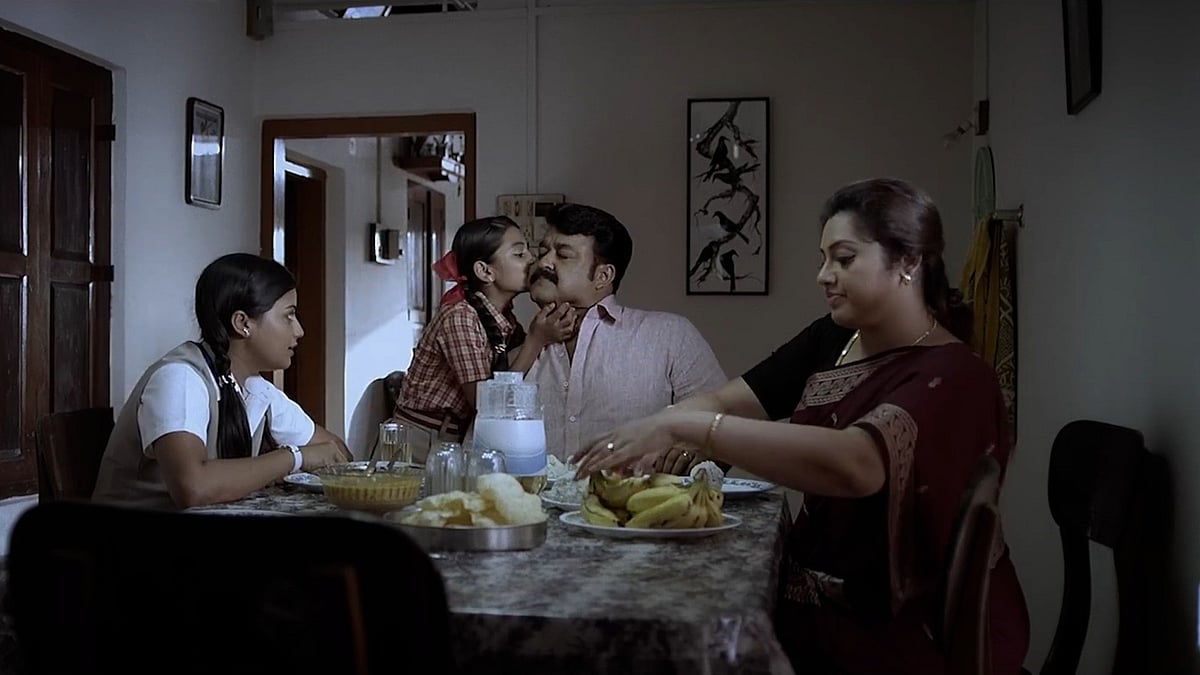
As we’ve seen in the previous two chapters, the first half of Drishyam 3 catches us up with the family and largely dwells on the domestic drama—in this case, getting Anju married off.
A still from Drishyam 3.
Photo Courtesy: YouTube
We aren’t just restlessly shifting in our seats, waiting around for the eventual bang we know is coming.
I similarly love how honest these sequels feel as sincere, organic continuations of the lives of these characters. Granted, by this third film, there’s a sense of familiarity that’s creeped in.
Drishyam may not have a predictable formula, but there is certainly a design.
A Worthy Sequel
Among the many triumphs of both sequels is how they don’t feel like an opportunistic gimmick of a “new villain crops up every few years to mess with the family” kind of story.
The passing of time itself presents new challenges in the war that rages on between Georgekutty and those who would see him held “accountable”. The case remains unsolved, and therefore, always attracts prying eyes.
Many around Georgekutty are jealous of his success and growing wealth. Varun’s parents still haven’t found closure. Time seems to have softened Georgekutty, made him more sentimental, and perhaps less capable of fighting another attack on his family.
I like that, for the first time, his enemies don’t underestimate Georgekutty. Even when following the breadcrumbs he’s left behind, they’re forced to wonder what is real and what might be a false trail. I also love how these films constantly excavate (pun intended) and interrogate the actions and baggage of what came before. Each film tries to expose his latest “cover-up”.
With each move he makes, Georgekutty builds a precarious Jenga tower of scheming and strategy, constantly putting an increasing number of band-aids on bullet wounds. But that’s the thing about old wounds. They fester with time.
Drishyam 3 releases in theatres 21 May.
(Suchin Mehrotra is a critic and film journalist who covers Indian cinema for a range of publications. He's also the host of The Streaming Show podcast on his own YouTube channel. This is an opinion piece, and the views expressed above are the author’s own. The Quint neither endorses nor is responsible for the same.)