'Kohrra' Season 2 Review: A Dark, Unruly Study of Fathers and Fault Lines
'Kohrra' Season 2 delves into fatherhood and systemic flaws in a gripping murder mystery.
advertisement
Kohrra, meaning fog or mist, refers to a difficulty in seeing what’s in front of you. It’s an apt title for a series set in small-town Punjab, where solving a murder requires seeing through systemic structures, from patriarchy to class.
With season 1, Sudip Sharma and his team crafted a slow-burning masterpiece that examined love, sex, and attachment. The creator of Paatal Lok established his own genre of police procedurals, in which the cop is not an infallible hero who saves the day but a deeply broken man who finds catharsis in doing his duty in a broken system.
Created and written by Gunjit Chopra, Diggi Sisodia, and Sharma, Kohrra season 2 continues in this tradition, despite being led by a female cop. The sophomore season, directed by Sharma and Faisal Rahman, is equally dense, detailed, and dark.
The Crime: Preet Bajwa and the Cost of Return
Season 2 also begins in the early morning, this time in Dalerpura. As a procession passes and cows moo, the camera slithers into a barn next to a modest house to reveal Preet Bajwa’s (Pooja Bhamrrah) dead body.
Preet has been living here in her brother’s (Anurag Arora) house for months, separated from her husband (Rannvijay Singha) and two children in the US. She has been making Instagram dance reels with a local influencer, Johnny, with whom she may or may not be having an affair.
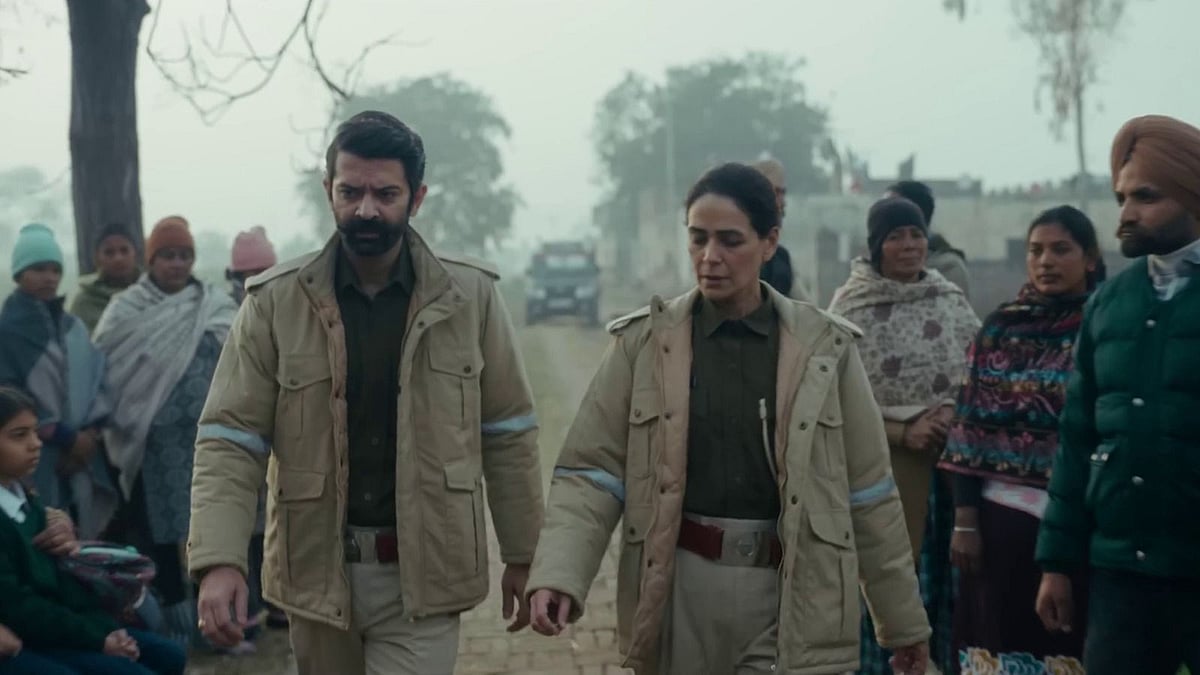
Assigned to investigate her murder is Amar Pal Garundi (Barun Sobti), recently transferred to Dalerpura and now working under Sub-Inspector Dhanwant Kaur (Mona Singh).
From the outset, several suspects emerge, each with a clear motive to want Preet gone. There is her brother, a failed businessman deep in debt, who wants to sell their ancestral land without having to share it with her.
There is her husband, who calls to threaten her, demanding the return of the $600,000 he claims she fled with—money he says she is holding hostage. Then there is Johnny and his girlfriend, who may be concealing far more than their carefully curated public personas suggest.
Barun Sobti as assistant sub-inspector Amarpal Garundi in Kohrra season 2
(Photo Courtesy: YouTube)
A Hopeless Quest
Running parallel to the murder plot is the story of a young migrant labourer (Prayrak Mehta) who has come to the city searching for his father, Rakesh Kumar, whom he last saw 20 years ago—a near-impossible task.
Yet his desperation is heartbreakingly sincere. He navigates humiliation after humiliation—the contempt of employers, the indifference of the state, the quiet disgust of the middle class. The performance lays bare the desolation and destitution of his situation. But what does a nameless worker’s hopeless quest have to do with Preet’s murder?
Prayrak Mehta in Kohrra season 2
(Photo Courtesy: YouTube)
Cops Carrying Their Own Wounds
Like the previous season, this one also zeroes in on the leading cops’ difficult personal lives. Garundi is newly married to Silky, a loving, gentle, almost self-effacing wife. But his past continues to haunt him as his pregnant sister-in-law, Rajji (Ekta Sodhi)—also his former lover—moves into his home, presenting a ticking time bomb of dramatic irony.
Meanwhile, Kaur’s conflict is shaped by grief and guilt. Dhanwant Kaur must shoulder the demands of her extremely consuming job while living with an alcoholic husband, the two of them still reeling from the loss of their teenage son in a bike accident.
In some ways, she resembles Aamir Khan’s Inspector Shekhawat from Talaash. But as a woman, she cannot externalise her rage in the same way. Instead, she must find quieter, more suffocating ways to “manage” her pain: compartmentalising, over-functioning, swallowing rather than shouting.
Mona Singh’s performance as Kaur anchors all this emotional complexity. Her face is a mask of professionalism and control, but you can feel the immense pressure building beneath it.
The bond between Garundi and Kaur never has the same lived-in warmth or complicated affection. Kaur, importantly, is also a more straightforwardly sympathetic protagonist than Balbir Singh, less morally compromised.
Mona Singh plays Sub-Inspector Dhanwant Kaur
(Photo Courtesy: YouTube)
Fatherhood, Inheritance, and Patriarchy
Rajji’s pregnancy forces Garundi and his brother to confront what the next generation of fatherhood might look like. For Kaur, the question is even more pointed. Her husband, we learn, was the more active parent when Nishant was alive; his current descent into alcohol and avoidance is inseparable from his own sense of failure as a father.
One of the season’s most affecting through-lines is Kaur’s broken marriage. She wants her husband to provide sperm so they can try IVF and have another child. He avoids the appointments, chronically drunk, drifting from bar to bar. When she finally forces him to go to the clinic, we see him masturbate in a sterile cabin to give his sample—a moment Sharma stages with an almost unbearable sadness.
Preet and her brother inherit more than just property; they also inherit deeply exploitative legacies. The series is unsparing in tracing the consequences of such unequal inheritances.
Living with the Fog
In this sense, Kohrra’s second season recalls Hansal Mehta’s The Buckingham Murders in its interest in family dynamics, betrayals, and patriarchal bargains. Both works are less interested in the thrills of the whodunnit than in the emotional and social architecture that enables such crimes.
The men of Kohrra are not excused, but they are examined empathetically, as both products and perpetrators of patriarchy.
In the end, the fog of Kohrra is not just the mystery of who killed Preet Bajwa. It is the mist of inheritance and memory, the insurmountable gap within the most intimate of relationships—father and son, brother and brother, husband and wife.
Kohraa season 2 releases on Netflix on February 11.
(Kaashif is a writer and film critic from Mumbai, currently based in London. He is the Assistant Culture Editor of The Polis Project.)