PM Modi Unveils Development Projects Worth Rs 830 Cr, Slams TMC in Singur Rally
PM Modi also criticised the TMC government over national security and alleged illegal infiltration.
advertisement
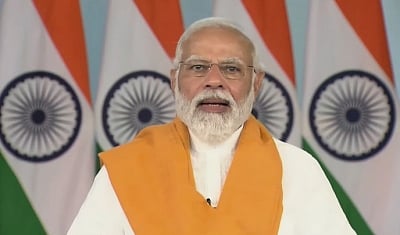
Prime Minister Narendra Modi visited West Bengal on 18 January 2026, where he inaugurated development projects valued at over Rs 830 crore in Singur, Hooghly district.
He also flagged off three new Amrit Bharat Express trains connecting Kolkata with New Delhi, Varanasi, and Chennai. The visit included the launch of infrastructure projects such as the Jayrambati-Barogopinathpur-Maynapur rail line and the foundation stone laying for the Extended Port Gate System at Balagarh.
According to Deccan Herald, the Balagarh project is being developed as a modern cargo handling terminal with a capacity of about 2.7 million tonnes per annum. The project, reportedly, aims to improve cargo evacuation efficiency by diverting vessel movement away from congested urban corridors, enhancing road safety and reducing pollution in Kolkata.
As reported by Hindustan Times, Prime Minister Modi stated that all central projects would accelerate the development of West Bengal.
He emphasised the government’s commitment to the growth of eastern India and highlighted the symbolic significance of Singur, where Chief Minister Mamata Banerjee led a major protest against land acquisition nearly two decades ago.
As highlighted by The Hindu, the Prime Minister also launched the new Amrit Bharat Express trains, which expected to strengthen rail connectivity between West Bengal and other major cities, with routes including Howrah-Anand Vihar Terminal, Sealdah-Banaras, and Santragachi-Tambaram.
As per Financial Express, these train launches are part of a broader plan to introduce nine new Amrit Bharat Express services across India, aiming to improve long-distance travel and passenger comfort.
During his visit, Prime Minister Modi also addressed political issues, criticising the Trinamool Congress (TMC) government for its handling of national security and alleged support for "illegal infiltration". According to Deccan Herald, he accused the TMC of aiding infiltrators for vote-bank politics and called for an end to what he described as “maha jungle raj” in the state.
“Industries will be established in Bengal, investments will come only when law and order improve here, but in Bengal, rioters, looters, and mafias have been given free rein. Only the BJP government will end this syndicate tax, this mafia rule, and this is also Modi's guarantee,” he said.
Reporting indicated that Modi also addressed the Matua community, assuring them of protection under the Citizenship Amendment Act (CAA) and stating that refugees fleeing religious persecution have constitutional rights to stay in India. He accused the TMC of blocking central welfare schemes and preventing benefits from reaching the poor.
In his speeches, Modi linked the state’s development to the need for a “double-engine government” and called for a change in leadership. As details emerged, he claimed that large-scale illegal migration had altered West Bengal’s demography and contributed to social unrest, particularly in districts like Malda and Murshidabad.
Further updates confirmed that the Prime Minister’s visit was part of a two-day tour, during which he also launched rail and road infrastructure projects from Malda and addressed rallies ahead of the upcoming state assembly elections.
Note: This article is produced using AI-assisted tools and is based on publicly available information. It has been reviewed by The Quint's editorial team before publishing.