
'Both BJP & TMC Polarised Bengal Polls': Congress Leader Adhir Ranjan Chowdhury
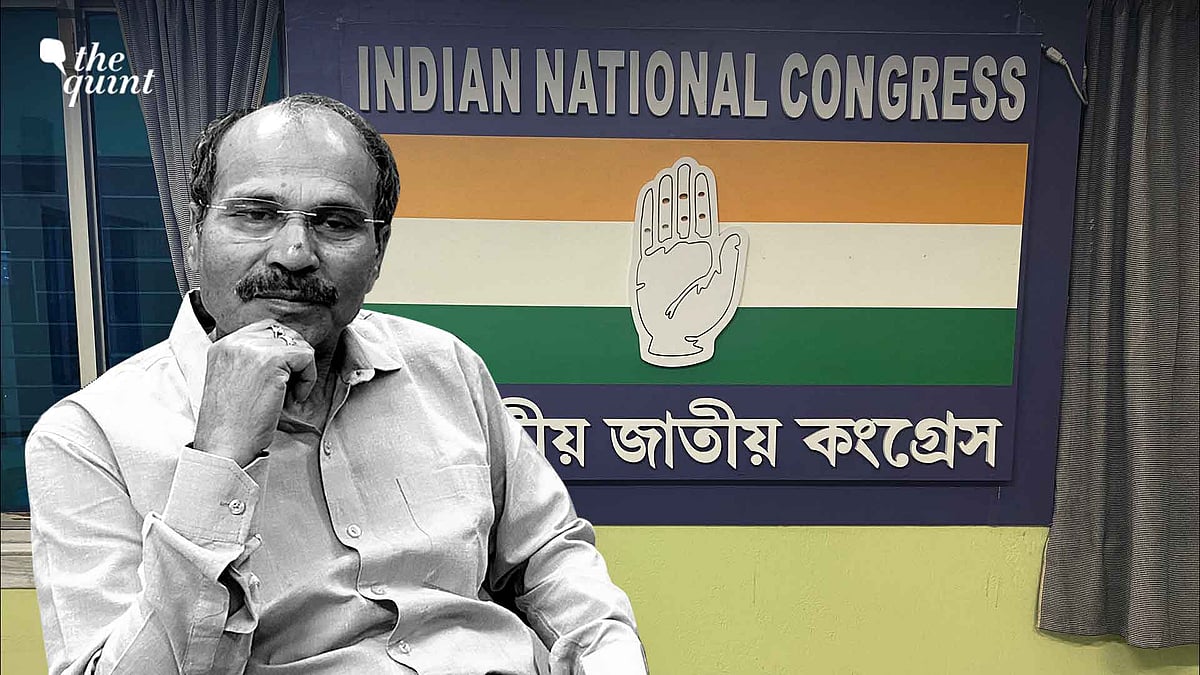
The Congress seems to be back in the game. And the charge is being led by senior Congressman Adhir Ranjan Chowdhury.
advertisement
Berhampur constituency goes to polls on 23 April in the first phase of the 2026 Assembly elections in West Bengal.
This time, Berhampur—and the 21 other seats of Murshidabad district—are seeing a three-way fight between the incumbent Trinamool Congress (TMC) which won 20 Assembly seats in the 2021 state elections, the Bharatiya Janata Party (BJP) which won two, and the Congress which at the time did not open its account.
In an exclusive interview with The Quint, Chowdhury talks about the impact of SIR on the 2026 polls, votebank politics, polarisation, and future alliances.
Edited excerpts:
Is the Congress looking to open its account in this Assembly election?
See, first of all, I beg to differ with your contention that in Bengal we never opened our account. May I remind you that in the last by-election in my district Murshidabad, for the Sagardighi Assembly seat... that was owned by the Congress party. So, technically, we are not nil. The Congress still holds one Assembly seat, as per legislative parlance. However, that elected member of the Congress party later switched over to the ruling regime. So, technically, you may say that we are zero, but legally and legitimately, according to the legislative protocol, you cannot say that we are zero.
What does it feel like to be back in the state politics after being in Parliament for the last five terms? And why contest now as an MLA after an MP?
Politicians who have been elected as MPs have on a number of occasions contested from a state in later years. Captain Amarinder Singh, [Bhupesh] Baghel, [Ashok] Gehlot... so a number of MPs eventually entered regional politics when the situation warranted it. I was defeated in the last Lok Sabha election, so my party suggested to me that the senior leaders should contest the Legislative Assembly elections because if the senior leaders contest, the Assembly aspirants will further be energised.
I think there is no prohibition to fight the Assembly elections, even for a person elected to Parliament a couple of times. There is no harm. Both are pertaining to legislative business—one in relation to the nation and the other in relation to the state.
I am in the electoral fray like my other colleagues, and when they see me, they think it's possible for them as well. They think it prudent that they should also fight with all the resources at their disposal in order to restore our lost ground. And, to that point, I may play some pivotal role.
So, when the high command suggested this, as a foot soldier of the Congress, I immediately fielded myself in the Assembly election.
Right... you spoke about your loss in 2024 to the TMC's Yusuf Pathan. At that time also you had emotionally said this was a loss for secularism, not Adhir. What did you mean by that?
West Bengal, since Independence, has never witnessed any kind of communal polarisation in any electoral frame. Since the last couple of years though, this situation has radically changed, and a high dose of colonial politics has been injected into the society of our state.
Till now I have received the support of both the communities—Muslims, Hindus, and everyone basically—in this district. The issue that I have observed, however, is that there is a serious disenchantment in the wake of the last Lok Sabha elections, in which both the BJP and the TMC were successful in polarising the entire political spectrum of my district.
Later on, people started to understand the fact that they have been deceived. They have been cheated. They have been misconstrued by their own logic. They are realising that this kind of parochial politics will not serve their purpose. They need the potential personalities in order to serve their own purpose. Communalisation of the society or only communalisation of politics won't help neither Muslim people nor Hindu people, as is desired.
But, as far as Murshidabad goes, I think people understand that credibility of the leadership matters in politics.
So is the Muslim vote splitting?
Whenever common people, either Muslims or Hindus, observe someone credible in their eye, they will support the credibility of the personal individual.
The Muslim people are being deceived by Mamata Banerjee for over the decades. Murshidabad district, in absolute terms, has the highest concentration of Muslim population in India, and they are getting disenfranchised day after day. Mamata Banerjee is a politician who once promised the world to the Muslim community only to refuse it later.
So, Muslim people now are getting disenchanted with her promises and policies. That is why the Muslim population is now banking upon the secular forces, particularly in Murshidabad, Maldah, and Dinajpur. That is why we are observing some sort of a resurrection, you may say, of the Congress party.
But these are also the districts that have seen the highest numbers of voter deletions amid the ongoing Special Intensive Revision (SIR) process, right? Do you think that there is a pattern here or that these deletions are particularly targeted politically or communally?
Murshidabad district has the highest concentration of Muslims in India in terms of percentage. Anantanag holds the highest percentage of Muslims, but in absolute terms, it is Murshidabad.
So, as a corollary of it, once deletion takes place naturally in Murshidabad where Muslims are predominant, the majority of the deleted persons will be Muslims. But here, Hindus have also been deleted. But if you look at the numbers, certainly, a majority of the deleted persons in these areas belong to the Muslim community, and it is total chaos.
Common people, both Muslims and Hindus, have been running from pillar to post in order to enlist themselves as a voter. But here, the state officials from BDO to DM, they have never extended their sincere cooperation to those affected persons.
So who is enemy number one then for the Congress party in this election?
I don't know... (laughs). I don't believe in the gradation of enemies. I belong to the Opposition. I am opposing both the BJP and the TMC.
On result day, if the TMC falls short of a few seats, will the Congress extend a hand in support for its INDIA partner?
This is a hypothetical question. Certainly, you may ask it, but it is till now a hypothetical question. When the situation arises, that time we will respond to it according to the situation. And, at that time, my high command they will decide what is to be done.
- Access to all paywalled content on site
- Ad-free experience across The Quint
- Early previews of our Special Projects
Published: undefined