'Pulled the Dead Fish Out by Hand': Pollution is Threatening Kashmir's Springs
The Beehama spring's sudden collapse has come to symbolise a broader crisis unfolding across Kashmir.
advertisement
(The Quint is telling the full story of how climate change is reshaping lives in India. Help us do more. Become a member.)
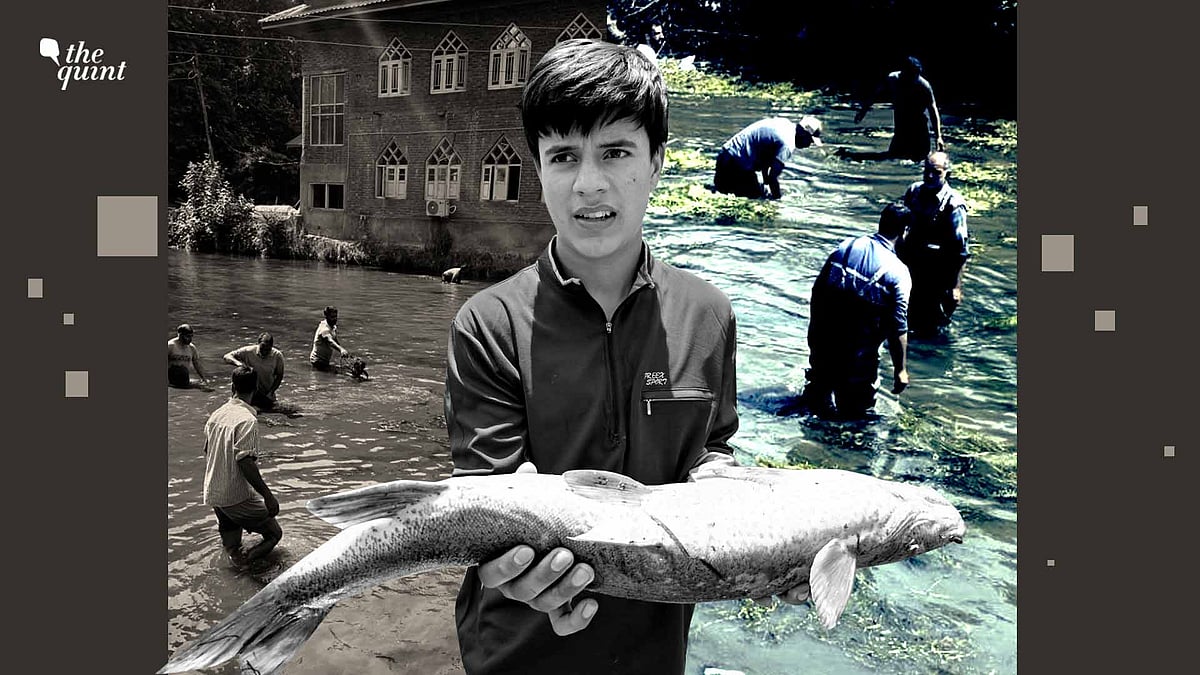
When hundreds of native snow trout floated lifelessly across the surface of Beehama spring in Kashmir's Ganderbal district in April earlier this year, residents stepped into the cold water to pull out the dead fish by hand.
For generations, the freshwater spring had provided drinking water, nurtured native fish, and anchored community life. But the continuous inflow of contaminated water from household drains proved to be detrimental.
“If the spring is properly cleaned, and the polluted inflows are stopped, the fish habitat can still be saved. What is needed is scientific intervention, proper treatment, and regular monitoring," said Bilal Ahmad Bhat, a resident of Beehama village in Ganderbal district.
On 1 July, the Brengi stream in Anantnag district became the site of similar scenes of mass fish mortality.
"Brengi is home to valuable brown trout and native snow trout, and such an incident is alarming for the health of this delicate freshwater ecosystem," said Junied Ahmad, 35, a resident of Kokernag in Anantnag district.
Beehama and Brengi springs' sudden collapse have come to symbolise a broader crisis unfolding across Kashmir, where polluted and shrinking freshwater springs are threatening ecosystems, livelihoods, and public health.
Local residents remove dead fish from a spring after mass fish deaths.
(Photo: Umaisar Gul)
Household wastewater, bathroom drains, plastic, diapers, and other solid waste are being dumped into the water, severely damaging the ecosystem.
“If we continue to pollute these freshwater sources, we will not only lose the fish, but also a vital natural resource that supports our livelihoods. The only way forward is to reduce pollution, restore the spring, and treat it as a shared public responsibility,” said Bhat.
“The authorities are invested in fencing and other infrastructure, but keeping the spring clean should have been a priority. No one paid attention till the mass fish mortality brought Beehama into the spotlight," he said, adding:
'Not the First Time'
A mass fish kill occurred on 22 October 2017 along a 1.5-km stretch of the Jhelum River in Srinagar, where thousands of fish died within less than three hours, making it one of the first documented large-scale fish kill events in the river.
A study found evidence consistent with chemical contamination rather than oxygen depletion.
Water quality measurements did not support the official low-oxygen explanation. The river had neutral pH (7.2–7.3), normal temperature (15.8–16°C), and dissolved oxygen around 6 mg/L, which the study's authors say do not indicate sudden hypoxia as the primary cause.
"The recent fish mortality affecting the native snow trout (Kasheer Gaad) is the result of multiple interacting factors rather than a single cause,” said Prof (Dr) Farooz Ahmad Bhat, Dean, Faculty of Fisheries, Sher-e-Kashmir University of Agricultural Sciences and Technology of Kashmir (SKUAST-K).
Mass fish deaths in Beehama, Panzath, Mattan, Verinag, and other springs have been reported.
(Photo: Umaisar Gul)
An Entirely Manmade Disaster
“Traditionally, Kashmir’s springs were lined with natural stones and boulders that provided shaded habitats and shelter for fish. In several locations, these have been replaced with concrete and tiles without ecological assessment, exposing aquatic life to direct sunlight and reducing natural habitat," said Prof (Dr) Bhat.
Snow trout, or Schizothorax, is a bottom feeder that naturally grazes on organisms growing on stones. So, when tourists throw bread, corn, rotten rice, and processed snacks into the springs, the uneaten food settles on the bottom, decomposes, increases biological oxygen demand (BOD), and fuels microbial growth. During summer, this process rapidly depletes dissolved oxygen, causing fish kills. "Ideally, dissolved oxygen should remain between 6 and 9 mg/L," said Prof (Dr) Bhat.
A 2022 study report found that dissolved oxygen levels in Dal Lake have declined drastically over the past 40 years, while phosphate and nitrate concentrations have increased due to untreated sewage, agricultural runoff, and sediments from adjoining catchments.
It further highlighted that around 1,200 houseboats discharge an estimated 9,000 tonnes of waste annually into the lake, while 15 major drains carry sewage into Dal Lake. A 2020 expert panel also found that 70 percent of Srinagar's sewage flows directly into Dal Lake, with overloaded and poorly maintained sewage treatment plants failing to meet pollution control standards, further degrading fish habitat.
The problem worsens when natural spring outlets are blocked, turning flowing springs into stagnant pools.
An official Fish Mortality Analysis Report prepared by the Faculty of Fisheries at SKUAST-K found that the fish deaths at Martand Temple Spring in Anantnag were caused by multiple interconnected factors rather than a single event.
Scientists recorded dissolved oxygen levels of just 4.0–4.8 milligrams per litre, well below the 6-12 mg/L required for cold-water fish, alongside elevated concentrations of phosphorus, nitrate, ammonia, and free carbon dioxide, indicating nutrient pollution and severe environmental stress.
It recommended regular water-quality monitoring, measures to improve dissolved oxygen, periodic health surveillance, routine cleaning of springs, and preventing tourists from throwing food into the water to reduce future fish kills.
Prof (Dr) Bhat goes on to explain that the actual readings could be much higher as delayed reporting remains a major challenge, and samples often deteriorate before they reach laboratories.
A Public Health Crisis
Decades ago, spring water in rural Kashmir was clean enough to drink directly. Today, localised pollution has significantly reduced its quality.
Any contamination of water that enters the food chain poses a risk to human health.
"Once fish begin to decay in polluted water, they further degrade water quality, just as any decomposing organic matter would. Consuming such fish or contaminated water can lead to serious illness," said Dr Surayyah Jan Qadeem, Medical Officer, University of Kashmir.
She added, "If contaminated or decaying fish are consumed, they can cause food poisoning, which in severe cases may progress to sepsis shock, acute kidney injury, multiple organ failure, and even death.”
The health risks also depend on the nature of the pollutants entering the water. "Exposure to pesticides, fertilisers, heavy metals, or other toxic chemicals can result in poisoning and may affect multiple organs, including the kidneys, liver, lungs, heart, and blood", she explained.
Organophosphorus compounds, commonly found in certain pesticides, are particularly hazardous if exposure is significant.
"Protecting freshwater ecosystems is therefore both an environmental and a public health priority,” said Dr Qadeem.
Polluted springs don’t just threaten fish. Contaminated water and decaying aquatic life can endanger public health, biodiversity, and the communities that depend on these freshwater sources.
(Photo: Umaisar Gul)
The Scope of Damage and the Road to Recovery
"Kashmir’s rivers, including the Rambiara, Vishav, Doodhganga, Pohru, Arpath, Bringi, and Sukhnag are important trout habitats and should have been major contributors to the region’s economy,” said environmental activist Dr Raja Muzaffar Bhat.
He added, “Significant public funds have been invested in the fisheries sector under the Holistic Agriculture Development Programme (HADP), but much of that potential is being undermined.”
The Fisheries Department has published notices online on the allocation of funds to the fisheries sector across Jammu and Kashmir under the HADP. The Quint sent the department a detailed questionnaire but had not received a response at the time of publication.
He goes on to explain, “The Sukhnag River is a designated trout stream where mining is prohibited, and no mining leases or e-auctions were ever approved. Despite this, a company allegedly carried out illegal extraction worth more than Rs 500 crore, destroying trout habitats, fish eggs, tadpoles, and the fish stock of a local farmer. More than 3,000 mature fish were reportedly died in May 2024, yet no FIR has been registered.”
The pond owner, Peerzada Rayees of Sail, Beerwah (District Budgam), submitted an application at the Beerwah police station asking that an FIR be registered.
"I then went to the SDM office in Beerwah and submitted another application requesting that an FIR be lodged; there is still no FIR in the matter", Rayees added.
“The information about the FIR is held by the police station and, more specifically, by the fisheries officers. Whether an FIR has been filed can only be confirmed by them. We do not have that information,” said the SDM Beerwah Budgam (Sub‑Divisional Magistrate).
According to Dr Feroz Ahmad Shah, there have been some measures taken by the government to mitigate the damage and support farmers.
The environmental activist Dr Raja Muzaffar Bhat later filed a complaint against the Company NKC Projects Private Limited, following which the NGT later halted unauthorised extractions along the Sukhnag river in January 2025 after deploying expert monitoring panels from the Ministry of Environment, Forest and Climate Change.
Calling the Panzath spring a shared natural heritage, Abdullah Raheem Bhat, a resident of Panzath in Anantnag, stressed the importance of community-led conservation.
"The Panzath spring is a blessing bestowed upon us by Allah, and it is our collective responsibility to protect it,” he said.
“This spring is public property and supplies drinking water and irrigation to Panzath and several neighbouring villages, including Drinyan, Laidoora, Vessu, Damjan, Sangran, Nasu, and Vampora. Keeping it clean is not just the government’s responsibility; it is the duty of every resident. The overwhelming participation of local youth in this cleanup shows that people understand the importance of preserving this shared resource," adds Bhat.
The recent de-weeding and clean-up drive is one such joint effort by the Auqaf Committee, the Department of Fisheries, the Public Health Engineering (PHE) Department, and local residents.
Experts warn that restoring Kashmir’s springs requires regular monitoring, scientific intervention, sewage management, habitat restoration, and active community participation.
(Photo: Umaisar Gul)
Having said that, Abdullah Raheem Bhat also believes that long-term protection requires sustained government action.
“I believe the authorities should have acted much earlier. While the Fisheries Department operates trout farms in Nagbal and Vampora, the spring itself did not receive adequate attention. Stronger protection and regular maintenance are essential to ensure that such incidents do not happen again,” Abdullah Raheem Bhat said.
Environmental activist Dr Raja Muzaffar Bhat said legal intervention has helped strengthen enforcement against environmental violations affecting freshwater ecosystems.
“I eventually approached the National Green Tribunal on behalf of fish farmer Peerzada Rayees. Following the tribunal’s intervention, an expert team from Delhi investigated the matter, and a detailed charge sheet has now been prepared against the company. The case is scheduled for hearing this July, and I hope the affected fish farmer finally receives justice. However, it is deeply concerning that, despite the evidence, no FIR has been registered against the accused,” Dr Raja Muzaffar Bhat said.
(Ada Bhat, Ilhak Tantary and Umer Farooq Zargar are freelance journalists based in Kashmir.)