Flamingo Habitats At Risk as Pollution Turns Navi Mumbai Wetlands Toxic
Officials have stated that appropriate action will be taken once the findings are analysed.
advertisement
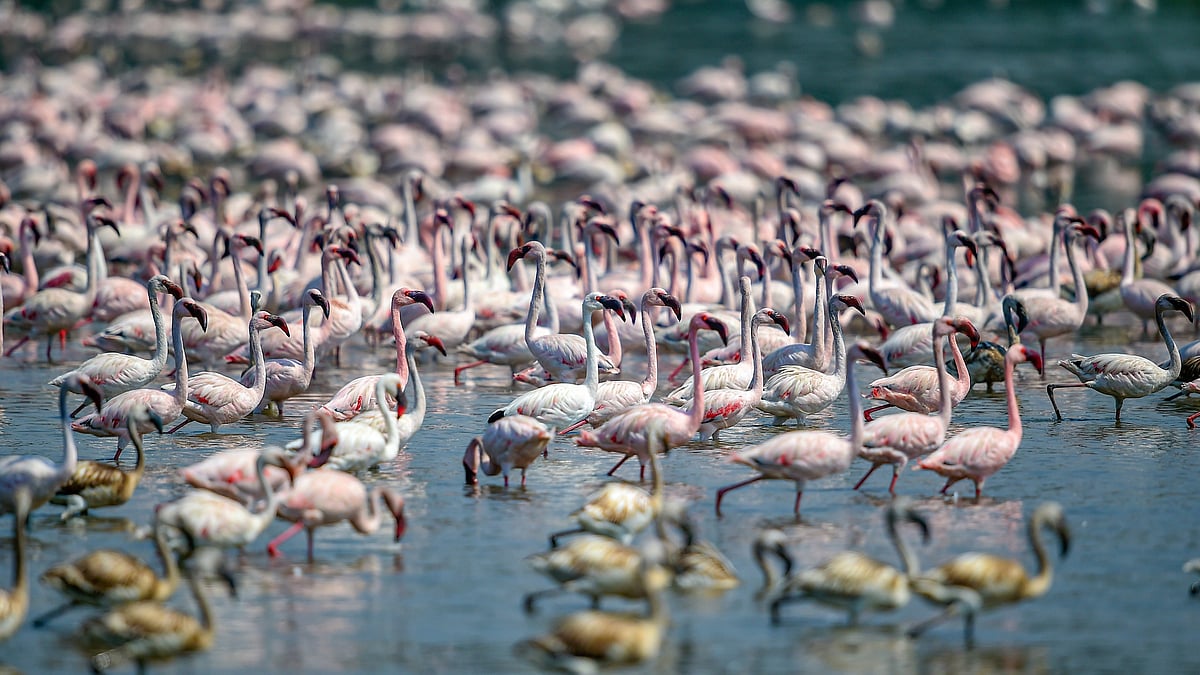
Laboratory tests on water samples from three wetlands in Nerul, Navi Mumbai, have revealed significant ecological degradation.
The affected wetlands—DPS Flamingo Lake, NRI wetland, and TS Chanakya lake—are crucial habitats for flamingos and serve as satellite ecosystems to the Thane Creek Flamingo Sanctuary.
According to Hindustan Times, water samples collected by the NatConnect Foundation and analysed at a Thane laboratory showed total dissolved solids (TDS) between 17,360 mg/L and 22,920 mg/L, far exceeding the 5,000 mg/L benchmark.
The pH level was above 9, indicating alkaline stress, while biological oxygen demand (BOD) and chemical oxygen demand (COD) values pointed to heavy organic and chemical pollution.
Field observations this season indicate a reduction in flamingo numbers using these wetlands during the migration period as coverage revealed.
Activists attribute this decline to both local stagnation and upstream pollution, including untreated sewage discharge observed along the Belapur–Vashi stretch of Panvel creek, with visible inflows near the NRI complex.
“These water bodies are showing clear signs of distress, with pollution levels far beyond what such ecosystems can sustain,” said Rekha Sankhala of the Save Flamingos and Mangroves Forum as reporting indicated.
BN Kumar, director of NatConnect Foundation, stated that the data points to a disruption in natural water exchange, allowing contaminants to accumulate instead of being flushed out by tidal action.
Environmental expert CS Jacob noted that elevated BOD and COD levels are consistent with degraded creek water quality, warning that unless the quality of incoming creek water improves, the connected wetlands will continue to deteriorate.
Activists have linked the deterioration to both restricted tidal flow and upstream pollution, including untreated sewage and possible industrial discharge as analysis showed.
Activists have dismissed suggestions that bird activity is responsible for the decline, instead pointing to sewage inflow and regulatory gaps.
Climate activist Nandakumar Pawar highlighted governance failures, stating that planning and regulatory lapses have contributed to the worsening situation as further details emerged.
“There has been little effective intervention despite visible degradation, and that has allowed the situation to worsen,” Pawar said.
Bittu Sahgal, founder of Sanctuary Nature Foundation, emphasised the broader implications, stating that the issue raises questions about environmental stewardship and could affect groundwater systems.
Pamela Cheema, an environmental activist, described the decline as deeply concerning, noting that these wetlands were once thriving ecosystems as highlighted in findings.
The issue has, reportedly, been escalated to the Prime Minister and the Maharashtra Chief Minister, with activists demanding restoration of tidal connectivity and strict checks on sewage discharge.
Meanwhile, the Navi Mumbai Municipal Corporation has initiated its own assessment, collecting samples from the identified wetland locations for laboratory testing.
Officials have stated that appropriate action will be taken once the findings are analysed, as authorities confirmed.
“What we are seeing is the cumulative impact of development pressures overriding ecological safeguards,” said Sandeep Sareen of the Navi Mumbai Environment Preservation Society.
Note: This article is produced using AI-assisted tools and is based on publicly available information. It has been reviewed by The Quint's editorial team before publishing.