
'With No Festivals or Elections Ahead, Yamuna's Foam Becomes a Non-Story'
Despite repeated promises, foam and froth continue to blanket large stretches of the Yamuna River.
advertisement
February 2026 is almost ending. In Delhi, there are no elections around the corner, no Chhath Puja approaching… and so, there is no urgency about the condition of the Yamuna, no heated debates, and no loud media outrage either. During this lull, I went to Kalindi Kunj, where the Yamuna River flowed silently, almost unnoticed… its pollution met with silence.
(Photo Credit: Majid Khan)
Large clusters of dense foam had accumulated beneath the bridge in Kalindi Kunj, spreading unevenly across the water’s surface. In several stretches, the river appeared visibly divided—one side carrying its dark natural flow, while the other was covered with thick layers of white froth drifting slowly with the current.
(Photo Credit: Majid Khan)
Along the banks, the foam had gathered in thicker patches. A sharp odour lingered near the riverbed. In the afternoon light, the froth appeared like accumulated detergent foam than scattered bubbles.
(Photo Credit: Majid Khan)
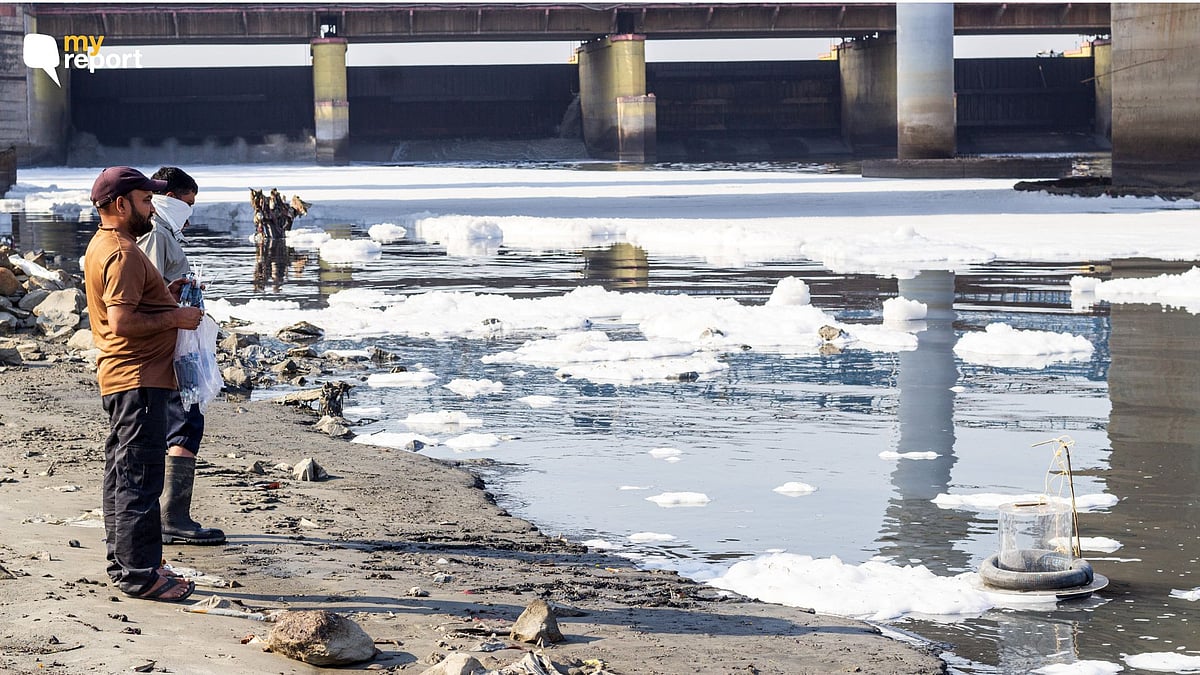
On the same stretch of the bank, I noticed two Delhi government employees testing the water quality using a handheld instrument.
(Photo Credit: Majid Khan)
I attempted to speak with them, but they declined to comment. Wearing just cloth masks, they continued their work. Their equipment included a syringe-shaped pump attached to a transparent sampling container. The water sample was drawn into the container, sealed, and then secured inside a protective case.
(Photo Credit: Majid Khan)
Many of the people living along the riverbank come from economically weaker backgrounds. Many come to the river to wash clothes, bathe, or clean utensils. Even as they complain about the foul smell and pollution, they admit that they have limited options. Relocating or finding better housing is not financially feasible for them, they say.
(Photo Credit: Majid Khan)
A report by the Parliamentary Standing Committee on Water Resources, tabled in March 2025, examined the water quality of the Yamuna’s Delhi stretch and highlighted untreated sewage as the major reason behind its poor condition. The panel found that 23 of the 33 monitored sites failed to meet basic water quality standards.
(Photo Credit: Majid Khan)
The Energy and Resources Institute (TERI), too, conducted a study on pollution in the Yamuna River in December 2025. The study identified untreated sewage, industrial effluents, solid waste, and microplastics as key causes of pollution. The study recommended upgrading sewage and effluent treatment infrastructure, among others, to curb pollution and improve water quality.
(Photo Credit: Majid Khan)
On 28 January, Delhi Chief Minister Rekha Gupta said that pollution in the Yamuna is a “legacy problem” caused by the negligence of previous governments. She said her administration is working on strengthening sewage infrastructure, preventing untreated discharge, and accelerating river-cleaning projects. Despite these assurances and policy announcements, visible progress remains minimal.
(Photo Credit: Majid Khan)
(All 'My Report' branded stories are submitted by citizen journalists to The Quint. Though The Quint inquires into the claims/allegations from all parties before publishing, the report and the views expressed above are the citizen journalist's own. The Quint neither endorses nor is responsible for the same.)
- Access to all paywalled content on site
- Ad-free experience across The Quint
- Early previews of our Special Projects
Published: undefined