‘Celebrating Our Tigers’: Can Music Make Us Feel Climate Loss?
The Bangash brothers turn India’s tiger landscapes into a musical journey of conservation, family, and legacy.
advertisement
“When you are doing projects of this nature, there is a canvas that is provided, and your idea is to kind of put your colours on that canvas, but you must keep the ethos of the painting alive,” says renowned Indian sarod player Ayaan Ali Bangash.
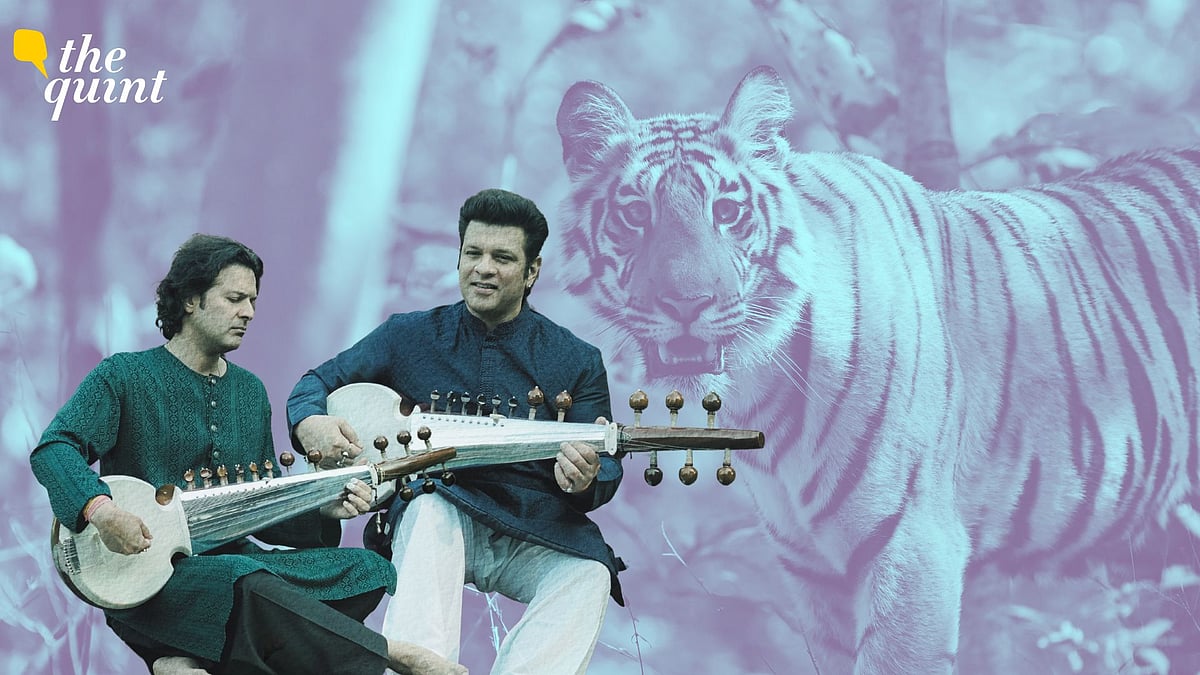
This time, the canvas they paint is India’s wild tiger. Following a string of successful global collaborations with bands and artists like Gorillaz and Yungblud, sarod maestros Ayaan Ali Bangash and his brother, Amaan Ali Bangash and have released Celebrating Our Tigers, a musical journey through some of India’s most fragile tiger habitats: Corbett, Bandhavgarh, Sundarbans, Kaziranga, Kabini, Ranthambore, and Pench.
The album, created in association with WWF-India, which has named the duo its Goodwill Ambassadors, arrives at a moment when tiger numbers in our country are rising steadily, even as human–tiger conflicts continue to increase.
What made the world-renowned musicians take on a project like this one?
When Amaan Ali Bangash and Ayaan Ali Bangash speak about Celebrating Our Tigers, they do not begin with studio anecdotes, but instead they talk about forests, their family and wildlife.
The Forest Has Its Own Music
The album’s emotional ignition point was their family. “It all started with my twins, who are 13, Zohaan and Abeer,” Ayaan tells The Quint. “In order to keep them earthy, real, grounded, and away from stereotypical fancy cars and the fancy everything in cities, I said, let’s go organic and go towards the wild.”
Before long, the family found themselves deep inside forests. “I never thought I’d be in the jungle for eight to nine hours a day,” he laughs. “But it was a learning process for my brother and I.”
His sons, Zohaan and Abeer, developed an obsession for tigers as well — memorising statistics, tracking histories and persuading their father to spend long hours in safari.
Inside the jungle something shifted. “You anyway feel very minuscule in front of the universe,” Ayaan says. “But when you are in the forest, the forest has its own music. It has its own sound. You realise how small you are as a specimen in a forest.”
Translating Geography Into Sound
The album is a sonic atlas of India’s tiger habitats, where each track draws from the folk idioms of its landscape.
“We were inspired immensely by folk music of every region because that is the most natural form of music in India. If you just listen to the music, you’ll know when you’re in Rajasthan, when you’re in Himachal, when you’re in Bengal, when you’re in Assam,” Ayaan explains.
The Kaziranga composition leans into Bihu with contributions from Assamese artists. The Sundarbans composition draws from Bhatiyali and Baul traditions of Bengal. There are sounds inspired by tunes from Rajasthan as well as on Ranthambore.
The Tiger May Be a Hero, But It Remains Vulnerable
“The tiger is there because the landscape is there,” Ayaan says. “It’s a give and take, the flora-fauna journey.”
India’s wild tiger numbers have been on the rise over the past decade, a conservation success story cited globally, but the habitats are still very fragile, and increasingly vulnerable.
“We are dealing with things like global warming,” Ayaan says. “I worry for the coming generations and if we can ever strike a balance between environment and our lives."
Dr Sejal Worah, Programme Director, WWF-India, notes. “Many of these landscapes face ongoing threats. WWF-India’s work to conserve these critical ecosystems and the wildlife within them will receive an added boost through the awareness created by this album.”
If he were to revisit this album half a decade from now, Ayaan’s wish is simple: “I would want the numbers (of tigers) to go way higher than today.”
Looking Ahead
Conservation is as much of a cultural work as it is a scientific labour and needs to be rooted in memory, ritual, pride, and art. “Music has this power to transcend borders, transcend regions,” Ayaan says. “It conveys a larger message of how we are one family as a human race. We are dependent on each other for everything and I think that realisation still needs to be tapped into.”
There is humility as well. “Sometimes we feel as if we did not choose the tiger, the tigers chose us.” Amaan adds.
(Sarthak Sharma is a music journalist who has interviewed many exciting acts including The Lumineers. He has previously worked as a bookseller and publisher.)