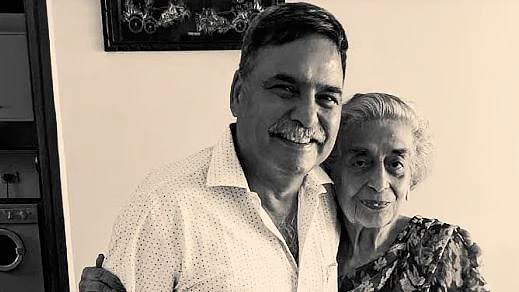
There are certain stories that need to be told. This little story defies boundaries of relationships and has in its essence untold grit, determination and stoicism to boot. It was while I was posted at a senior position in Mumbai that I got a call one fine morning from a woman who wanted to purchase a dishwasher from the Unit Canteen. With my curiosity aroused, I had a chat with the woman in question, who was an octogenarian, having had an association with the Indian Air Force (IAF), albeit short-lived, as her husband passed away in a fatal crash just a few years into their marriage, leaving her alone to care for their young daughter who was just a child at that time in 1955.
Tragedy Strikes Again
Our acquaintance turned into friendship and a deep-rooted bond that seamlessly segued her back to the Indian Air Force, the organisation with which she had many pleasant memories, notwithstanding the tragic and untimely demise of her spouse.
Even though there were many willing suitors seeking her hand from the fraternity in the blues, she had probably made up her mind, once bitten twice shy, that she did not want to get married to an Air Force officer again.
She met her partner, who was a gentleman to the core, scripting another chapter of her life that led to contended marital bliss with another baby girl joining the family. Her life continued with the girls growing up, doted upon by their parents and well-wishers, while the family continued to prosper and enjoy life like any other upper-middle-class family of Sobo, or South Mumbai. The elder daughter got married and settled in the US, while the younger one after finishing her studies also emigrated to the US, settling down with a good job over there.
The first signs of tragedy struck the family when the elder daughter, diagnosed with cancer in the US, passed away. As the years went by, the lady's husband suffered a stroke, restricting his mobility. The family continued to live life to the fullest, travelling as and when feasible, socialising, going to the club and mingling with friends. The younger daughter, now well-settled in the US, continued to visit her parents more than a couple of times a year, while they also made occasional trips across the continent, their health permitting. The spirit of the woman, always immaculately clad in a sari, with nail polish and lipstick and an unmatched joie de vivre and zest for life, would certainly put many youngsters to shame.
A Year-Long Quest For Pension
While our friendship and association grew, we moved on from Mumbai to Wellington and then to Delhi, where we finally dropped anchor. I happened to ask her once whether she was getting any pension from the Ministry of Defence, to which she said that she did get pension after her husband's death, though for a short while, as it had to stop as per extant rules when she remarried. The Government of India, having changed this policy a few years ago, ensured that the widow of a government servant was entitled to admissible family pension even on remarriage. I thought to myself that I need to make efforts to see whether I could accomplish this for my friend.
The exercise began in earnest with tracing the service records of the deceased husband to the bank account details where the pension was last credited more than six decades ago. The process was arduous to say the least, with a lot of paperwork and affidavits, observations from the Directorate of Air Veterans at Air HQ and the Principal Controller of Defence Accounts (Pensions).
With genuine help forthcoming from common friends and unknown well-wishers who pitched in, the Pension Payment Order, or PPO, was finally issued after more than a year's struggle.
Many Twists in the Tale
There were, however, many twists in the tale, as even before the pension orders were issued, the woman was widowed for the second time as her husband passed away in his sleep one night. The death occurred during the COVID-19 pandemic, and knowing the attachment of the daughter with her father, the woman decided not to reveal this news to her daughter as she would not be able to travel due to pandemic restrictions. International flights to the US remained suspended during the period and as the daughter would talk to her parents only on the landline or a basic mobile phone without WhatsApp or video calling facilities, the mother managed to keep this sad news from her daughter.
Left alone by herself, life dealt another terrible blow when her daughter in the US suffered a paralytic stroke. The travails of the lady did not seem to end as one could only empathise with her helplessness in the given situation. The efforts to bring her daughter back from the US with wheelchair support and a business-class ticket failed the first time as the airline refused to accept her responsibility for travel with COVID-19 restrictions in place at that time. She was sent back from the airport to the hospital with a four-hour painstaking journey in an ambulance with another COVID-19 test before they could re-admit her. Finally, a grand nephew of the late husband travelled to the US, just to escort her back to India. The mother and daughter, in each other's company, are finally happy to be together and living their life, with the daughter convalescing slowly with the active help and support of a physiotherapist.
Pain, trauma, agony, helplessness and loneliness are mere words that cannot describe what the woman has gone through in her life. In her ninety first year, her zest for life with an impressively concealed stoicism, is contagious. The laughter, humour and the equanimity with which one needs to live is indeed infectious and something that we can all learn from. From an innocuous phone call, to meeting and speaking every now and then with a warmth that is difficult to define, some relationships certainly transcend all boundaries.
(AVM Anil Golani is Additional Director-General, Centre for Air Power Studies. This is a personal blog and the views expressed are the author's own. The Quint neither endorses nor is responsible for them.)