Richard Zeckhauser, a political economy professor, once coined an antithesis to Murphy’s Law — the adage that anything that can go wrong will go wrong. His counter-proposition was elegantly simple: everything that can work will work. He called it Yhprum’s Law.
Cricket, perhaps more than any other sport, finds teams perpetually oscillating between Murphy and Yhprum. Consider the case of the Indian cricket team.
On 26 February, Thursday, a couple of matches were staged at the ICC Men’s T20 World Cup 2026. South Africa faced the West Indies in Ahmedabad’ Narendra Modi Stadium, followed by a meeting between India and Zimbabwe at the MA Chidambaram Stadium in Chennai.
Per Murphy’s Law, everything going wrong for India would have meant a defeat in their fixture, and a victory for the West Indies. Had that been the case, the defending champions would already be out of the semi-final race by now.
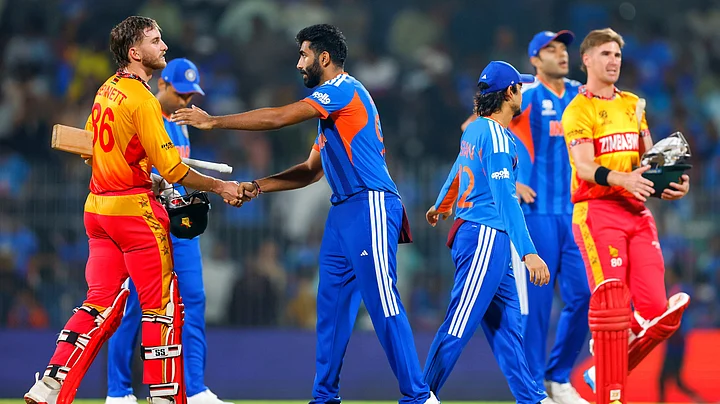
Instead, reality leaned firmly toward Yhprum’s Law. South Africa defeated West Indies, and India made light work of Zimbabwe, securing a 72-run victory. Scoring 256/4 after being asked to bat first, they restricted the Chevrons to a total of 184/6. Almost everything that could work in India’s favour, did work in India’s favour, who now will face West Indies in a virtual quarter-final, in Kolkata’s Eden Gardens on 1 March.
Here’s what went right for India in the fixture against Zimbabwe:
Abhishek Sharma Has Had Better Days With the Bat, but None as Relieving
Few players in this tournament have been subjected to scrutiny as intense as Abhishek Sharma. The attention was understandable — the world’s No. 1 T20I batter had managed just 15 runs in four innings, including two ducks. It will be unfair to blame both the journalists and fans, for the world’s number 1 T20I batter scoring only 15 runs in the first four matches, including two ducks, is as unusual as it is unexpected.
Throughout the ordeal, though, the Indian team management had stuck to a solitary justification for selecting Sharma time and again — that, a big knock from the opener is just around the corner. The corner was reached, and breached, today.
In the third over of the match, Sharma struck two fours and a six off Tinotenda Maposa’s bowling, thereby emphatically silencing debates about whether he might temper his natural aggression.
Sharma did get boundaries in the last fixture against South Africa as well, except on this occasion, he looked in complete command of his knock. He lost his opening partner, Sanju Samson, in the fourth over, and responded with a six and a four off Brad Evans in the very next over.
Sharma had scored eight half-centuries in T20I cricket prior to this fixture. All of those half-centuries came at a better strike rate than today’s. He had scored a couple of centuries as well, with one of them coming against this very opposition. Yet, in an Indian jersey, this might just be his most reassuring knock.
Sanju Samson Shows Why India Need Him
India’s all-left-handed top three had long appeared tactically awkward, yet dropping any one of them was never straightforward. Ishan Kishan has been in a rich vein of form ever since his return to the national team, Abhishek Sharma is the number 1 batter despite his three ducks for a reason, and Tilak Varma is India’s second-highest run-scorer in this format since 2025.
The real selection dilemma centred not on whether Samson would play, but at whose expense. The answer turned out to be Rinku Singh.
The southpaw has every reason to feel hard done by, for batting opportunities have never been in abundance for him. What is the reality, though, is that has been dismissed for a single-digit score in three of his last six matches.
The inclusion of Sanju Samson paid dividends — not because he scored 24 runs, but owing to the foundation he gave the team. In all of India’s last three matches, an off-spinner got a wicket in the very first over, be it Salman Ali Agha, Aryan Dutt or Aiden Markram.
Had it been either of Sharma or Ishan Kishan taking the strike for the first ball, Sikandar Raza could have rolled his arm over. But against Samson, who is among the stronger players of spin in the Indian squad, the Zimbabwean captain opted for Richard Ngarava, who conceded 13 runs in the first over. By the time Samson lost his wicket, India had already scored 48 runs in only 3.4 overs.
Tilak and Surya Score Runs, but More Importantly, at a Brisk Pace
Sharma’s ducks aside, a lot of the discourse had also been centered around the underwhelming strike rate of India’s middle-order pair — Suryakumar Yadav and Tilak Varma. Prior to this fixture, the former’s strike rate in this competition was 127.66, while the latter’s was even worse, at 118.89.
Those concerns will be emphatically dispelled after this match. Varma scored an unbeaten 16-ball 44 in this match, striking at a rate of 275.00. His captain was not miles shy either, scoring a 13-ball 33 at a strike rate of 253.84. This happens to be only the first instance where Varma played a 40+ run knock in T20 at a strike rate of over 260, while for Yadav, this was his third-highest strike rate among the knocks where he scored north of 30 runs.
No Concerns About Hardik Pandya
When a team suffers their biggest defeat at the T20 World Cup, in terms of number of runs, scrutiny is par for the course. Hardik Pandya could not evade it, despite having scored a half-century against Namibia earlier in this competition.
But his knock against Zimbabwe will help restore faith among the Indian fans, as the all-rounder struck a 23-ball 50. This happened to be Pandya’s ninth half-century in T20I cricket, and in terms of his strike rate (217.39), the second-highest after his 30-ball 71* against Australia in Mohali.
But There Is a Concern
But was everything on point for the Indian team? Not quite.
Indeed, the track prepared for this match was a belter, but India’s bowling could have been tidier. There will be concerns about Shivam Dube’s sudden dip in form with the ball. Having conceded 32 runs in two overs against South Africa, Dube leaked 46 runs in two overs today.
That aside, India will be content with the events of today, for a South African victory, followed by their own triumph, ensures that an inferior Net Run Rate (NRR) is now out of the equation unless there is a washout, and the match against the West Indies, which will be played in Kolkata’s Eden Gardens on 1 March, is now a virtual quarter-final.