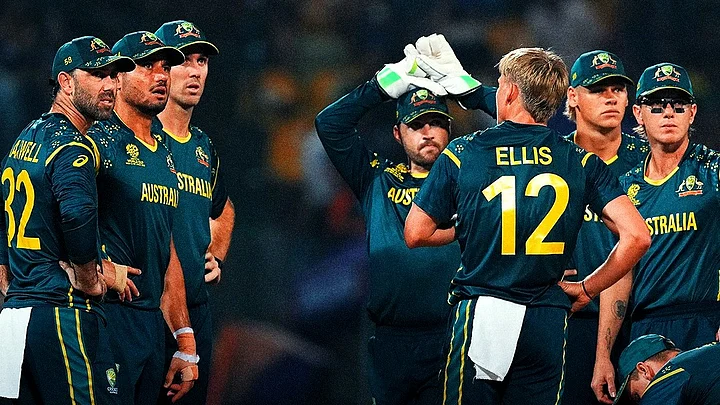
The Australian team could scarcely have imagined that they would all — not necessarily together, but all — find themselves praying that the match between Zimbabwe and Ireland is not washed out, desperately hoping that the famed “luck of the Irish,” a phrase synonymous with good fortune, would rescue them from looming embarrassment.
The 3-0 whitewash against Pakistan in the build-up to the ICC Men’s T20 World Cup 2026 might have quietly triggered the panic button, but because the team in question was Australia, its frailties were largely overlooked. Now, they have been. Australia lay bare, stripped of its usual sheen, aura and glory.
On Monday, 16 February, Sri Lanka defeated Australia by 8 wickets in Kandy. And today, Zimbabwe's match against Ireland in Pallekele was abandoned without a ball being bowled. The true significance of these two results lie in the Group B standings, where Australia languish in third place with just two points from three matches. Their ceiling is now four points, while Zimbabwe have already secured five points, which ensure them a place in the Super 8.
At the post-match presentation, Australian captain Mitchell Marsh acknowledged that his team is now in the lap of gods, and that the defeat has left him devastated. The gods have often been kind to Australia, but not on this occasion.
But, how did it come to this? How does the world’s third-ranked T20I side find itself eliminated from the group stage itself?
1. Poor From Spinners, Even Worse From Pacers
Bowling has proven to be Australia’s Achilles’ heel in this competition. At the R Premadasa Stadium in Colombo, where scoring runs pose an incredible challenge unless your name is Ishan Kishan, Australia conceded 169 runs against Zimbabwe. Against Sri Lanka, matters deteriorated further, as they leaked 184 runs in just 18 overs.
Historically, Australia have rarely struggled to locate a part-time option to complement Adam Zampa’s leg-spin in major tournaments. At the 2023 ODI World Cup, for example, Glenn Maxwell was Australia’s man with the golden arm, picking up 6 wickets.
Yet in this competition, Zampa has found himself isolated, bereft of meaningful support. Maxwell has only bowled three overs and conceded 30 runs, while Cooper Connolly, the youngster from whom Australia had high expectations, went wicketless in his six overs and conceded 8.83 runs per over.
A similar story can be seen in Australia’s pace unit. Nathan Ellis, expected to spearhead the attack, has performed respectably, but Ben Dwarshius, Xavier Bartlett, and Cameron Green have failed to contribute sufficiently to establish sustained pressure with the ball.
2. Green, David, Maxwell — Enormous Expectations, Negligible Returns
Within their ranks, Australia have the two most sought after players in T20 cricket across the globe — Cameron Green, for whom Kolkata Knight Riders happily spent Rs 25.20 crore at the Indian Premier League auction, and Tim David, who Dinesh Karthik told The Quint will become among the best batters in the world.
Both have been massively ineffective in this competition, Green scored 24 runs at an average of only 8, while David has scored 6 at an average of 3. With Glenn Maxwell added to the pair — 62 runs at an average of 20.66, but an underwhelming strike rate of 110.71 — Austrakia have gotten 76 runs from their middle-order trio.
3. For How Long Will Australia Rely on Veterans?
Be it the T20 World Cup in 2021 or the ODI World Cup in 2023, almost all of Australia’s triumphs at the global stage in recent years have had three recurring names — Mitchell Starc, Josh Hazlewood and Pat Cummins.
The first name on the list announced his retirement from T20 cricket last year, for he wanted to focus on Test and ODI cricket. Hazlewood was initially expected to play a major role in this T20 World Cup, but he never recovered from the Achilles’ injury he sustained during the Ashes. Cummins, on the other hand, faced a setback on his journey of recuperation from a back injury, and could not board the flight to Sri Lanka.
Moreover, captain Mitchell Marsh also had to sit the Zimbabwe match out owing to an injury sustained in training, whereas Marcus Stoinis could barely bat after being hit in the hand off his own bowling.
Absent this cascade of injuries, Australia might well have secured at least a Super 8 berth. Yet with Hazlewood and Cummins aged 35 and 32 respectively, Marsh at 34, and Stoinis at 36, Australia entered this tournament with one of the older squads in the competition. It is highlighted by their replacement option for Hazlewood — a 36-year-old Steve Smith.
The inability to find replacements for stalwarts might mean that Australia, in this particular format of the game, are now staring at a period of uncertain transition.