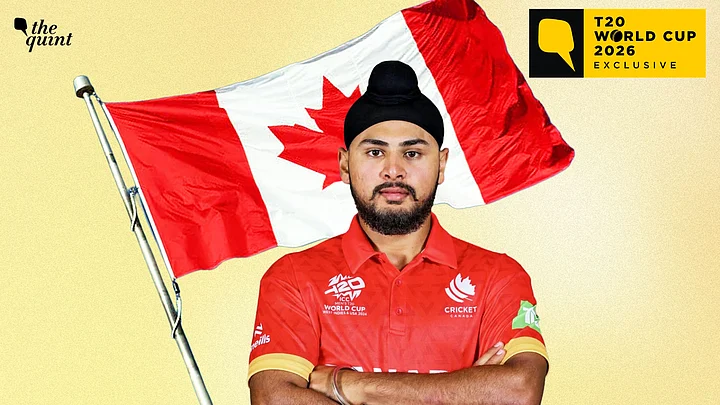
Except the 15 players who are representing India at the ongoing ICC Men’s T20 World Cup 2026, there are 40 cricketers — dispersed across multiple teams — who share some form of connection with India.
The recurring theme, on most cases, is that of how lack of opportunities and an insane level of competition drove a player out of India, to a nation where chances of selection are significantly higher, and how, in hindsight, the decision proved vindicated.
Except, Dilpreet Bajwa’s case is different. The 23-year-old captain of the Canada national team was once the leader of the Gurdaspur district team, and was playing alongside the likes of Abhishek Sharma, Arshdeep Singh, Naman Dhir and Harpreet Brar.
Bajwa had even been assured that his maiden Ranji Trophy cap was imminent, having impressed selectors through a string of consistent performances in inter-district tournaments and Punjab Cricket Association camps.
Though, destiny had other plans. Bajwa had to leave for Canada — where his father runs a trucking business — for urgent paperwork. He assumed that he will return in a few weeks, but was stuck during the COVID-19 lockdown.
Having continued his cricketing journey in Canada, he is now the nation’s captain at the global stage, at just 23 years of age. The Quint engaged in a candid and exclusive conversation with Dilpreet Bajwa. What follows are excerpts from that interaction:
Tell us why you started playing cricket in the first place.
I grew up in Batala, which is on the India-Pakistan border. There is a drug crisis all over Punjab, and the problem is even more severe in border areas. My father wanted to ensure that I do not fall prey to drugs. Being an avid fan of cricket, he thought that this sport can be a way to avoid the wrong path, so he got me enrolled to an academy when I was seven.
Did you idolise any cricketer growing up? And, have you had the opportunity of meeting your idol?
Yes. The first memory I have is from this tournament only — the 2007 T20 World Cup, where Yuvi paa hit six sixes. It was inspiring to see a guy from Punjab doing that for India. He inspired me to become a cricketer. I got a chance to meet him as well. He had come to Mexico to attend the wedding of teammate, Ravinderpal Singh. Yuvi paa shared his drills that he used to develop Abhishek Sharma and Shubman Gill, and asked me to practice those. It was a dream come true moment for me.
What was the turning point in your career?
The turning point was a game against Patiala in the U19 level. There’s a saying that if you want to make it big in Punjab cricket, you have to show your talent against Patiala. The reason is that majority of Punjab’s renowned players are from Patiala. They had pacers who were already done the NCA camps, so Patiala prepared a green-top wicket to trap us. We had a collapse, but then I scored 136, and we ended up winning by an innings. At the time, it was a huge achievement, because no one expected Gurdaspur to give Patiala an innings defeat.
So, how did Gurdaspur's prodigy ended up in the Canadian national team?
Canada happened purely by accident. Because of my knock against Patiala, I was called up for a camp of Ranji Trophy probables by the PCA, at the Mullanpur Stadium. It had just opened and the wicket was fresh, so no batter was being able to score big runs except two. One was Naman Dhir, who is now doing well for Mumbai Indians, and the second one was myself. I was told that my Ranji Trophy selection is just around the corner. But at the same time, I had to go to Canada for some paperwork as my father was already there. I remember Harpreet Brar and Nikhil Chaudhary, who’s now in Australia, telling me not to go. But I thought I will be coming back soon. As luck would have it, I reached there and the COVID lockdowns were announced, so there was no way for me to return to Punjab.
Did you not think of returning when the lockdown was eased?
By the time world returned to normalcy, I had already established myself in Canada. I started playing for British Columbia, and in my first domestic tournament here, I won the Best Batter Award and the Most Valuable Player Award. My parents said that since my cricketing journey can be continued in Canada, there’s no need to stay alone in Punjab. Hence, I made the decision.
How did you progress, from Canada's domestic structure to the national team?
Because I was doing well in domestic cricket, I got a chance to play at the GT20. I played for Montreal Tigers under Dave Whatmore, whose influence on me has been huge. After that, I also played Minor League Cricket in the USA. I was consistently scoring runs, and then suddenly, coach Pubudu Dassanayake called me one day and said that I’ve been selected for the national team.
Are there any influences from your GT20 days which has had a role in honing your skills?
I will always be grateful for two players that I met during the GT20. Firstly, my captain, Shakib Al Hasan. We all know that he is a great cricketer, but beyond that, he is a great human being, too. He always treated me as his brother. I would say that Shakib to me has been the mentor that Yuvi paa has been to Abhishek and Shubman. And secondly, Chris Gayle has also motivated me a lot, and told me I’m made for the big stages. He was once so impressed with my batting that he asked me for my bat. Usually it is the other way round — we ask legends for their bats, but Gayle was unique.
You turned 23 only three weeks ago — this is a very young age to lead a team in a tournament like the T20 World Cup. Have you faced any pressure?
Captaincy does not faze me at all. I was made the captain of Gurdaspur district at a very young age, and since then, I have captained one team or the other. Here in Canada, I have been leading my domestic team since the last four years, and I have won a trophy in every season. Fortunately enough, I have got a lot of senior guys around me to guide me in every step of the way, so there has not been any pressure at all.
Going back to your playing days in India, did you get a chance to play with any of the players of the current Indian team?
The likes of Abhishek Sharma and Arshdeep Singh were my teammates in the U-23 level. feel proud when I see that the players I have grown up with are now playing for India. I remember how Punjab were not giving much chances to Arshdeep, because his pace was not up to the mark. He grinded alone in Chandigarh day in day out to become the bowler that he is today. I remember how Abhishek would come to the Gandhi Ground in Amritsar everyday with his father and some bowlers, and then bat all day long.
Are you still in touch with any of your teammates from Punjab?
I am still in touch with Arshdeep. In fact, just before the T20 World Cup, I was telling him that it would have been amazing if India and Canada were in the same group. Unfortunately, we were in India’s group last time around, but the game did not happen because of rain. Arsh was telling me that hopefully, we will be in the same group in the next edition.
What would Canada like to do at this T20 World Cup?
We were dealt with a difficult group, if you look at it. Three teams from our group played in the Super 8 last time, so you can understand how challenging it has been. But regardless, our target is always to be competitive and give a good account of ourselves. It is always exciting to play against the likes of South Africa, because you don’t get to play with them everyday.
Personally, which players are you eager to have a battle against?
Quinton de Kock has always been my dream wicket, so it felt amazing to get him out in our match against South Africa. Now, I am really looking forward to the match against Afghanistan. The reason being — we have been told often that Rashid Khan’s googly is the toughest to pick. So, I just want to experience that challenge and see if I can pick up. Besides that, I am also eager to face Mitchell Santner in our match against New Zealand.