
ADVERTISEMENTREMOVE AD

The US Attack on Venezuela Ought to Be Condemned—But Wasn’t

The pusillanimous responses of much of the world might encourage Trump, if he does intend to redraw the global map.

Published
story-hero-img
i
Aa
Aa
Small
Aa
Medium
Aa
Large

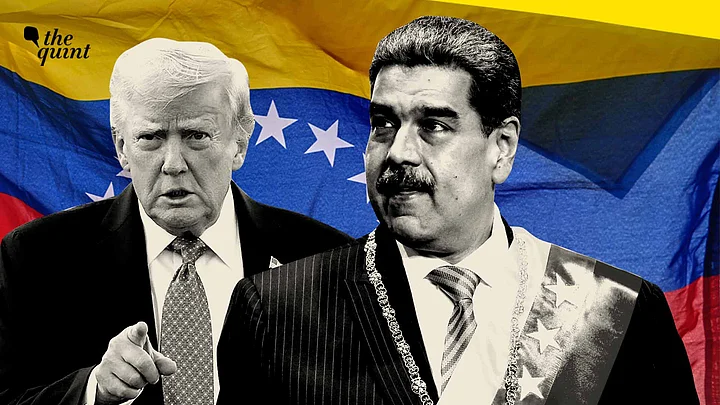
As if the invasion of Venezuela and the abduction of its President, Nicolas Maduro, and his wife Cilia Flores, were not enough, US President Trump indicated on Sunday that he was not done yet. The Venezuelan Vice President and current acting President Delcy Rodriguez could be next, he said, and so could the president of Colombia next door. 

Rodriguez will surely be targeted after she said over the weekend that the attack on her country had an “undoubted Zionist tinge.” She has a revolutionary background of the (former President) Hugo Chavez brand. As if on cue, Trump told reporters on Sunday, “Maduro gave up immediately. His Vice President is next.”

Similarly, Colombian President Gustavo Petro seemed to have painted a target on himself by talking of “a bunch of pedophiles” killing “our fishermen” to stop a list from emerging. He seemed to be referring to the Epstein list while responding to the US actions in adjacent Venezuela.

ADVERTISEMENTREMOVE AD

International Law Thrown Aside

It seems as if international law and sovereign territories have ceased to have meaning. Indeed, Trump recently repeated his intention to take over Greenland, saying, “We need Greenland for national security… We have to have it.” He had begun this second term in office a year ago by demanding Greenland and even Canada. 

His plan for the Americas evidently goes way beyond that of James Monroe, who presided over the US for eight years until 200 years ago. Monroe wanted Spain, Portugal, and other European powers—which had colonised the Americas over the previous two centuries—to keep away henceforth. Trump evidently envisages US control over key portions of those continents.

One has to wonder if Trump has a fresh arrangement of spheres of influence in mind. If so, it should worry Indian strategists. For the eastern half of Asia might then be treated as China’s sphere. 

Scant Condemnation

The pusillanimous responses of much of the world might encourage Trump, if he does intend to redraw the global map. Indeed, Austrian Foreign Minister Beate Meinl-Reisinger bluntly tweeted that the European Union (EU) is turning into “An impotent plaything, which the nationalists in Europe want to make us into!” German Chancellor Friedrich Merz tweeted that “The legal assessment of the US intervention is complex and needs careful consideration.”

Many Western countries went out of their way to point out that they had not recognised Maduro’s legitimacy.

In fact, relatively few countries condemned the Presidential abduction. Cuba and Mexico were predictably among those that did—either could be next! So were China, Brazil, and South Africa. Latin American reactions ranged from Colombia's tough talk to Peru’s President Jose Jeri welcoming the invasion. 

Like that of many others, India’s reaction was restrained: “…A matter of deep concern. We are closely monitoring the evolving situation. India reaffirms its support to the well-being and safety of the people of Venezuela. We call upon all concerned to address issues peacefully through dialogue, ensuring peace and stability of the region.”

Shifting Geopolitics

The invasion came amid a global shift: Europe is dissipating, while China emerges as a global power. A senior Chinese envoy had just met Maduro a little before he was abducted. There could be a message in that timing. Plus, US Secretary of State Marco Rubio’s talk on Sunday of an “oil quarantine” indicated that the US wants to prevent Venezuelan crude from benefiting China’s growth trajectory. 

Though the US imports a lot of crude, it has a lot of reserves too. On the other hand, China’s oil needs are entirely imported. Now that it controls the world’s biggest oil reserve (Venezuela has more than the Saudis), it can squeeze China, which gets 40 per cent of Venezuela’s oil exports.

However, China will not be drawn into a war at the current time, and certainly not across the Pacific—as Japan so dramatically and unsuccessfully tried to, by attacking Pearl Harbour in 1941. Russia and Iran, Venezuela’s other notable allies, are both engaged in their own defence/offence.

Indeed, it’s quite possible that Trump counts on Russia’s acquiescence, since Trump has recently leaned heavily on Ukraine to not only stop fighting Russia, but to cede territory, stay out of NATO, and downscale militarily. That’s a sweet deal for President Putin.

No wonder Russia, ostensibly a backer of Maduro, only said that, “The US committed an act of armed aggression against Venezuela, which gives rise to deep concern and warrants condemnation. The pretexts used to justify these actions are untenable.” Saying it “warrants condemnation” seemed to leave a question mark over whether Russia actually condemns it.

In tune with Western Europe, Ukraine’s Foreign Minister Andrii Sybiha stated that, “Ukraine has consistently defended the right of nations to live freely, free of dictatorship, oppression, and human rights violations. (But) The Maduro regime has violated all such principles in every respect.”

Back-room Pact Speculated

A factor that may lie behind the restrained reactions is that speculation was rife over whether the operation was part of a deal.

Tongues wagged over the weekend at the “surgical precision” of Maduro’s smooth abduction, and the lack of subsequent warfare other than widely televised dramatic bomb explosions that night—despite announcements by vice-presidents and ministers that Maduro had already instructed all the people and forces of Venezuela to take to the streets for the country’s defence. 

Sky News even quoted “sources inside the Opposition” to say they believe Maduro's capture was a "negotiated exit.” Some said it was “a reshuffle, not a transition,” since key members of the administration remained. Other analysts refined this, saying the remaining leaders would now accommodate the US—and may have given Maduro up to the US. 

Another view was that these leaders would be replaced after fresh elections by opposition leaders such as Edmundo González, who many believe actually won the 2024 elections, or even by openly pro-US leaders such as Nobel Peace Prize awardee Maria Corina Machado.

Both kinds of analysts held that retaining most of the government would allow stability and obviate violence.

However, the story may not be over yet. 

(The writer is the author of ‘The Story of Kashmir’ and ‘The Generation of Rage in Kashmir’. He can be reached at @david_devadas. This is an opinion piece and the views expressed above are the author’s own. The Quint neither endorses nor is responsible for the same.)

Speaking truth to power requires allies like you.
Become a Member
Monthly
6-Monthly
Annual
Check Member Benefits
×
×