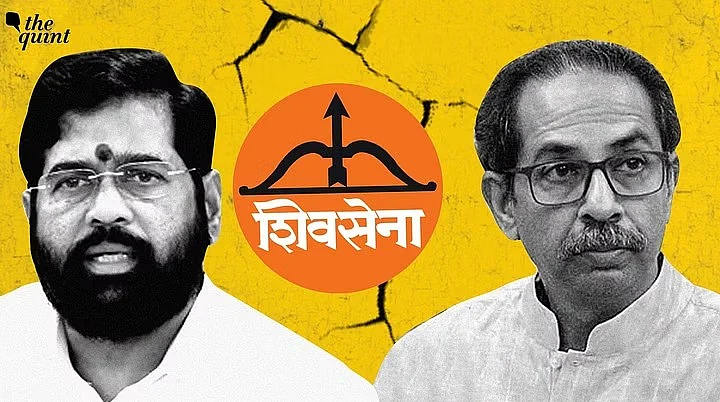
There is an old Marathi saying: 'Vagh mhanle tari khato, vaghoba mhanle tari khato’.
It transliterates into something like this: "Any attempts to appease the tiger are of no use. Ultimately, the sheep is bound to end in the stomach of the king of the jungle, whose writ runs."
This ditto applies to the current political situation in Maharashtra, where the resurgent Bharatiya Janata Party (BJP) is in the driver’s seat, both in the premier state and at the Centre, as if almost declaring, "I am the monarch of all I survey; my right is for none to dispute."
Ironically, the undivided Shiv Sena under its late founder, Bal Thackeray, as well as the present one led by his son Uddhav Thackeray, are known by their tiger symbol, once aimed to signify its raw power as it fought for the Marathi Manoos.
Things have taken a dramatic turn since the advent of Narendra Modi on the national stage in 2014, with the Shiv Sena going from the senior partner in its alliance with the BJP to the junior partner and, eventually, a marginal force.
The Reversal of Power
Politics is a ruthless game, and in Maharashtra, the roles have drastically reversed. The BJP has now become the ‘tiger’ whose writ counts, while the Sena (UBT) has become the 'sheep'.
Hence, the split in the Shiv Sena (UBT) parliamentary party (which is in the making) did not surprise anyone. For now, it may have run into some obstacles, but many observers believe it is only a matter of time.
The perception in political circles is that once a move has the backing of Union Home Minister Amit Shah, it gathers considerable momentum in Maharashtra.
There seems to be more than just animosity between Shah and Uddhav since he broke ranks with the BJP and joined hands with the Congress and Sharad Pawar to form the Maha Vikas Aghadi (MVA) government in 2019. The move was termed a betrayal by the BJP, which has since been baying for the blood of the former CM. "If you rile a tiger, he is going to show his claws."
So, the ‘Operation Tiger,' or what is being enacted, has been scripted by Shah, while being aided and abetted by the Deputy Chief Minister Eknath Shinde, the bête noir of Uddhav, who owes his rise in state politics to the mentorship of the powerful Home Minister.
A Split in the Making
Among the six out of Uddhav's nine MPs who want to defect, a majority are Marathas.
As Maharashtra's dominant political community, the Marathas have historically remained closely aligned with centres of power. It was calling the shots for decades when Congress was the numero uno.
For the community, power is an ideology. And that is why they are closer to the party/leader, which can ensure power and protect their sugar mills, educational institutions, power in cooperative sector, including banks and get their ' share' in local developmental works.
Besides, it is a fact that the rising expectations and ambitions among leaders in the premier state have turned them to be on the side of the ruling establishment for pelf and power.
Shiv Sena (UBT) leader Sanjay Raut’s charge—that the MPs, whose worth is not even Rs 50,000, have sold themselves for Rs 50 crore—reflects the general feeling that a politician generally crosses over to the ruling side for some consideration. "There are no Raja Harischandras in politics."
The Limits of the Thackeray Brand
The problem with the Thackerays—both Uddhav and his son Aditya—has been that they remained engrossed in the Thackeray brand, in the mistaken belief that they carry the aura and influence of the flamboyant and fiery founder, who ruled from the ‘Matoshree’ without stepping outside the residence. Bal Thackeray’s word was virtually the law.
Shiv Sena has never been a well-knit political organisation. It was run by its founder with the help of the 'Shakha Pramukhs' (local party chiefs) in respective areas where loyalty was the main consideration and caste and creed were never taken into consideration.
In the changed scenario, Uddhav failed to bring either fresh blood or ideas to the organisation, nor was he seen going the extra mile to spread the network in the past nearly two decades.
Bonhomie between the MPs of the two Shiv Sena factions was visible even before the attempts for a split in the parliamentary party began. Most MPs want to remain with the party in power for a number of reasons. Shrikant Shinde, son of Eknath Shinde, being an MP, has been instrumental in building the bridges.
Right or wrong, many MPs appear to have concluded that the party's prospects are limited in its present form, even if Uddhav and the Maharashtra Navnirman Sena (MNS) chief, Raj Thackeray, come together. Their unity did not help in winning the key Brihanmumbai Municipal Corporation (BMC) elections. These MPs are believed to be seeking political relevance and access to power that comes from proximity to the ruling establishment.
The MVA in Maharashtra, comprising Congress, Sharad Pawar's NCP and Uddhav's Shiv Sena, is a loose combination and has been weakened due to the defeat in the Assembly polls some 18 months ago.
Who Owns the Jungle Now?
The two factions of Shiv Sena cannot come together or merge for the simple reason that the Thackerays cannot play second fiddle, and Shinde wants to finish them politically.
The party's best chance of survival, some argue, may lie in a rapprochement with Narendra Modi and the BJP, which can accommodate the two factions of Shiv Sena.
Buoyed by its success in tearing apart the beleaguered Mamata Banerjee's Trinamool Congress in Parliament, the BJP has now embarked on “Operation Tiger."
Playing in tandem with the BJP, Shinde has emerged as a leader in his own right and has left no stone unturned to marginalise Uddhav and his party in Mumbai, the Konkan region, and Marathwada, once the strongholds of the undivided Sena.
As of now, media reports suggest that the split has been put on hold ahead of the party’s 60th foundation day celebrations on Friday.
Uddhav's exasperated remark that those who want to leave the party can do so, nevertheless, suggests a leader increasingly resigned to the possibility of further defections.
The same political churn could soon play out in the Maharashtra Assembly and the Brihanmumbai Municipal Corporation. Whether that process has already begun behind the scenes remains to be seen.
(Sunil Gatade is a former Associate Editor of the Press Trust of India. Venkatesh Kesari is an independent journalist. This is an opinion piece and the views expressed above are the authors' own. The Quint neither endorses nor is responsible for them.)