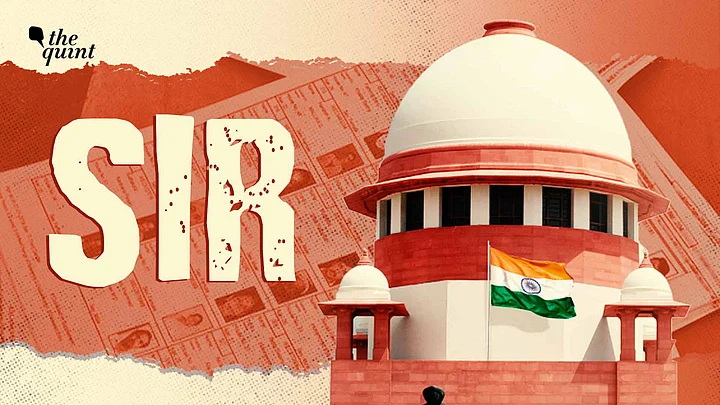
The latest news (read noose) of judicial deference to executive fiat arrives packaged as the Special Intensive Revision (SIR) of electoral rolls. The Supreme Court’s affirmation of the Election Commission (EC)’s authority to conduct the SIR effectively institutionalises a process in which the rhetoric of “eligibility verification” becomes a veneer for redefining political representation.
Presented as a benign administrative safeguard, the SIR is ostensibly designed to ensure that no eligible elector is left out and no ineligible elector is included. But behind this technocratic justification lies a far more consequential reordering of political belonging.
A Question Over Belonging: Citizen or Not?
What began as bureaucratic scrutiny of voter eligibility in Bihar has now been extended to multiple states and Union Territories. If any lesson is to be drawn from the Bihar exercise, it is that much deeper questions demand attention: Who belongs? Through what administrative and legal mechanisms does the state determine who qualifies?
My reading of these developments points to five key reasons why the court’s current approach is insufficient, if not outright damaging.
First, the SIR shifts the burden of proof from the state to the citizen.
By making access to and possession of identity documents a precondition for electoral inclusion, the SIR imposes an unequal test, felt most acutely by those least able to navigate it. It transforms parts of the electorate into “suspect voters,” whose legitimacy must be re-established rather than presumed. Migrant workers, religious minorities, residents of informal settlements, and populations at the edges of urban planning remain the most vulnerable to this inversion of constitutional presumption, as recent reportage has underscored.
Second, this shift weakens the presumption of citizenship itself and places the individual under implicit suspicion.
By setting stringent definitions of “eligible” and “ineligible” voters, the EC is poised to recast citizenship. What the Constitution conceived as an inherent right of every adult citizen has now been reframed as a conditional verification process. The SIR does not merely correct a clerical list; it instructs people on how to inhabit the category of “voter.”
While the EC does not formally determine citizenship, the practice nudges it into that role, demanding documentation that goes beyond identity verification. Even as the Supreme Court has clarified that citizenship questions fall squarely within the purview of the Ministry of Home Affairs, the SIR’s operational logic blurs this boundary. In this sense, the process bears the imprint of a backdoor National Register of Citizens (NRC), heightening documentation demands in ways that disproportionately burden specific groups, making administrative verification a surrogate tool for political classification. The SIR performs a function eerily similar to the NRC exercise in Assam—ironically monitored by the Supreme Court itself. Much like the NRC, which differentiated “genuine” from “doubtful” citizens, the SIR classifies voters into “eligible” and “ineligible.”
A Poll Gambit: Telling the Electorate Who's in Charge
Third, the timing of the SIR heightens its political implications.
In Bihar, the process was launched on the eve of state elections, illustrating how revisions can be strategically deployed. According to the EC’s final roll update, between June and the publication of the final rolls, the number of registered voters decreased from approximately 7.89 crore to 7.42 crore—a staggering reduction of nearly 47 lakh names, while 21.5 lakh new voters were added.
The scale and pattern of deletions have raised alarm among observers and Opposition parties. In several constituencies, the number of voters removed exceeds the victory margins in the recently concluded legislative Assembly elections. What was presented as an administrative “clean-up” appears instead to have functioned as a significant recalibration of electoral representation. It is not coincidental that the SIR has been extended to states and UTs where elections are due.
Fourth, while the court has introduced minor safeguards, they remain procedural rather than structural.
In the Bihar case, it directed the EC to accept Aadhaar as an additional identity document and to publish district and booth-wise deletion lists. Yet, it simultaneously held that Aadhaar does not prove citizenship or electoral eligibility. In other words, the court tinkers at the edges of process without engaging with the deeper question of who is being subjected to scrutiny—and why?
Fifth, what should have been a routine revision of electoral rolls has instead become a state-led exercise in disciplining the electorate.
Bihar had already undergone a summary revision six months earlier, yet the SIR reopened the process for an intensive scrutiny. What appears as a technical or bureaucratic intervention, in fact, functions as a political technology of classification—echoing colonial governance, where census, survey and identification exercises were used to institutionalise constructed categories of caste, race, tribe and religion. Through the SIR, a similar logic resurfaces: separating “eligible” from “ineligible” voters, “insiders” from “outsiders,” and “citizens” from populations rendered “suspect.”
Need to Look Beyond Procedural Lapses
Thus, when judicial scrutiny is limited to whether the EC has followed statutory procedure, it sidesteps the deeper political implications of that very procedure. Disenfranchisement does not always emerges through overt exclusion but also through neutral-seeming administrative criteria.
While the SIR may be technically permissible under electoral rules, its operational logic mirrors colonial governance, where ostensibly objective norms conceal politically motivated categorisations.
What is being revised, therefore, is not just the electoral roll, but the boundaries of political belonging itself.
Whether the Supreme Court recognises this will determine not only the outcome of the present case, but the future contours of democratic belonging in India, given the tumultuous history of partition. The legal process must resist naturalising what is historically constructed.
(Burhan Majid teaches legal and constitutional theory at the School of Law, Jamia Hamdard, New Delhi. He tweets at @burhanmajid. This is an opinion piece, and the views expressed above are the author’s own. The Quint neither endorses nor is responsible for the same.)