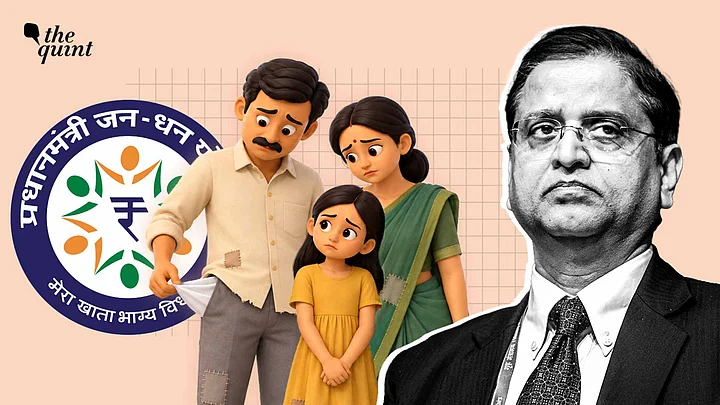
The Narendra Modi government celebrated 12 years of Pradhan Mantri Jan-Dhan Yojana (PMJDY) last month, lauding itself for 59.09 crore jan-dhan accounts (JDAs) opened as of 19 August, with "32.92 crore female beneficiaries". The government also highlighted an approximate 20 times surge in deposits—from Rs 15,670 crore in March 2015 to Rs 3.16 lakh crore on 19 August 2026.
In a press release, the government claimed that PMJDY had transformed financial inclusion into a "lived reality for millions of Indians" by providing "expanded access to banking", strengthening "financial security", and connecting "unconnected citizens with credit, insurance, pensions, and digital payments".
The inactive JDAs (which had no customer-induced financial or non-financial transaction for a continuous period of 24 months), however, are rising menacingly. Most JDAs are not being used for UPI payments as well.
While the government calls PMJDY a "game-changer", it publishes no information on inactive JDAs and their use for UPI.
The government runs many schemes for disbursing cash through the JDAs to numerous types of beneficiaries, including PM KISAN (Rs 6,000 a year to about 10 crore farmers) and the Viksit Bharat-Guarantee for Rozgar & Ajeevika Mission (Gramin) (VB-G RAM G).
A large number of JDA holders do not even withdraw cash disbursed in their accounts. Many only withdraw the cash deposited while not carrying out any other transaction.
So, do JDAs only serve the purpose of receiving direct cash disbursement from the government? Do large number of inactive accounts indicate cash transfers to non-existing and fake beneficiaries? Are increasing JDA deposits trapped government funds? Is PMJDY and the JDAs stunted and in need of a redo?
Jan-Dhan Accounts are Weaklings
The JDAs, under the Reserve Bank of India (RBI) rules, require no minimum deposit to open and maintain the account (or they are zero balance accounts). These accounts earn interest at normal savings bank interest rate.
A RuPay debit card is almost always issued with the JDA (41.29 crore RuPay debit cards as of 19 August). There is also an accident insurance cover of Rs 2 lakh for these accounts (and Rs 1 lakh for accounts opened before 28 August 2018). An overdraft facility of up to Rs 10,000 is also provided to eligible households after six months of satisfactory performance.
However, there are some restrictions. The JDA holders cannot maintain another regular saving bank in the same bank (they can do in other banks).
Many JDAs, categorised as "small accounts" (actual number not disclosed) as their KYC hasn't been completed, are subject to additional restrictions: maximum balance cannot exceed Rs 50,000 at any point, annual credits cannot exceed Rs 1 lakh, and monthly withdrawal/transfers capped at Rs 10,000 per month.
The PMJDY progress report, published by the Department of Financial Services (DFS), informs that of 59.3 crore JDAs as on 16 September:
46.71 crore (or 79 percent) accounts are in public sector banks
11.13 crore (or 19 percent) are in regional rural banks
0.19 crore (0.03 percent) in rural cooperative banks
Private sector banks had only 2.26 crore (4 percent) accounts
Almost all JDAs are in the government-owned banks. Most JDA holders maintain a regular saving bank account in private sector banks or in other public sector banks.
The JDAs are quite a weakling functionally. They are being used largely to receive the government cash transfers—and not for doing banking transactions or their financial inclusion.
Inactive Accounts
The RBI compiles all kinds of banking data. It also collects the data relating to total and inactive JDAs. However, it does not publish the data of inactive JDAs. Such information has to be painstakingly accessed by the people through parliamentary questions or the Right To Information (RTI) applications.
In response to unstarred Lok Sabha question no 2304—answered on 3 August 2026—the government admitted that there were 15.32 crore (about 26 percent) inactive JDAs with no customer-induced transaction, including withdrawal of benefit in previous two years.
The government also informed that the RBI had advised the banks to undertake a regular review of inactive accounts—and "to take steps to trace the customers of these accounts/deposits".
The number of JDAs inactive for more than one year would be much higher. Even if we assume that inactive JDAs of more than a year are another 10 percent, more than one-third of the JDAs are of those beneficiaries who are untraceable (fake?). This is nothing short of scandalising.
The problem of untraceable/non-existent beneficiaries' JDAs is far more acute in the "cow belt" states. In response to an RTI application (the data has been blacked out by the DFS and the RBI from public portals), it was informed that, in Uttar Pradesh, out of 10.51 crore, as many as 3.23 crore or 31 percent of JDAs were inactive.
The problem is humungous. The government and the RBI must publish state-wise data on inactive JDAs by widening the definition of inactive JDAs to one year or six months with no customer-induced transactions.
Zero Balance JDAs
The zero balance JDAs speak loudly that such beneficiaries use these accounts only to receive and immediately withdraw government cash benefits. They leave no balance in the account as they do not want to conduct any other transaction through the JDAs.
Again, the RBI and the DFS do not publish the data relating to zero and small balances in JDAs. The people have to again get this information through RTI. As per a RTI reply furnished by the DFS, as many as 5.72 crore JDAs were zero balance accounts as of 12 August 2026 (nearly 10 percent of total JDAs). If one excludes the inactive accounts, nearly 14 percent of active accounts are zero balance accounts.
To know whether JDAs are used only for receiving and withdrawing government cash transfer, one need to know how many JDA accounts maintain less than Rs 500 balance, as most people don’t want to run down their accounts to zero balance. If this criterion is adopted, it might turn out that about 25 percent of JDAs are either zero or near zero balance accounts.
Zero balance JDAs also do not serve the cause of real banking inclusion of the poor people.
Poor UPI Linkage
Total deposits of Rs 3.15 lakh crore (in about 59 crore JDAs) mean that average balance is about Rs 5,350.
Neither the RBI or the DFS, which manage the JDAs, nor the National Payment Council of India (NPCI) which manages the UPI, provide data relating to JDAs with UPI linkage. The NPCI not providing this data also hides the inconvenient truth about JDAs.
The NPCI informs that there were roughly 55.49 crore unique UPI users in the country. The NPCI does not provide the break-up of UPI users even in urban, semi-urban, and rural classification. The industry estimates suggest that roughly 70 percent of total active UPI users reside outside Tier-1 metro cities (but that is not rural areas, where most of jan-dhan beneficiaries are).
The Confederation of Indian Industry and other industry estimates suggest that roughly 38-40 percent of individuals in rural and semi-urban India use UPI. The lack of sunlight on data relating to JDAs and UPI linkage in rural areas and the state of inactive and zero balance JDAs suggest that very small proportion of rural JDAs have the UPI linkage.
Clean Up JDAs or Abolish Them
It is time the government stops highlighting only the total number of JDAs and the deposits accumulated and sell the PMJDY as the poster child of financial inclusion of the poor in India.
The data of inactive JDAs (by bringing the criterion to more than 6 months) and zero/near zero JDAs (by taking Rs 500 balance as cut-off) and JDA-UPA linkage need to be published in all granular details to bring the actual status of PMJDY out transparently.
JDAs have become stunted. Either make these sturdy by remedying the problem of inactive, zero/near zero balance, and poor UPI linkage or simply convert them into normal saving bank accounts.
(Subhash Chandra Garg is the Chief Policy Advisor, SUBHANJALI, and Former Finance and Economic Affairs Secretary, Government of India. He's the author of many books, including 'The $10 Trillion Dream Dented, 'We Also Make Policy', and 'Explanation and Commentary on Budget 2025-26'. This is an opinion piece, and the views expressed above are the author’s own. The Quint neither endorses nor is responsible for the same.)