
ADVERTISEMENTREMOVE AD

Why Nitish Kumar Pulling a Doctor’s Hijab Is a Constitutional Violation

Nitish Kumar's hijab controversy isn't about his 'mental health.' It's about how the State normalises misogyny.

Published
story-hero-img
i
Aa
Aa
Small
Aa
Medium
Aa
Large

The act of Bihar Chief Minister Nitish Kumar forcibly pulling down a Muslim doctor's hijab during a state ceremony is not merely a fleeting controversy; it is a profound assault on individual dignity, religious freedom, and the constitutional fabric of India.

The Indian Constitution guarantees many rights, but one of them is right to choice and dignity of an individual, which somehow was openly and brazenly violated on national television.

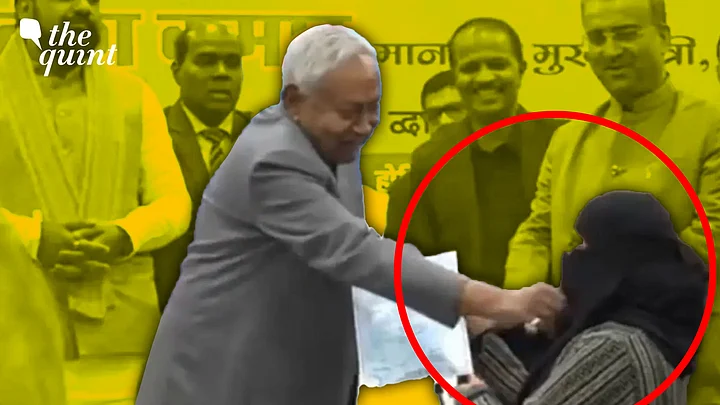
During an event to distribute appointment letters to AYUSH doctors, Nitish Kumar, upon seeing Dr Parveen approach in a hijab, gestured and asked, "What is this?" before reaching out and yanking the garment from her face. This brazen violation, committed by the state's highest executive against a young professional on what should have been her day of achievement speaks of grotesque abuse of power.

As Amnesty International India stated, the act constitutes an "assault on this woman's dignity, autonomy, and identity," sending a dangerous public message that such behaviour is acceptable. In addition to this, what is more disturbing is the visual of other officials laughing in the background, which is a damning portrait of a leadership utterly divorced from the principles of respect and equality it is sworn to uphold.

ADVERTISEMENTREMOVE AD

Sinister Echoes

The incident reveals a chilling mindset that extends beyond one individual's action, finding disturbing echoes in the statements of other figures in power. It is unfortunate that some people perceived Kumar as a ‘father figure’, even as others criticised the incident as an invasion of privacy.

Uttar Pradesh Minister Sanjay Nishad, in a crude attempt to deflect criticism, offered a defense so vile, it compounded the original injury. Questioning the public outcry, he asked, "What would have happened if he had touched somewhere else?"

This remark, which he later claimed was a light-hearted comment lost in translation, provides a window into a misogynistic and predatory worldview. It normalises physical violation by suggesting a hierarchy of assault, implying hijab-pulling was only a minor transgression.

The fact that a sitting minister felt emboldened enough to make such a statement publicly, and that it was met with demands for apology from multiple Opposition parties rather than immediate disciplinary action, underscores how deeply such attitudes have been emboldened.

In toto, this whole incident is nothing but an attack on a woman’s choice to wear a hijab.

Privacy, Dignity, and the Law

One cannot ignore the fact that the Chief Minister's behaviour is a direct attack on the inviolable private sphere guaranteed to every citizen. The choice to wear a hijab, or any religious or cultural attire, resides solely with the individual—it is an expression of autonomy that the state is duty-bound to protect, not strip away.

Such an act violently breaches the fundamental right to privacy, a right meticulously enshrined by the Supreme Court in the landmark Justice KS Puttaswamy vs Union of India judgment.

In Paragraph 298 of his opinion, Justice DY Chandrachud established privacy as the bedrock of dignity and liberty, stating it "creates a protected zone enabling the autonomy of body and mind." The ruling is unequivocal: "the destruction by the State of a sanctified personal space whether of the body or of the mind is violative of the guarantee against arbitrary State action" and "privacy of the body entitles an individual to the integrity of the physical aspects of personhood." 

By affirming that liberty includes the autonomy to choose "the way one will dress" and "the faith one will espouse," the Puttaswamy judgment provides a direct constitutional condemnation of Kumar's action.

Nitish did not merely pull a piece of cloth; he violated a "sanctified personal space," the very core of what the Constitution protects from arbitrary state power.

Hijab Beyond the Classroom Debate

Privacy is not an alien concept in India—unlike before, privacy is now a recognised fundamental right by the Supreme Court. John Stuart Mill in his essay, ‘On Liberty’ (1859) gave expression to the need to preserve a zone within which the liberty of the citizen would be free from the authority of the state.

“The only part of the conduct of any one, for which he is amenable to society, is that which concerns others. In the part which merely concerns himself, his independence is, of right, absolute. Over himself, over his own body and mind, the individual is sovereign.”
JS Mill

Privacy without dignity is an empty glass of water. Human dignity was construed in M Nagaraj v Union of India by a Constitution Bench of the Supreme Court to be intrinsic to and inseparable from human existence. Dignity, the Court held, is not something which is conferred and which can be taken away, because it is inalienable.

The Court held that “the rights, liberties and freedoms of the individual are not only to be protected against the State, they should be facilitated by it... It is the duty of the State not only to protect human dignity but to facilitate it by taking positive steps in that direction. No exact definition of human dignity exists. It refers to the intrinsic value of every human being, which is to be respected. It cannot be taken away. It cannot give. It simply is. Every human being has dignity by virtue of his existence...".

While the specific question of hijab in educational institutions saw a split verdict from the Supreme Court, the broader right to religious expression and personal choice remains fiercely protected. It is critical to distinguish the limited context of uniform regulations from the general, fundamental freedom to practice one's faith through attire in public life.

In the Aishat Shifa vs State of Karnataka case, Justice Sudhanshu Dhulia, in upholding the right to wear the hijab, delivered a powerful rebuke to any attempt to curtail this autonomy at the threshold of public participation. In his judgment, Justice Dhulia held that "a girl child has the right to wear hijab in her house or outside her house, and that right does not stop at her school gate. The child carries her dignity and her privacy even when she is inside the school gates." 

He poignantly added, "We live in a Democracy and under the Rule of Law, and the Laws which govern us must pass muster the Constitution of India.

“The unfortunate fallout of the hijab restriction would be that we would have denied education to a girl child. A girl child for whom it is still not easy to reach her school gate. This case here, therefore, has also to be seen in the perspective of the challenges already faced by a girl child in reaching her school. The question this Court would put before itself is also whether we are making the life of a girl child any better by denying her education merely because she wears a hijab!”
Justice S Dhulia

Amongst many facets of our Constitution, one is Trust. This principle extends far beyond the school gate. A professional woman receiving an appointment from the state is entitled to that same trust—the trust that her faith and her personhood will be respected. Chief Minister Kumar's act shattered that constitutional trust, treating a symbol of faith as an object of public curiosity to be physically removed.

ADVERTISEMENTREMOVE AD

The Resonant Silence

Amidst the ongoing outrage, emerging reports suggest that Dr Nusrat Parveen may choose not to join the government services for which she was being honoured. This marks a profoundly tragic coda to this saga. If true, this represents a double injustice; the public humiliation of her person and faith, followed by the derailment of a hard-earned professional career built on years of dedication.

The state's role is to nurture talent and secure futures, yet its highest representative has instead sown fear and disillusionment. While her personal decision in the face of such trauma must be respected without question, it is a national loss if her hard work is extinguished by this act.

Her joining the service would be a powerful act of resilience. However, the onus is now squarely on the state to actively ensure a safe, dignified, and non-discriminatory workspace for her, with explicit guarantees against retaliation.

The government must demonstrate that merit and service trump bigotry, and that it can protect those within its fold from the abuses of its own leaders.

What makes this moment particularly alarming is the resonant silence from institutions meant to act as checks and balances. While opposition parties have condemned the act and activists have filed police complaints, there is a conspicuous absence of swift, institutional accountability. The courts, the final arbiter in matters of fundamental rights, have yet to speak on this specific egregious violation by a sitting head of government.

This vacuum of authoritative censure creates a perilous precedent. It signals that those in the highest echelons of power can violate the personal and religious space of citizens with impunity. What happens if tomorrow a mob comes and takes off a hijab? Who will be held accountable if the head of the state justifies the act through silence?

When the State is the perpetrator, the question arises: to whom does the citizen turn for justice?

A Vacuum of Accountability

The silence is not just administrative; it is a deafening endorsement that erodes the very social contract between the state and its people, especially its minorities and women. It suggests a paralysis in the mechanisms designed to call power to account, leaving constitutional guarantees feeling hollow for those they are meant to protect most.

The act of pulling a woman's hijab is unbecoming of any individual, let alone a Chief Minister sworn to uphold the Constitution.

True redress requires more than political condemnation. It demands an unequivocal, public apology from Chief Minister Nitish Kumar to Dr Parveen. It requires a recommitment from all state institutions to enforce the principles of Puttaswamy and protect the "sanctified personal space" of every citizen.

Finally, it requires ensuring that Dr Parveen's career, and the aspirations of millions like her, are not collateral damage in a display of unconstitutional authority. The fabric of the nation is not in the hands of those who would tear at its threads, but in the resilience of its principles and the courage to uphold them.

(Areeb Uddin Ahmed is an advocate practising at the Allahabad High Court. He writes on various legal developments. This is an opinion piece and the views expressed above are the author’s own. The Quint neither endorses nor is responsible for them.)

Speaking truth to power requires allies like you.
Become a Member
Monthly
6-Monthly
Annual
Check Member Benefits
×
×