Last year on November 4, I was standing outside the Brooklyn Paramount theater in New York City right when the results were announced — that the city had elected its first Muslim and Asian American mayor.
Zohran Mamdani won what had surely become the world’s most famous mayoral race. This election was especially historic given the mood of the country at the time and the Trump administration’s crackdown on immigrants. I stood there watching Mamdani exit the stage on Dhoom Machale as an international student who had faced severe visa anxiety to pursue higher education in the United States. The moment emboldened the India story of the American Dream for so many of us.
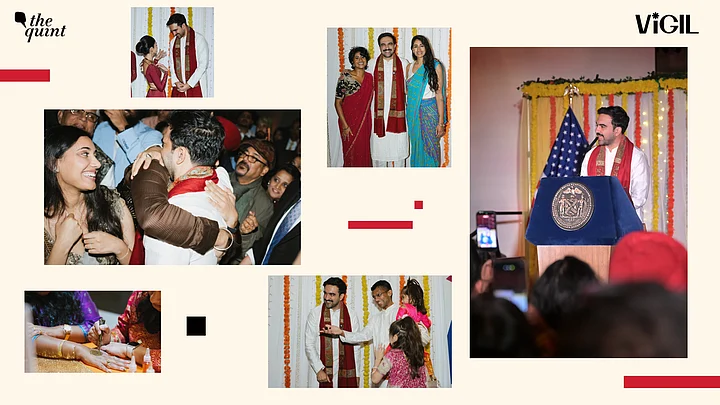
A year has passed since then. Earlier this week, on November 17, Mamdani celebrated his first Diwali as mayor with South Asian community leaders, elected officials and residents in Queens, a multi-ethnic bastion of diversity. Dressed in a white kurta and a red stole, Mamdani began his speech with a resounding Namaskar, while wishing everyone a happy Diwali. He traced back his Punjabi and Gujarati heritage, and asserted his values being inspired from Hindu traditions and multicultural upbringing.
“The Ramayana shows us the brother, the wife, the husband, the friend that we aspire to be," said Mamdani. "The Mahabharata shows what family is really like, where even the bravest heroes and the wisest gods stumble, and where one’s dharma comes before one's loyalty.”
Emphasizing the wisdom of the stories that have inspired pursuits of justice world over, he took the moment to remind himself and others in the room to work hard to create a politics of light.
That light is needed amidst moments of uncertainty and concern, in an environment of rapidly increasing hate against South Asians in the United States. Addressing those concerns, Mamdani referred to the targeting of Hindu temples and the instances of hate against Sikhs.
As he declared, “To anyone who has been told to go back home, whose belongings have been questioned, let me say unequivocally, you are home, New York City is home,” the hall thundered with applause.
Speaking to the gathering, Aminta Kilawan, a daughter of Indo-Carribean immigrants and a co-founder of Sadhana, a coalition of progressive Hindus, emphasized the importance of not weaponising the Hindu faith to spread hatred.
She said, “Our teachings tell us vasudhaiva kutumbakam – the world is one family, and lokah samastah sukhino bhavantu – may all beings be happy. Diwali’s light belongs to people of every faith and no faith."
“Today's representation offers another incredible powerful light," Kilawan added. "We have a mayor whose South Asian heritage and immigrant story reflects our city’s diversity. His incredible leadership reminds us that working class immigrant communities are not outsiders, they are the very fabric of New York and a force to be reckoned with.”
The speeches at the event represented a visible shift in leadership. Many I spoke to were happy to be finally seen by the city, and not merely relegated to the margins.
The party was attended by the who's who in the diaspora, including celebrities taking South Asian culture to the world from right here in New York. Amongst others, popular comic Hasan Minhaj, actor Kal Penn, and author Kiran Desai were in attendance. Amidst smiles and selfies, the community mingled with one another. One could almost forget that we were in New York City and not New Delhi.
The party was a potpourri of cultures. A Nepali group proudly flaunted dhaka topis and posed in front of the banner for the party while almost everyone wore traditional attire representing their heritage. People from different cultures feasted on samosas and rasmalai, while the DJ played Bollywood tunes to keep up the vibe.
Mamdani’s cabinet also features a number of officials with South Asian heritage. Among them Jagpreet Singh, First Deputy Commissioner of the Mayor's Office of Mass Engagement, Shekar Krishnan, New York’s first Indian-American Councilmember, Diya Vij, Commissioner of the New York City Department of Cultural Affairs were present at the party.
Shonita Joshi, events lead at the Mayor’s Office of Mass Engagement is another representation of the growing influence of Indian-Americans in the leadership of this city. Joshi said that “the aim of her office was to bring the same spirit of knowledge, light and connection that Diwali represents to the city government to make it transparent and accessible to all New Yorkers.”
Mamdani’s election is monumental to the global influence of Indian-Americans. As the mayor of the richest city in the world, he is seen as a champion of the working class who delivers on his promises. He represents a brand of politics that is now increasingly being favoured by people all over the country. This midterm election also saw a change in the conventional media communication and an increased use of social media videos to convey core campaign messages to voters. The Mamdani playbook was clearly being replicated.
When I came to the US last year, there was a general sense of fear amongst immigrants, including among Indians on H-1B and student visas. There still is.
But having an immigrant like Mamdani in elected office, holding the highest post in the country's largest city, is a force towards countering such targeting.
This was Mamdani's first Diwali event since he took office. And his message was clear — religion must not be weaponized to spread hate. Instead, it has the ability to bring together unity as an instrument that spreads love. It was a sharp contrast to the messaging by sections of the Hindu right wing in the Indian diaspora that had sought to label Mamdani as anti-Hindu in the run-up to his mayoral election.
Celebrating Diwali with the mayor of the city is something that many children of Indian immigrants might not have imagined. Let alone someone new to the city. Yet, we were here.
We are here.
(The author is a journalist based in New York City. This is an opinion piece. All views expressed are the author’s own. The Quint neither endorses nor is responsible for them.)