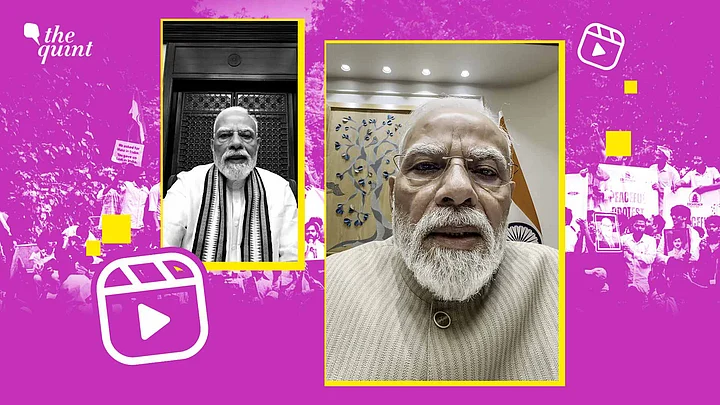
For roughly five hours before dawn on 28 July, the most visible man in Indian public life did not exist on Facebook. A selfie video Narendra Modi had posted on 23 July, which was a direct pitch to Gen Z over the NEET-UG paper-leak fiasco that had kept students at Jantar Mantar for the better part of five weeks, went dark around half past midnight and did not return until about five in the morning.
Meta called it an error and restored the clip. The government did not buy it, and the Parliamentary Standing Committee on Communications and Information Technology decided this was nothing less than an attack on democratic institutions.
That verdict now sits atop a far longer charge sheet: child sexual abuse material (CSAM) surfacing through Instagram's ad plumbing, unlabelled AI-generated imagery, and a wave of morphed, derogatory deepfakes targeting the Prime Minister, women and children, one of which has already produced an FIR from the Telangana Police.
Meta's global team was summoned. Chief Global Affairs Officer Joel Kaplan apologised to IT Minister Ashwini Vaishnaw for the "error restricting PM Modi's post," and by 5 August, government sources were briefing that Mark Zuckerberg himself had conveyed regret for the CSAM lapses, the deepfakes and the operational failure.
The committee's price for peace was blunt: a personal apology from Zuckerberg within three days, or it would recommend stripping Meta of safe harbour.
What 'Safe Harbour' Really Means
It is worth being precise about what that threat invokes, because the phrase is being flung about as if it were a switch a committee can flip. It is not.
Safe harbour lives in Section 79 of the Information Technology Act, 2000. Strip away the legalese and it is a bargain: an intermediary which is a platform that merely transmits, hosts, or stores what others put up is not liable for that third-party content, provided it behaves like a neutral pipe and does its due diligence.
Section 79(2) sets the conditions; the role must be essentially passive. Section 79(3) is where the shield cracks: immunity evaporates if the platform has "conspired, abetted, aided or induced" the unlawful act, or fails to take content down "expeditiously" once it has actual knowledge of illegality.
The Supreme Court, in Shreya Singhal verdict in 2015, tied that phrase down usefully—"actual knowledge" means a court order or a government notification, not an angry email from a stranger.
The due-diligence obligations were fleshed out by the Information Technology (Intermediary Guidelines and Digital Media Ethics Code) Rules, 2021.
For a platform Meta's size which qualifies as a "significant social media intermediary" well past the fifty-lakh-user threshold, these are not trivial: a resident Chief Compliance Officer, a nodal contact person, a grievance officer, monthly compliance reporting, and fast action on unlawful material, CSAM emphatically included.
Rule 7 is the sting in the tail: flout the Rules and the platform forfeits its Section 79(1) exemption, exposing it to prosecution under whichever law it has offended and today it is the Bharatiya Nyaya Sanhita.
Can Meta Actually Lose It?
So what would losing all this actually mean?
In practice, a safe harbour is the load-bearing wall of the entire business. Remove it and every post, reel and advertisement on Facebook, Instagram, and WhatsApp becomes something Meta itself can be sued or charged over and not the user who wrote it, the company that hosted it. Billions of daily items convert overnight from other people's speech into Meta's legal exposure.
Legal experts were near-unanimous this week that no platform of that scale could operate in India under those terms; the only rational responses are to over-censor pre-emptively, geo-fence risky features, or litigate without end. Indian users would feel it first, in a jumpier platform quick to pull anything that might invite a notice.
But here is the part the apology drama has obscured. The committee did not merely wave Section 79 around, it argued that by pulling the Prime Minister's post, Meta had acted as a publisher rather than a neutral intermediary. Government sources sharpened it further: a platform whose algorithm actively selects who receives content stops being a passive conduit, and safe harbour was never written for publishers.
This is not a uniquely Indian theory; courts here and abroad have already chipped away at the passive-intermediate fiction for e-commerce sites that curate listings. Applied to a recommendation engine, it is potentially devastating and it needs no new legislation to deploy.
Which is why the ultimatum should be read for what it is rather than what it sounds like. A parliamentary standing committee scrutinises and summons; it cannot revoke a statutory protection, direct a prosecution or impose a penalty. It can only recommend it.
Any real stripping of safe harbour would have to come from the government amending the framework, or from a court applying Section 79(3) to specific facts. And that machinery is already turning. In minutes dated 14 July and filed with the Supreme Court on 3 August, the Centre told a court-monitored committee it is examining a broader review of safe harbour, including a provision making intermediaries liable to compensate victims of cyber fraud. The apology theatre is the noise; this quiet filing is the signal.
A Bigger Question Than Meta
There is an uncomfortable irony worth naming. Section 79 and the 2021 Rules exist precisely to force platforms to purge things like CSAM and non-consensual deepfakes, the real, grave harms Meta has demonstrably been too slow on.
Yet the episode acquired its political velocity not from the abuse material but from five hours of downtime of the PM’s video.
When the machinery of accountability revs hardest over the disappearance of the powerful rather than the exploitation of the vulnerable, it invites the suspicion that safe harbour is becoming less a rule of law than a bargaining chip extended to the compliant, dangled over the inconvenient.
Meta has apologised, but the harder question is being decided quietly, in a reading of the word "intermediary" that could one day be turned on any platform whose algorithm dares to choose.
(Subimal Bhattacharjee is a defence and cyber security analyst and columnist focusing on technology, national security, and digital governance. This is an opinion piece and the views expressed are the author’s own. The Quint neither endorses nor is responsible for them. )