(Contains spoilers)
“Main kahan jaaun?” (Where should I go?)
This was a question my grandmother often asked in her final days. No answer satisfied her, though the word Lahore would sometimes bring a smile to her face. She often thought she was in Lahore. She was suffering with Alzheimers. That, at least, was the medical explanation. Lahore carried more than memories of a sweet shop she remembered.
"Bauji kahan hain?" (Where’s my father) was another question she asked frequently. Sometimes she knew. "Bauji bahar gaye hain, log ek doosre ko maar kaat rahe hain," (He has gone out, people are butchering each other) she told me with deep anxiety. She was, at once, both in 1947 and 2026.
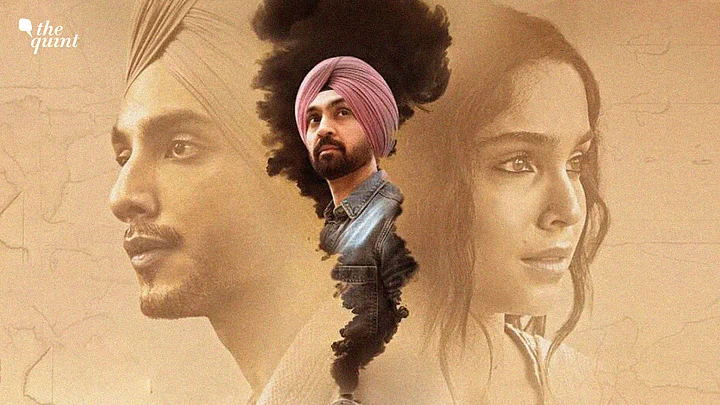
Imtiaz Ali’s latest—Main Vaapas Aaunga (MVA) is similarly set in 1947 and 2026. In that partition and in this one. Popular discourse about partition in 2026 only asks one question, and it is a rhetorical one—whose fault was it? The answers are ready.
The Indian National Congress, Muhammad Ali Jinnah, Muslims, those who are alive, and those who are discriminated against and lynched. Muslims, those alive then and those alive today, are perpetually responsible for “breaking” the country.
The Partition Lives On
MVA briefly portrays what “broke”, besides political territory. The violence, and mutilation, literal and metaphorical, perpetrated on “others” and ourselves. When I use the word ‘other’ here, I don’t mean the real or imagined political other, I mean the other, in contrast with the individual self.
MVA rejects the lie that the suffering of partition ended in 1947 or only with the people who experienced it first-hand. It moves between questions what did we, the partitioning, and the partitioned, do to each other in 1947? and then every day after it? It reveals that each successive generation inherited both- the partition and the partitioning.
The partition was lived and inherited as trauma. Partitioning was a more generous inheritance. It lived and lives not only in the communal divide, but first and foremost in our minds and our homes. It lives in our attitudes to money.
My uncle, who has worked every moment and atom of his life, from delivering newspapers when young to running his own graphic designing agency later, has done very well for himself. He is 70 now. One evening, when I was sitting with him, he told me, almost as if possessed—all this money, it can go any moment, “One piece of news comes, and everything is destroyed” he told me.
A friend’s father took out even the door handles and the footmats of the hatchback he was buying to save money.
The partitioning lives on in what we do, sometimes despite ourselves, to our children, inside homes, in schools. My grandmother hit her children. Some of her children hit their children also. It lives in what we do to our romantic partners. It colors our intimacies, our desires, our heartbreaks.
'An Impending Doom'
A few days back, I had a fierce argument with my partner, which the next day I regretted. The next day, I found myself remorseful and determined to offer apologies. I also spent the day fearing—what if she dies today? In an accident, in a pothole, under a falling bridge. This will be my last memory.
My psychologist and psychiatrist call it living with a sense of impending doom.
I have written about this before—when I was in my early teenage, I would cut out op-eds and reportage on communal violence and paste it in black coloured scrapbooks. Why was I doing that? What impending doom?
The partition has seeped into every aspect of our life and the film tries its best to reveals how much it affects. More often than not, it does this well.
MVA also offers compassion to the motives of our elders who hid away the worst from us. For the generation which told us—“Chodo kal ki baatein, kal ki baat purani, naye daur mein likhenge mil kar nayi kahaani.” (Forget about what happened yesterday, we Indians will write a new chapter.) Trauma was repressed with the noble aim of protecting us from both the partition and partitioning.
In a moving, powerful scene in the film, when implored by a young person to recount the trauma they suffered, the old person responds with rage. Why should we tell you? You will take our pain and transform it into the poison of hatred, he observes. You can see that he is infuriated at the partitioning which continues
The young person asks in response if the repression prevents hatred or acts as fodder for it. This is a question many of us have found ourselves asking after 2014, when political forces which argue that what India needs is more partitioning arrived at our door.
They were always here, biding their time. The Alzheimers' caused more remembering than it did forgetting.
For my grandmother, the partition began in 1947 and continued into 2026. It didn’t remain contained within her and now lives in her children and grandchildren. What do you destroy when you uproot an individual? How long does the fire which you light someone’s house on live? I often wonder- if the rioters knew how much and how long they destroy would they still do it?
While watching the film, I felt shock at how much of my personal life the film had captured. What a co-incidence. Later, on social media, I witnessed countless people my age from both sides of the border who commented, talking about how their parents and grandparents suffered till their last day, how their grandparents, much like mine, always cautioned them not against the religious, political or nationality “other” but against hatred. Anyone who hates is a Martian, says the film. The rest of us are humans.
In its final mid credits song, the film appeals to the partitioned to fight the partitioning. We owe this to ourselves.
(The author is a lawyer and research consultant based in Mumbai. This is an opinion piece, and the views expressed are the author’s own. The Quint neither endorses nor is responsible for them.)