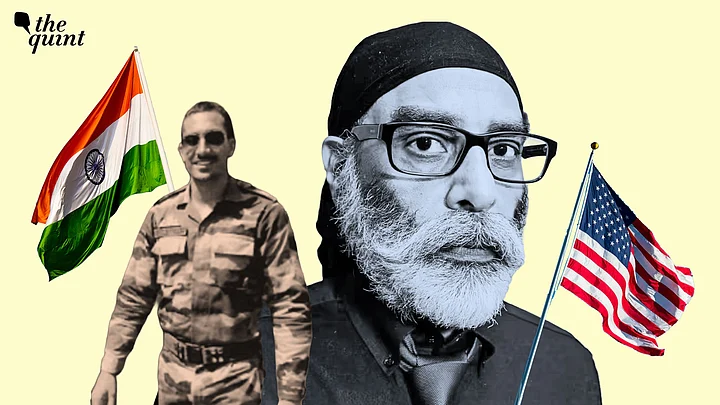
The botched alleged murder-for-hire operation to kill Gurpatwant Singh Pannun, a Khalistani activist, has left India with a lot of egg on its face.
With the middleman of the conspiracy, Nikhil Gupta, being entrapped by the US' Federal Bureau of Investigation (FBI) in the course of its investigation, the developments indicate very little legroom for New Delhi to wriggle out of its predicament.
Fortunately, for reasons of his own, Gupta pleaded guilty in a New York court and spared us the burden of having prosecutors rub India's nose on the ground with the evidence they had collected.
Luckily, too, the Indian official who allegedly contracted Gupta to arrange the assassination was operating from India, where he has now gone underground. The US indictment names Vikash Yadav, an erstwhile junior officer of the Research & Analysis Wing (R&AW), as a co-accused—and it remains to be seen whether the US will seek his extradition.
He remains in the FBI’s “most wanted” list.
The Politics of Pleading Guilty
Gupta pleading guilty implies that he may have made a deal with the US authorities to give information on Yadav, the alleged mastermind behind the conspiracy. Gupta could provide information that would make the case against Yadav airtight.
India has denied any official role in this affair. But this is standard operating procedure in the intelligence business. If you are caught, the government publicly washes its hands off you. In select cases, though, it will seek to make backroom deals to prevent further damage.
India, however, may have taken precautions to ensure that Yadav cannot be extradited. It can refuse extradition if Yadav is facing criminal charges in a case in India.
On 18 December 2023, the Delhi Police Special Cell arrested Yadav after a resident accused him of kidnapping and extortion. The complainant alleges that Yadav is linked to gangster Lawrence Bishnoi who is currently jailed in Gujarat. Separately, the Canadian police have accused the Indian government of outsourcing the targeting of Sikhs in Canada to the Bishnoi gang.
The US indictment also points to Yadav and Gupta referring to the Canadian case relating to the killing of Hardeep Singh Nijjar, a Khalistan activist, in June 2023.
The Pannun Assasination
According to the US case, in May 2023, Yadav recruited Gupta to arrange the assassination of Pannun, a US national and votary of Khalistan, designated a terrorist by India. Gupta seems to have a criminal background in narcotics and weapons trafficking, and he, in turn, established contact with a man who was actually a source working for the US Drug Enforcement Administration (DEA). This person put him in touch with a DEA undercover officer who posed as a killer-for-hire. Yadav agreed to pay $100,000 for the murder, and as advance payment, he delivered $15,000 through Gupta.
A month later, Yadav provided Gupta information about Pannun, including his New York City address, phone numbers, and his day-to-day activities. These were passed on to the hitman.
On 18 June, Nijjar was murdered in Canada outside a gurdwara in British Columbia, and after the murder Gupta told the hitman that Nijjar had also been the target and that given his murder, the time had come to eliminate Pannun a well.
The US authorities had been following the case and had also gathered intelligence through technical means. Since Gupta pleaded guilty, there was no need to unveil the evidence, but there could be information here that can be used to pressure India.
According to The New York Times, American spy agencies provided crucial information to Canada, which helped it conclude that the Indian government had been involved in the Nijjar case.
Hearings in the case will begin in August and will likely lead to more embarrassment for New Delhi.
Flashback to the Gadhia Case
This is not the first time the India has been caught in such a predicament. Back in 1994, a senior officer at the Washington Embassy undertook an operation to fund a number of pro-India politicians in New Mexico. So, a senior officer of the embassy gave Lalit Gadhia, a rising Indian-American politician in Maryland, $46,000 to make contributions through the Indian American Leadership Fund. Gadhia claimed that the money was contributions from a number of individuals.
As per US election laws, the Leadership Fund has to report all contribution to the election authorities, and there is a limit on how much one individual can contribute. It is illegal for non-citizens to fund American elections or for anyone to make a contributions in anyone else’s name.
Gadhia got caught when several of the cheques were found to have a common address, and were issued on the same date. Investigations found the location was an Indian-American restaurant and many of the workers there were the alleged contributors. They, in turn, pointed their finger at Gadhia, who pleaded guilty, pointing instead at a minister in the Indian Embassy as the party that had provided him money. He served three months in jail.
The Fallout
There is little doubt that the case is a result of the greater assertiveness enjoyed by the Indian intelligence agencies under the Narendra Modi government.
In the past five years, Pakistan has accused India of organising approximately 20 targeted assassinations.
The hits include Paramjit Singh Panjwar, the leader of the Khalistan Commando Force, killed in Lahore. Among the others killed was Shahid Latif, a high-ranking Jaish-e-Mohammed leader responsible for the Pathankot airbase attack in 2016.
India has, of course, dismissed these as being “false and malicious” propaganda. Since many of those killed have participated in terrorist actions against India, it is more than likely that New Delhi has been involved.
While the Pakistan killings get subsumed in the general climate of lawlessness in that country and its not-so-secret proxy war against India, the incidents in Canada and the United States stand out.
The major problem is that Indian agencies do not get their own hands dirty in assassinations. They tend to use criminal elements who can be cut off, if caught. On the other hand, the two agencies who excel in this kind of work—the Israeli Mossad, and the Russian SVR—tend to use their own officers and the planning and execution of their actions are tight.
Nevertheless, Vikash Yadav was no rogue operator but someone working under higher directions from New Delhi.
After all, he would not put out an advance of $15,000 for the killing of Pannun, who was hardly the terror threat that New Delhi is seeking to make him out to be. No doubt there is considerable reputational damage for Indian actions.
But of greater concern is the incompetence with which the Pannun and Nijjar plots were undertaken. Hopefully those who manage these things in the echelons of power in New Delhi will learn some lessons from this sorry episode.
(The writer is a Distinguished Fellow, Observer Research Foundation, New Delhi. This is an opinion piece and the views expressed are the author's own. The Quint does not endorse or is reponsible for them.)