
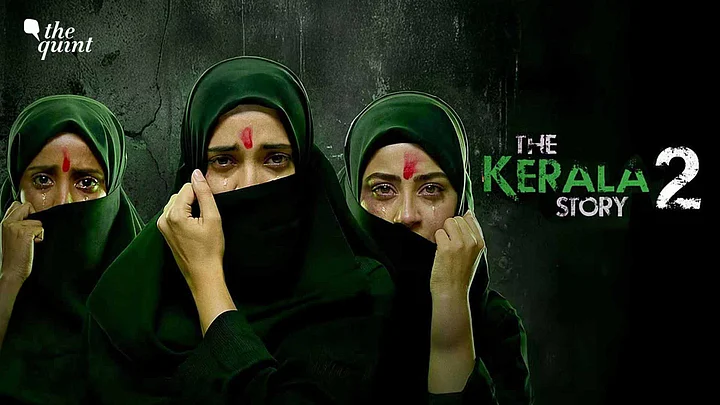
If you have seen the trailer of The Kerala Story 2: Goes Beyond, you already know this Hindi film portrays Muslims as monsters.
What the trailer did not reveal is that Hindu women in the story are shown to be stupid, easy to get, and in need of protection from their own stupidity. This is Patriarchy 101.
In that sense, for women who back Hindutva, Kerala Story 2 is an unwitting reminder of the subordination awaiting them in a Hindu Rashtra. It’s also a horrifyingly hate-filled film, with loud and tacky presentation to boot.
A Script Built on Female ‘Stupidity’
Kerala Story 2 has three Hindu female protagonists.
Surekha Nair from Kochi is preparing for an entrance exam. She has had a liberal upbringing. While her mother is a temple-goer, her father is not, and has given her the freedom to choose. Surekha is in love with a married journalist called Salim who pretends to be progressive, and tells her he will divorce his first wife. Meanwhile, Surekha decides to live with him.
Woman No. 2 is actually a girl. Divya Paliwal is a 16-year-old dancer in Jodhpur. Her boyfriend Rasheed tells her the only way to attract millions of online followers and build a career is by uploading sexy dance videos, and assures her that unlike her conservative mother, he will leave her free to do so if she marries him. Divya and Rasheed have a registered marriage. We later learn that since she’s a minor, they submitted a fake document as proof of her age, with her consent.
Rounding off the trio is Neha, an accomplished javelin thrower in Gwalior whose father is her trainer. Neha is Dalit. She and her parents dote on each other. She is dating a man who lies that his name is Raju. He promises to introduce her to a renowned coach capable of helping her fulfil her international sporting ambitions. So, Neha agrees to marry Raju.
Huh?
Yes, seriously, that’s all it takes for Neha to deceive the parents she adores and secretly marry this chap. She has no proof that Raju genuinely knows that coach. Nor does it make sense that she needs to marry him to be introduced to the coach. She doesn’t ask. That’s how easily she is won over. As I said, stupid and easy to get.
But wait...the female stupidity on display in Kerala Story 2 does not end here. The minute Divya enters Rasheed’s house, his family makes cutting remarks about her ashleel videos, but he convinces her that all will be well if she converts to Islam and has a nikaah with him.
Read that again: a Muslim man convinces a Hindu girl that his overtly ultra-orthodox family who are openly hostile to her because of the body-baring Reels she posts on public platforms will change their minds about her if she converts to Islam.
Stupid. Really, really stupid.
Love Jihad Redux: The Film’s Core Conspiracy
Like The Kerala Story released in 2023, Kerala Story 2 rests on the Islamophobic conspiracy theory labelled “love jihad”, according to which Muslim men lure Hindu and Christian women into marriage and religious conversion.
The men’s assignment in Film 1 was to recruit these women into a global terror network or make them sex slaves. In Film 2, the job is to alter India’s demographic composition.
Intrinsic to this unsubstantiated scare-mongering is the assumption that Hindu and Christian women are innocent, gullible and, therefore, need the superior wisdom of their family and community, especially male relatives, to guide them in their choices or choose on their behalf.
So you see, the stupidity of Kerala Story 2’s female characters is a bad scriptwriter’s notion of feminine innocence.
The Kerala Story peddled the conspiracy theory and simultaneously vilified Kerala, a state that has repeatedly rejected the Bharatiya Janata Party (BJP) in elections and pushed back against Hindutva on multiple fronts, including Malayalam cinema. Part 2’s added objective is to counter liberal arguments against Hindutva and establish that Muslims have taken advantage of Hindu liberalism to manipulate Hindu society and the Indian system.
Surekha Nair, for instance, is a vehicle for many keywords that liberals use against anti-Muslim propaganda. She accuses her parents of “Islamophobia” and parroting “WhatsApp University” bunkum. The film’s intent is so glaring, that we know right away she is being set up to later reverse her stand.
In a sneaky move, the information she dismisses as WhatsApp chatter is an allusion to the true story of Shraddha Walkar, a woman allegedly chopped up in 2022 by her live-in boyfriend Aftab Poonawala who was further charged with disposing of her body parts at different locations in Delhi.
The media has reported other similar cases of brutality by boyfriends and spouses from the majority community, but this one was given a communal spin and played up by the Hindutva ecosystem because the man was Muslim and the woman Hindu. Such spin, and the conflation of individual crimes with entire communities, have been long-running ploys of anti-minority movements worldwide.
Caste, Demographics and Hindutva Talking Points
Elsewhere in Kerala Story 2, when a Hindu couple begs for community support in their bid to get their daughter home, a fellow Hindu accuses them of being “right wing”. The agitated parents claim that Muslims get their way because Hindus are divided, whereas if even a single Muslim country has a problem, all of them stand together.
This is a laughable claim. Exhibit A: right before our eyes, since October 2023, Muslim-majority Palestine has been subjected to a genocide by Israel, but most Muslim countries in West Asia have done nothing for Palestinians.
Kerala Story 2’s reference to Hindu disunity conveniently steers clear of divisions in the service of caste supremacy and oppression. Neha is written as Dalit only to make space for a claim about the so-called “love jihad” machinery that the Hindutva machinery has circulated online in the real world for years: the claim being that Team Islam has a rate card, which places a premium on upper-caste Hindu women. In the film, Muslim men are paid Rs 12 lakh for acquiring a Brahmin woman.
Demanding verified truths and cogent reasoning misses the point of Project Kerala Story. Such films are designed to feed the confirmation bias of an audience that is either already unapologetically Islamophobic or deems itself liberal yet has been subconsciously influenced by anti-Muslim propaganda, or to radicalise young, malleable minds.
Demonising an Entire Community
After Neha marries Raju in a temple, and he reveals that he is Faizan, he convinces her to convert to Islam as the only means to gain acceptance from his family and community. She sees no way out since her father has disowned her by then.
You might think she is a cautionary tale for parents who abandon adult daughters when they assert their autonomy, but of course that is not the case. Instead, Neha later expresses regret for prioritising a boyfriend she barely knew over a maata-pita who had taken care of her all her life.
Surekha, who is irreligious, is of course, posited as a cautionary tale for Hindu parents who do not teach their daughters Hindu rituals, scriptures, and sanskaar. She is the one force-fed beef by a band of Muslims in a scene now made infamous by the trailer. She later writes in a letter that though she had not realised it until then, “my cultural DNA is Hindu”.
1,000 years of Muslim rule, too much freedom for daughters, the inconvenience of laws and Constitutional provisions that give primacy to a woman’s agency over the rights of parents who must surely be deemed to know better—all Hindutva’s favourite tropes are stuffed into this film produced by Vipul Shah, helmed by a little-known director called Kamakhya Narayan Singh, and starring a cast of unknowns barring Alka Amin. Really Alkaji? Why?
Every single Muslim man in Kerala Story 2 is either a rapist, a murderer, a conspirator, or all three. Muslim women are their active collaborators, pimping a Hindu woman and supervising her rape in a brothel, imprisoning a Hindu woman and forming a burqa-clad barricade—literally—to prevent her escape, and exhorting a Muslim husband to plant half a dozen babies in his Hindu wife’s belly as a means to tame her. Muslims, according to Kerala Story 2, are undiluted evil. Their goal, as declared by one nasty Muslim in the film, is to turn India into an Islamic state where Sharia law prevails.
In the end, a bulldozer demolishes the brothel, laying the ground for a justification of what has come to be known as “bulldozer justice” in India (or what Amnesty International has described as the “arbitrary and punitive demolition” of Muslim properties “by state authorities using bulldozers as a collective form of punishment” and “without any due process”).
This moment kicks off a lengthy, deafening scene featuring purposeful Hindu hordes, Muslim men being bashed up, and a song titled Shiv Shambho commanding “Babars and Aurangzebs” to fall in line or prepare to be destroyed. Kerala Story 2’s mission is encapsulated by this passage combined with the slogan “Ab sahenge nahin...ladenge” (We will not suffer any more...we will fight) in its closing minutes.
Free Speech vs Hate Speech
The release of the film’s trailer—featuring scenes unrelentingly villainising Muslims, and claiming to be “inspired by many true events”—prompted a petition in the Kerala High Court seeking a stay on the film’s release.
In response, at least one prominent liberal defended the filmmaker’s freedom, arguing that the public should be allowed to see Kerala Story 2 and make up their own minds about it. This is a fair defence when, for instance, thin-skinned religionists claim that their “sentiments are hurt” by critiques of their faith—freedom of expression must, of course, include the right to offend. But is it a valid stand when cinema demonises a minority group, mixes fact with lethal fabrication such that they are indistinguishable from each other, and aims to incite, excuse and normalise violence?
Defending such a film in the interests of free speech seems mindless at a time when decades of anti-Muslim propaganda have been compounded, in the past 12 years, by a hate campaign mounted on a giant scale, and the international NGO Genocide Watch has stated that “in India, all the early warning signs of genocide against Muslims are present”.
The question for legal minds is whether a film qualifies as hate speech under Indian and international law if it blatantly advocates violence against a community, and whether calling it out as such amounts to curbing the maker’s freedom of expression.
UN Secretary-General António Guterres acknowledged this eternal dilemma while launching the United Nations Strategy and Plan of Action on Hate Speech in 2019. “Addressing hate speech does not mean limiting or prohibiting freedom of speech,” he explained. “It means keeping hate speech from escalating into something more dangerous, particularly incitement to discrimination, hostility and violence, which is prohibited under international law.”
Kerala Story 2’s agenda screams off its every frame, in the production design, lighting, and shooting of pleasant-looking Hindu homes versus intimidating Muslim residences, in sunshiney Hindu-dominated localities versus the cold greyness of Muslim mohallas, in the warm atmospherics marking the heroines’ pre-Muslim lives versus the ominous soundscape heralding their entry into Islam and even regular Islamic practices like namaz.
The use of Kerala in the title, though only one of the three stories is set there while the other two are in Madhya Pradesh and Rajasthan, is among the umpteen acts of mischief packed into this dangerous film. It’s a good reminder, to those who think they are safe, that while Muslims are the primary target of Hindutva wrath, they are not alone on that hate list.
The hilarious beef-porotta videos with which Malayalis mocked Kerala Story 2’s trailer were important. Ridiculing hate-mongers is an essential service. It’s just as essential to recognise the venom coursing through the veins of this poorly crafted, ugly film, and identify the antidote to it.
(Anna M.M. Vetticad is an award-winning journalist and author of The Adventures of an Intrepid Film Critic. She can be reached at @annavetticad on Twitter, at @annammvetticad on Instagram, and at AnnaMMVetticadOfficial on Facebook. This is an opinion piece and the views expressed above are the author’s own. The Quint neither endorses nor is responsible for the same.)
