Transparency is the glitziest ornament of a credible democracy. But an insecure state often buries that ornament in an abyss of extraneous, obfuscating details.
In India, we’ve confronted incredibly sticky questions around two population-scale processes—ie, how we estimate our GDP and count votes. Because these processes impact the lives of 1.4 billion citizens—ie, they are not small, isolated, or one-off problems, but gigantic exercises recurring at “population scale”—it’s critical to be, and to be SEEN, as pristine, beyond reproach. It’s the “Caesar’s wife moment” for our eight-decade-young democracy.
Raw GDP Data: Let Apples Be Apples, Oranges Be Oranges!
Let’s tackle GDP first. We surprised the world with a strong upswing, ie real GDP growth of 7.8 percent in the first quarter of the current year. Despite two global wars, supply shocks, stinging inflation, and a plummeting rupee and capital markets, our economy was in the pink of health. There was a significant caveat—this estimate was based on a new methodology.
Independent experts were quick to pick two “tweaks” which, prima facie, required transparent detailing.
First, last year’s GDP at current prices was slashed by over Rs 12 trillion, or almost four percent. The government defended, asserting it was caused by the new methodology. Fair enough. Yet experts did not relent.
Experts: “Sir, you have all the information, please blow up this Rs 12 trillion shrinkage into components—like a punching error, or over-estimation cleaned up by new data, or other reasons.”
State (air of injured innocence): “This is a much more credible, scientific model. The World Bank and IMF are applauding. Why are you attacking us?”.
Experts (nonplussed): “Who is attacking the new methodology? We too are applauding, it’s the correct way forward. But yes, we are asking you to reconcile this outlandish Rs 12 trillion number, or give us the raw data, and Claude will do it for us”.
But this transparent demand was met with a mysterious, holier-than-thou silence.
Second, for the first time in independent India, we’re using a “double deflator”—ie, using separate measures for input and output inflation rates—to estimate “real” quantities.
Experts: “Sir, congrats on moving to the “double deflator”! Now please give us the mega worksheet of input/output prices and ratios across all industries and operations that you’ve collected to calculate the “double deflator”. That will solve the mystery of why it’s a lowly 2.5 percent while the wholesale and consumer inflation rates are twice, even thrice that number.”
State (quixotically): “It’s such a dramatic advancement! Our earlier model of applying consumer or wholesale price inflation to both inputs and output was so blunt, medieval. Because of this scientific change, previous year’s data has been thoroughly revised and cleaned up – yet you do not accept it.”
Experts (now irked and irritated): "Sir, we’ve already said it’s a terrific step forward. But don't conflate the demand for reconciling past year’s data with clarity around the “double deflator”. These are two independent streams – two separate enquiries - so don’t try to throw us off-track by mixing them up! The Rs 12 trillion reconciliation must be done on current price data, which is not double deflated.”
State (bigger air of injured innocence): “Why do you need to hark to past practices? Earlier we counted apples, now we are counting oranges. You can’t compare apples and oranges, stop cribbing!”.
Experts (gleam in the eye): “Exactly! If you also give us the current quarter’s GDP on the earlier methodology, we will compare today’s apple with yesterday’s apple. And since you’ve already given us both estimates on the new methodology, we shall compare oranges with oranges. So please just give us the latest GDP print in current prices on the earlier methodology. That’s all we are asking for! C’mon, show the world how transparent and honest our national stats are.”
But this innocent, globally benchmarked demand was met with an even more mysterious, holier-than-thou silence.
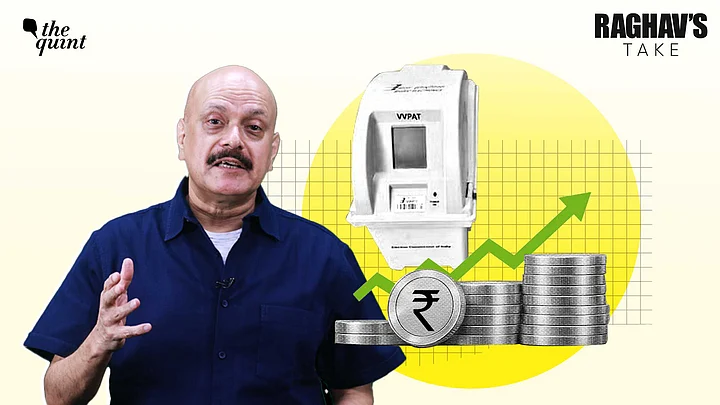
Full VVPAT Count: Largest Democracy Validated in Mere 36 Hours!
The suspicion around EVMs (Electronic Voting Machines) is the other, denser, fog hanging over our transparent democracy. Off the bat, I am not saying that EVMs are being hacked or used to fudge electronic voting. I don’t think there is conclusive evidence to take such a black/white stand. However, equally, there are two potential points of mistrust which are not trivial and need to be seriously addressed.
One, the government claims, sanctimoniously, that an EVM is never attached to the Internet. That’s simply not true. The EVM does link the symbol loading unit (SLU) to the Election Commission’s (EC’s) website–now that’s a connection which could, repeat could, suck in malicious software. The state pleads that only a screenshot is uploaded, not a programmable bug. But why should transparency advocates take the EC at face value? Remember that wise dictum, "Trust, but verify?" Why don’t we open this “junction” of the EVM to the EC’s website to full and continuous scrutiny? Shut the critics up, once and for all?
Two, there’s immense scepticism around the way the voting process is wired at the polling booth. When I press the button on the ballot unit, my vote goes to the control unit which instructs the VVPAT (Voter Verified Paper Audit Trail) unit to cut the paper slip and show me the symbol I’ve voted for. Experts fear that when the signal travels back to the control unit, it can be re-programmed, or changed, to get “cast” for a different candidate than the one I voted for and saw on the VVPAT unit. The government contests vehemently but cannot deny that this is a probable chink in the armour.
So, what’s the fail-safe, unquestionable solution? Simple. Just count all the VVPAT paper slips, and declare the winner on the basis of the paper count if it contradicts the electronic tally. Yes, the results may take an extra 36 hours to be validated, but that’s the tiniest price to pay for scrubbing all cobwebs off the world’s largest democratic elections.
Breaking Fake News: India leaps in the Global Transparency Index as she agrees to a full VVPAT count in elections; and publishes raw data for its new GDP estimation methodology!