
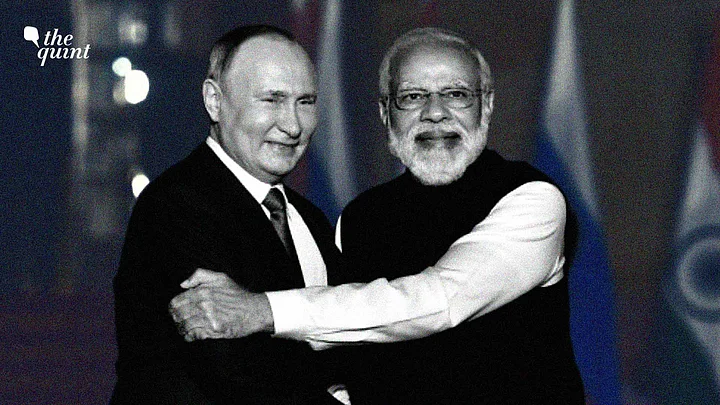
When the Russian parliament ratified the Reciprocal Exchange of Logistics Support (RELOS) cooperation agreement this year, it marked a structural redefinition of India-Russia maritime relations, recasting India not simply as a buyer, but as a co-logistics partner with potential access to Russia’s Arctic and Far Eastern ports.
The timing of the ratification, just before Vladimir Putin’s state visit to New Delhi in the first week of December, displayed its importance to India-Russia bilateral relations. With this pact, India secures potential access to Russian Arctic bases Murmansk, Vladivostok, Petropavlovsk-Kamchatsky and possibly even the Mediterranean littorals.
This reorientation is aligned with India’s 2022 official Arctic policy. The policy's six pillars include transportation and connectivity, economic development, resource access, and capacity building, signalling that Arctic shipping corridors and resource flows are now central to India’s global maritime vision.
By integrating with Russian logistics in the High North, RELOS operationalises the policy’s goals of securing access to new shipping lanes, diversified energy flows, and future resource corridors.
This change acquires concrete significance against the backdrop of Russia’s own recognition that the Arctic coastline lacks robust port infrastructure, ice-breaker capacity, and diversified investment to make the Northern Sea Route (NSR) fully dependable.
Operationalising the Northern Sea Route
RELOS assigns India assured logistical entry points across Russia’s Arctic and Far Eastern network. Although base-specific access remains classified, the agreement’s scope is explicitly global, enabling use of Russian facilities as mutually decided, including in Arctic and Pacific stations critical to the NSR.
If implemented at scale, these arrangements collectively create a continuous logistics arc for India underpinning the creation of a joint working group under the inter-governmental commission on trade, economic, and scientific cooperation.
Moreover, the recently launched Chennai-Vladivostok Eastern Maritime Corridor (CVMC) provides an immediate sea link between Indian ports and Russia’s Far East, enabling a continuous maritime axis from Indian Ocean ports to the Russian Far East and, potentially, onward via Arctic routes.
If these initiatives are fully realised, India gains access to a genuinely global logistics network: linking Indian Ocean ports, Russian Far East terminals, and Arctic-enabled maritime routes. Such a network would allow India to reduce dependence on narrow bilateral pacts, diversify its access to Russian energy and mineral supplies, and legally entrench Indian presence along multiple maritime corridors spanning the Indian Ocean, Greater Eurasia, and Arctic-to-Europe interfaces.
The NSR and Arctic-Far East infrastructure, combined with the CVMC, would help operationalise a pan-oceanic strategy contingent on institutional capacity building in shipping, long-haul logistics, and polar-navigation training by India’s maritime stakeholders and state agencies such as the National Centre for Polar and Ocean Research (NCPOR).
On the Russian side, RELOS is complemented by a parallel push to operationalise the NSR and the wider Arctic-Far East maritime complex with external partners, driven by acknowledged deficits in Arctic port infrastructure and icebreaker capacity. Russia needs partners beyond traditional suppliers. India’s energy demands, resource needs, and growing maritime ambition make it a strategic alternative.
The China Contradiction
This recalibration in Moscow’s external partnerships produces a direct strategic contradiction for China because the partner it has treated as its closest wartime ally, Russia, is now formalising Arctic cooperation with India in ways that are functionally analogous to giving basing and logistics access to China’s regional rival.
This outcome collides with how China has framed the Russia relationship in its wider contest with the US and allied Indo Pacific architectures.
The EU Institute for Security Studies analysis of the “dependence gap” in Russia-China relations notes that the partnership is explicitly strategic, grounded in a shared desire to dilute US primacy and the spread of liberal democracy, and that Russia has become China’s primary geopolitical partner in Europe and the Arctic.
Chinese state companies hold significant equity stakes in Yamal LNG and Arctic LNG 2, and long-term off-take contracts were designed to lock in Arctic hydrocarbons to Chinese markets for decades. India’s institutionalised Arctic access disrupts China’s Polar Silk Road monopoly, creating direct strategic competition.
Understanding the asymmetric economic foundations of the Russia-China relationship helps explain why Moscow can tolerate China’s discomfort with India’s entry into the Arctic. The share of Chinese products in Russia’s total imports jumped from 23 percent in 2021 to 57 percent in 2024, with deep dependencies in machinery and electronic equipment. Russia’s share in China’s imports rose by less than one percentage point and China depends on Russia for less than 0.1 percent of its product categories. In energy, however, Russia now relies not only on China, and that it seeks capital-rich partners among its largest energy customers.
The most immediate shifts, however, will surface from China's maritime posture, as India will gain replenishment capabilities from Russia's Far East, as well as potential Arctic facilities.
The PLA Navy is likely to enforce or reinforce its Indian Ocean Region (IOR) presence through dual-use port networks. Satellite verified assessment from the CNA and CSIS Asia Maritime Transparency initiative shows us that there is a steady military grade infrastructure expansion at Gwadar, Hambantota, which are masked off as economic projects but increasingly serve as contingency logistics roles.
These ports allow China to normalise the submarine and surface combat rotation into the IOR under the established cover of “anti-piracy” patrols.
On the other hand, in the continental front, RELOS is strengthening China’s incentive to maintain leverage along the Himalayan frontier. If RELOS enhances India's arctic reach and energy security, China may also quietly expand the PLA's ISR assets in Tibet as a counterbalance.
As India’s Arctic Policy embeds shipping routes, energy security, and mineral exploitation in a national strategy, and as MoUs on the NSR and the Russian Arctic are operationalised, China risks losing its ability to treat Russia’s Arctic coastline and infrastructure as an extension of the PSR.
Instead, the corridor that once underpinned China’s self image as a near Arctic state becomes a contested, triangular space where India can translate Arctic presence into wider bargaining power in the Indo-Pacific.
India’s expanded access to Russian naval facilities elevates its maritime reach from the Indian Ocean into the Arctic and Western Pacific, eroding China’s strategic depth in Southeast Asia. As Russia diversifies away from Beijing, India emerges as its key Asian partner, strengthening New Delhi’s ascent as both a regional counterweight and a rising global power.
(Deepanshu Mohan is Professor of Economics and Dean, OP Jindal Global University. He is a Visiting Professor at the London School of Economics and an Academic Research Fellow, AMES, University of Oxford. Saksham Raj and Aditi Lazarus are Research Analysts with Centre for New Economic Studies (CNES). This is an opinion piece. All views expressed are the author’s own. The Quint neither endorses nor is responsible for them.)
