
ADVERTISEMENTREMOVE AD

Modi's 'MANAV' Vision: India's AI Leap Hinges on What Happens After the Applause

Turning 'MANAV' from vision to reality requires all five layers of India’s AI Stack to mature—some are far from it.

Published
story-hero-img
i
Aa
Aa
Small
Aa
Medium
Aa
Large

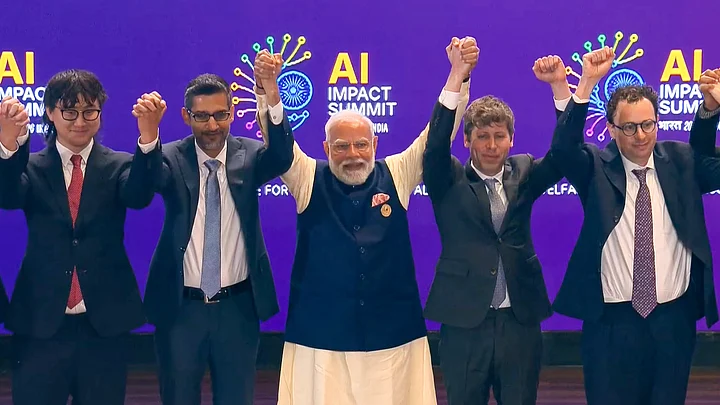
When Prime Minister Narendra Modi unveiled the 'MANAV' Vision for AI at the India AI Impact Summit at New Delhi's Bharat Mandapam on 19 February, it was a genuinely significant moment. Manav, meaning human, stands for five guiding principles:

  • Moral and ethical systems

  • Accountable governance

  • National sovereignty over data

  • Accessible and inclusive technology

  • Valid and legitimate systems

It places the person—and not the machine—at the centre of AI governance. In doing so, it signals an India not merely waiting to receive the norms of an AI-driven world, but attempting to help write them.

The summit itself has made history. Billed as the largest AI summit ever convened, it brought together an extraordinary cross-section of stakeholders—heads of state, technology CEOs, researchers, civil society organisations, startup founders, and policymakers from across the globe. Participation spanned over 100 countries, with major technology corporations, multilateral institutions, and academic bodies represented in the same hall.

Yes, there were logistical hiccups—scheduling overruns, connectivity issues in breakout sessions, and the usual friction of coordinating thousands of participants across time zones and agendas. Yet, the sheer breadth of voices in the room, and the seriousness with which delegations engaged, marked this as a watershed moment in global AI diplomacy.

India demonstrated, convincingly, that it could convene the world on a question that matters to all of it.
ADVERTISEMENTREMOVE AD

Five Layers, One Systemic Test

These are meaningful steps worth acknowledging. But for MANAV to move from a keynote vision to the lived reality for 1.4 billion Indians, five distinct layers of the India AI Stack must all mature. Several are still far from ready.

The India AI Stack—the government's integrated framework for building and scaling AI nationally—has five interlinked layers: the application layer, the model layer, the compute layer, the data centre and network infrastructure layer, and the energy layer.

The architecture is thoughtfully designed, with the five interdependent layers meant to function as a unified system.

The logic is sound. And while advances in compute, datasets, and multilingual models signal real momentum, population-scale impact will depend on strengthening every layer—not just the most visible ones. The promise of AI collapses if even a single layer falters.

A brilliant healthcare diagnostic model is useless to a patient in rural Chhattisgarh without reliable internet. A multilingual chatbot for farmers is irrelevant without affordable compute to run it. Therefore, the five layers cannot function as isolated pockets of progress.

Some layers are genuinely advancing.

  • At the compute layer, the IndiaAI Compute Portal now offers approximately 38,000 GPUs and 1,050 TPUs at subsidised rates under Rs 100 per hour.

  • The BharatGen Param2 model, handling 22 Indian languages, was launched at the summit.

  • The IndiaAIKosh repository hosts over 5,700 datasets and 250-plus AI models across 20 sectors.

  • The Bhashini initiative has built over 350 language AI models covering speech recognition, translation, and text-to-speech.

These are not trivial achievements.

Last-Mile Realities of the AI Push

Yet, gaps remain—and some are structural.

At the application layer, which most directly touches citizens, state-level AI deployments in agriculture have reportedly delivered productivity gains of 30 to 50 per cent in parts of Andhra Pradesh and Maharashtra through AI-driven sowing advisories.

But the harder truth is that the farmers benefitting are overwhelmingly in districts with reasonable connectivity and digital literacy. The Kisan e-Mitra chatbot has handled over 95 lakh queries—an impressive headline—but the majority of India's agricultural workforce operates where smartphone ownership, internet access, and comfort with digital interfaces remain limited.

The data centre and network infrastructure layer tells a similar story. India's major hubs Mumbai, Bengaluru, and Hyderabad are expanding toward a projected $200 billion investment pipeline through 2030. But these are metropolitan concentrations.

For AI to function at the last mile—in a primary health centre, a rural school, a district court—connectivity across India's non-urban geography must improve substantially. Near-universal 5G coverage is a declared aim, but declared aims and deployed, reliable infrastructure are different things.

AI’s early gains are real, but uneven. From farm advisories to data centre expansion, progress is concentrated where connectivity and digital literacy already exist. Until infrastructure reaches India’s last mile, the AI dividend will remain geographically skewed.

The energy layer is perhaps the most under-appreciated dependency. Data centres running AI workloads are extraordinarily power-intensive. India has made real progress—over 51 per cent of installed capacity now comes from non-fossil sources, and the SHANTI Act will enable nuclear energy and small modular reactors to power future data centres. But grid stability in tier-2 and tier-3 cities remains inconsistent. A compute infrastructure dependent on an unreliable summer grid is a fragile one.

From Service Powerhouse to AI Author

MANAV's 'N', which stands for National Sovereignty, raises the most structurally important challenge of all. India's R&D expenditure remains at roughly 0.64 percent of the GDP.

A country aspiring to co-author the AI age, not merely serve as its most capable service provider, cannot sustain that ambition at this investment level.

BharatGen and Sarvam AI are promising beginnings. But the gap between India's frontier model capability and that of leading global AI laboratories that spend tens of billions of dollars annually on research is not closing at the pace the AI Impact Summit's optimism might suggest.

Domestic model development at globally competitive scale requires a sustained, decade-long commitment to foundational research. That commitment must be backed by budgets.

India’s AI ambition cannot stop at being the world’s back office. Moving from a service provider to a sovereign model-builder requires sustained public investment in research, long-term institutional commitment, and the political will to fund foundational science at globally competitive levels.

There is also a quiet irony in some of the summit's most celebrated partnerships. Google's commitment to training 20 million Indian civil servants on AI platforms is genuinely significant. But when those platforms are built by a foreign corporation, the 'A' for Accessible and 'N' for National Sovereignty in MANAV exist in real tension with one another. Deepening human capability and deepening technological dependency can occur simultaneously.

India's policymakers must be clear-eyed about actively managing that distinction over the long term. Celebrating capacity-building partnerships is entirely reasonable; doing so without acknowledging the strategic trade-offs involved would be a mistake.

Execution Is the Real Test

MANAV is a serious and philosophically coherent framework. The India AI Impact Summit has been a genuine landmark. The India AI Stack provides a sound blueprint. But frameworks do not run on principles alone. They run on fibre optic cables, functioning power grids, trained district officials, funded research institutions, and the unglamorous work of state-level implementation that rarely features on a summit agenda.

Startups that are many, harnessing AI capabilities, have to be better supported across the country in terms of ease of doing business and getting their idea to the ground.

India has the architecture of an AI nation. What must follow is the hardest phase of any transformation—converting national vision into verifiable, ground-level impact, in every district, in every language, and for every citizen that MANAV framework is intended to serve. The Global South is looking eagerly to emulate India's steps.

(Subimal Bhattacharjee is a Visiting Fellow at Ostrom Workshop, Indiana University Bloomington, USA, and a cybersecurity specialist. This is an opinion piece. The views expressed above are the author’s own. The Quint neither endorses nor is responsible for them.)

Speaking truth to power requires allies like you.
Become a Member
Monthly
6-Monthly
Annual
Check Member Benefits
×
×