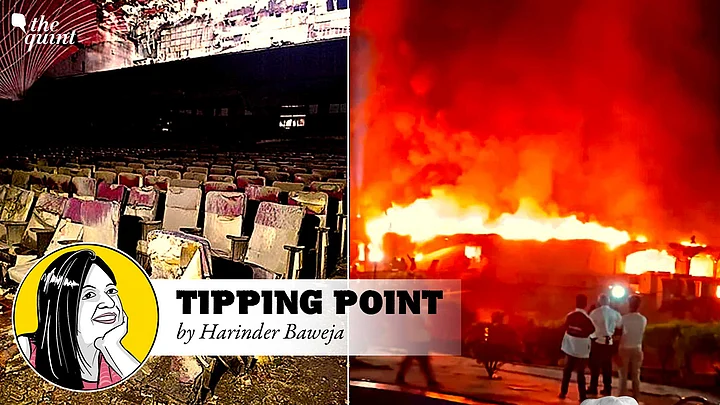
The stench from the Goa inferno that consumed 25 lives is nauseatingly familiar. The deaths at Birch by Romeo Lane, owned by brothers, Saurabh and Gaurav Luthra, came as a stark reminder of the 59 lives that had been snuffed out at Delhi’s Uphaar Cinema, 28 long years ago.
The comparisons are inevitable. They are also necessary. Uphaar, owned by the powerful Ansal brothers, was also running movies, back to back, without necessary permissions, just like Birch was hosting parties back to back.
The illegalities tumble out only after ‘tragedy’ strikes. Tragedy, is actually the wrong word to use because Neelam and Shekhar Krishnamoorthy, parents of Unnati and Ujjwal — who died painful deaths in the Uphaar theatre — dug out facts to prove that the fire was, in fact, a man-made murder.
Uphaar and Goa: Parallels That Can’t Be Ignored
Soon after details of the Goa deaths emerged, Neelam vented her feelings on social media, saying, “It is heartbreaking that yet again, a place meant for joy becomes a scene of devastation all because human life continues to be valued less than profit and safety. The Goa fire shows that 28 years after Uphaar, nothing has changed. When those responsible walk scot-free, when there is no real deterrence from our courts, the same deadly patterns repeat. Until accountability is certain, tragedies will continue.”
Neelam has lived each of the words contained in her post. I first met her and Shekhar soon after they lost both their children. If the case against Uphaar and its owners reached the Supreme Court, it was due entirely to their perseverance. Their quest for justice needs to told — and retold —because the Goa inferno has so many parallels.
The ‘deadly pattern’ replayed itself in so many ways. Powerful owners who tried to distance themselves from the catastrophe. While the Ansals claimed they had nothing to do with the day-to-day running of the cinema hall, the Luthras are on the run.
They had the presence of mind to fly to Thailand after Saurabh Luthra initially claimed in a statement that, “In this hour of irreparable sorrow and overwhelming distress, the management stands in unwavering solidarity with the families of the deceased…”
Liability Dodged, Again
It, however, did not take long for the Luthra brothers to tell the court — just like the Ansal’s did — that criminal liability cannot be pinned on them because they were not present at the Goa nightclub where a blazing fire killed unsuspecting midnight revellers. The court was also told that the brothers, who run several businesses, were not involved with the day-to-day running of Birch.
Their detention in Thailand is only one small step in what is going to be a long journey, not just for the victim families but for basic safety and security.
The criminal negligence at the Goa nightclub is a mirror image of the complete lack of regulatory vigil at Delhi’s theatre. The families of those who perished at Birch need what I call the ‘Uphaar Model’.
A Couple Who Refused to Let the Buck Stop Below
The fight should not be left to individuals, but if the Krishnamoorthys had not stepped in, the buck would have stopped at the usher and the theatre manager. But the couple persevered and unearthed fact after fact. The Goa investigation is already smacking of shocking negligence: no fire safety equipment, no emergency exits, no clearances, and no evacuation plan.
The Krishnamoorthys scaled down their business and made justice their life mission. I remember Neelam telling me that she hadn’t stopped being a mother just because her children were dead. In turn, she promised the children she had lost, that she would try and avenge the loss by fighting the very system that had failed the families of 59 victims.
She proved, beyond doubt, that the Ansals were in charge of the day-to-day functioning of the theatre; that greed had led to a criminal flouting of the laws. Extra seats had been put at the exits. The afternoon show had not cancelled on June 13, 1997 even though the transformer had caught fire that morning.
The balcony area, where the maximum deaths took place, had only one exit and that had been bolted from the outside. Their children died slow, painful deaths as the hall filled with smoke. None of the 59 who died had burn injuries. They were all asphyxiated.
The more the Krishnamoorthys dug, the more they uncovered. The facts where shocking and disturbing: the ambulances that came to Uphaar had come without oxygen and the fire tenders without water. A broom lay placed in the cabinet in the hall where a fire extinguisher should have been, and the public address system in the theatre did not have a megaphone.
Courage Born From Grief
Courage deserves to be acknowledged, especially when it is born from the depths of despair. What can be worse than losing both your children at one go? The Krishnamoorthys fought, not just for their children, but for accountability; for a more stringent law for man-made disasters. They met the law minister in the United Progressive Alliance urging for a review and held follow-up meetings with the Law Commission.
They managed to send the Ansals to jail but Goa is a reminder of a brutal fact, that you can kill and get away with it, that the system fails you, that the fight for safety is a lonely battle.
Only two years ago — by which time they had spent 26 years in different court rooms — the Krishnamoorthy’s ordeal was encapsulated in a series released on Netflix. As more and more people finally warmed up to their Trial by Fire, the name of the series and a book authored by them, Neelam was left asking herself, “Is this the legacy I wanted?”
The easy answer is, No. The answer for the families of Goa’s victims will also be a firm, No.
Ordinary Lives, Extraordinary Loss
The Krishnamoorthys were an ordinary couple, content with life. Like all parents, they had dreams for their children. Their daughter Unnati was 17, and son Ujjwal, a mere 13. Unnati would soon be in college and Neelam was focussed on helping her chart her future.
But that one day — 13 June, 1997 to be precise — the children decided to do what most kids like to do: watch a movie the day it hits the theatre. They’d been gone longer than they should have and Shekhar kept pacing in the balcony, waiting for the ubiquitous yellow and black auto rickshaw to show up. It never did. The parents kept paging the children, unaware at the time that Uphaar would go on to become a tragic leitmotif.
The couple had quietly stolen their way out of the gynaecological ward at the All India Institute of Medical Sciences, to watch a movie at the same theatre, Uphaar, a day before Unnati’s birth. It is a memory Neelam likes to share and she’s shares it often, almost each time we speak.
The ordinariness of their lives was shattered when they had to make their way back to the same hall and the same hospital, to discover the bodies of their children laid out on stretchers. Unnati’s earlobes were torn. Someone had ripped her gold earrings off.
A Choice That Wasn’t a Choice
As I read news reports about Goa, I am reminded of my several meetings with the Krishnamoorthys. Life had brought them to a fork where they said they had only two options: accept the deaths as a blow fate had dealt them or take the long road to justice. The “legacy” Neelam talks about came from this choice. It, in fact, wasn’t even a choice.
Soon after they’d performed the rituals that death necessitates, the Krishnamoorthys found facts staring them in the face: none of the 59 had died of fire injuries. Instead, they’d breathed their last, gasping for breath as smoke billowed into the balcony section of the theatre.
They had got trapped in the gas chamber because the only exit had been bolted from the outside. The usher was nowhere to be found and the Uphaar manager was more concerned about retrieving the cash box.
Fate had not dealt them a bad card. The system had failed them.
It is important to recall the Krishnamoorthys' struggle for justice because it has been steadfast. I’ve written this before, and it bears repetition, because the struggle has grit, determination, resilience, and inspiration woven into it. It is admirable for another reason: a couple was determined to fight against the high and mighty. That was a promise a mother had made to her children.
Neelam remembers what one lawyer told her: the prospect of going to jail is what business tycoons fear the most.
She fought hard and managed to send the ageing Ansals to jail three times, and she’s not done yet. The Krishnamoorthys continue to fight for fire safety norms. Goa has reminded them, not just of their own loss but of how cheap human lives are, of how licences are issued without inspections.
They’ll keep the good fight going but the governments at the state — and the Centre — need to step in. For as Neelam asks, how can it still be happening nearly three decades since Uphaar? Truly, how can the stench be so nauseatingly familiar?
(Harinder Baweja is a senior journalist and author. She has been reporting on current affairs, with a particular emphasis on conflict, for the last four decades. She can be reached at @shammybaweja on Instagram and X. This is an opinion piece, and the views expressed are the author’s own. The Quint neither endorses nor is responsible for them.)