
Made in 1954, barely seven years after the independence of India, the feature film “Jagriti” had a song which goes as follows:
“Hum laaye hain toofan se kashti nikaal ke,
Is desh ko rakhna, mere bachhon, sambhal ke.”
Roughly translated, it means, “We have brought the boat safely out of the storm, ie, we have got freedom for the country. It is now for you, my children, to keep the country safe."
The song voices the confidence that the post-independence leaders had in the ability of the youth to shape and steer the nation forward.
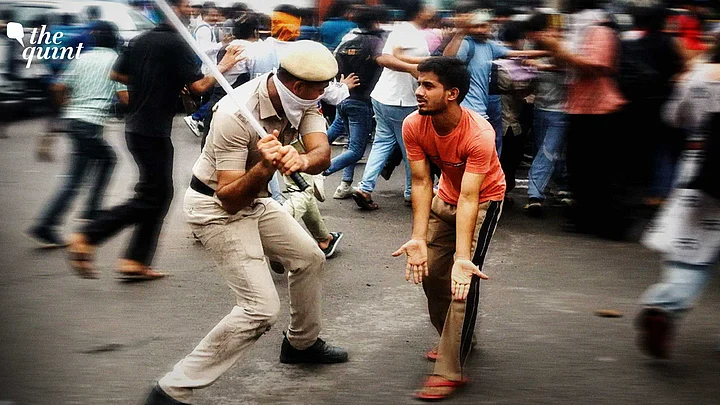
However, the current dispensation and its law enforcement apparatus' atrocious handling of the Cockroach Janata Party (CJP) protests, led by thousands of students, parents, teachers and NEET aspirants on 20 July, belies that confidence.
The handling, in fact, appears to indicate that the instruments of State power and authority actually treat the youth not as an asset but as enemies.
An Oppressive Mindset
20 July 2026 is certain to be remembered as a black day because of the manner in which Delhi Police dealt with the student protesters.
The behaviour of the cops and other forces responsible for managing the protest reminds one of the behaviour of the Imperial Police. Raised by the British to ensure native Indians remained suppressed and unable to raise their voice against the colonial administration, as had happened during the first war of independence in 1857, they performed the task using brutal force.
The present day protesters, who had earlier taken an oath to remain peaceful and not indulge in any kind of violence, were trying to march to the Parliament peacefully. Having arrived from all over India in large numbers, the protesters did actually try to remain peaceful. However, the brutal treatment meted out to them has once again proved that Police in general—Delhi Police in particular—instead of being a service meant to ensure safety, security and wellbeing of common people, are ever willing to behave like a force to suppress the voice of common citizens.
Inexplicable Lapses
The signs appeared ominous when protesters found a truck loaded with stones inexplicably standing along the route of the protest march, a day prior. The appearance of broken cars near the protest area was also noticed.
The protesters apprehended that the authorities were intent on provoking the protesters and blame the resultant violence on them. Their apprehensions proved true when videos of police personnel throwing stones at them emerged. Videos of police personnel themselves seemingly damaging vehicles are also in circulation, though one such video has been fact-checked by The Quint as not being from the CJP protests.
While legacy media has downplayed the police brutality unleashed on unarmed students, videos of the above mentioned incidents are available and being circulated widely on social media.
The aim, obviously, was to create confusion and provide rationale for use of force against protesters. Notwithstanding the denials by Delhi Police about use of force against the protesters, multiple videos circulating on social media show that there indeed was excessive use of force.
Police personnel, of course, have the right to private defence but most of the evidence circulating on social media indicates that the protesters at no stage behaved in an aggressive manner.
Protesters trying to march to Parliament house were confronted by a large posse of police and RAF personnel armed with batons, including batons allegedly fixed with nails, to indiscriminately beat them up. Jammers were put in place and internet shut dow so protesters could not share real time footage or recordings.
The police also is alleged to have used Taser guns which emitted electric shock when used against protesters. In a practice adopted from the handling of protests in 2019, none of the Police or RAF personnel were displaying their name tags, which is against the existing instructions mandated by law.
There was no need to resort to these tactics if they were acting in good faith. The aim obviously was to shield the identities of the assaulters and abort any future legal action. Instructions not to display name tags obviously must have come from the proverbial top.
Girls as young as 16 years and senior citizens became victims of police high handedness. Women were reportedly sexually harassed as well by uniformed and plain-clothed male personnel while being beaten with sticks and shoved, as can be seen in videos. Even persons in the area for some other work and with nothing to do with protests also became collateral damage of police aggression.
And perhaps the most disturbing trend observed since the handling of the anti-Citizenship Amendment Act (CAA) protests at Jamia Millia in 2019, is the visual of civilians wielding standard police batons, supposedly to carry out law enforcement on behalf of the police or in conjunction with them.
Delhi police sources have been quoted in the media saying that specialised detection and intelligence units do undercover work and thus are often dressed in plain clothes.
While the requirement of police personnel being deployed in civil dress to collect intelligence is understandable, why should there be a requirement of such deployment to directly tackle the protesters?
This leads to the question: is Delhi police abdicating their responsibility and outsourcing it to—for want of better adjective—hoodlums? This is absolutely unprofessional and a critically unethical trend. Such "deployment" is likely to give further rise to vigilantism in an already polarised society.
It is also been reported that protesters detained by police were subjected to physical assault in buses and police stations, and denied contact with their family members.
In Need of an Ideological Rethink
There is no glory in how the security forces have dealt with the protests, the visuals confirm that. But these visuals are not new for Delhi Police, who have once again proved they are anti-people and ready to strike the underdogs at the behest of those in power. This trend has been on the rise in the last decade or so, starting with the incidents of 2016 at Jawaharlal Nehru University.
Another common trend observed in the handling of protests by the Delhi Police in the last decade is that the top leadership, but for some honourable exceptions, is generally found missing in action during these strikes. The police jawan who actually faces the crowd is only following orders. He has no answer to the questions that the protesters raise.
Jawans faced with such situations find themselves faced with the dilemma of following orders of superiors vs his/her conscience. After all, jawans are humans too and perhaps facing similar problems that the protesters are raising. There is thus a psychological toll on the personnel, which needs to be addressed.
That the people responsible for maintaining law and order in the capital will resort to such unconstitutional means and use excessive force against own citizens doesn’t augur well. The police are for the protection of the common people and the common people should have faith in them.
The unfortunate manner of handling the 20 July march has caused a severe dent in Delhi Police's reputation.
Leadership of the force needs to introspect on how to remedy the situation and restore the police's image as a people-friendly service rather than a State-friendly one.
(Sanjiv Krishan Sood (Retd) has served as the Additional Director General of the BSF and was also with the SPG. He tweets @sood_2. This is an opinion piece and the views expressed above are the author’s own. The Quint neither endorses nor is responsible for the same.
