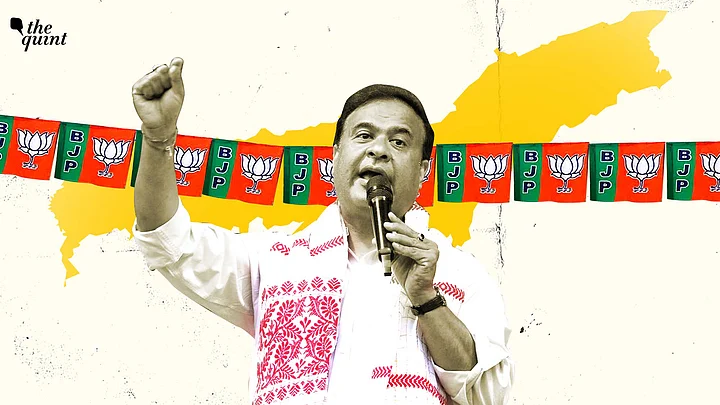
As expected, the Bharatiya Janata Party (BJP)-led National Democratic Alliance (NDA) returned to power for the third time in Assam. This time, the alliance secured over three-fourths majority, increasing its tally to 102 seats, with the BJP alone crossing the majority mark of 64 by securing 82 seats.
This isn’t just another victory for the saffron party. Along with its allies, the BJP has either won or swept all the regions—from Upper Assam and North Assam to Central Assam, Lower Assam, and Barak Valley.
The saffron party contested 90 seats and polled 37.81 percent, an increase of 4.6 percent votes. The NDA increased its vote percentage to 48.01 percent, an increase of 3.5 percent.
NDA ally Assam Gana Parishad (AGP) increased its tally from 9 to 10, while Bodoland People’s Front (BPF), which fought the last election in alliance with the Congress, saw its seats go up from 6 to 10. Last time, the NDA included the Bodo regional party, United People’s Party Liberal (UPPL). This time, it was replaced by the BPF. Notably, the UPPL, which won 6 seats last time, contested alone and scored a zero.
On the other hand, the Congress-led Asom Sanmilito Mancha (ASOM) bloc was decimated, securing only 21 seats. The Congress was reduced to 19 from 29 seats, while its ally Raijor Dal increased its tally from 1 to 2. Baddruddin Ajmal’s All India United Democratic Front (AIUDF) performed poorly with only 2 seats, while the Trinamool Congress managed to open its account in the state after a gap of 15 years.
Understanding BJP’s Dominance
In Upper Assam, the BJP-led NDA won 33 seats restricting Congress to Nowboicha, while Raijor Dal’s supremo Akhil Gogoi retained his Sibsagar seat. This sweep is significant as the Congress-led ASOM ran a good campaign in the region banking on three Gogois—state Congress president Gaurav Gogoi, Assam Jatiya Parishad leader Lurinjyoti Gogoi, and Akhil Gogoi. Barring Akhil, the two Gogois lost the election.
Gaurav, who was also the chief ministerial candidate of ASOM, lost by more than 23,000 votes in the Jorhat Assembly seat, while Lurinjyoti lost from the Khowang seat by more than 9,000 votes.
Gaurav’s defeat shows the poor state of Congress. Only two years back, he emerged as a strong candidate after defeating the BJP’s Tapan Gogoi from the Jorhat Lok Sabha seat. The Congress led in 8, including the Jorhat Assembly seat, out of 9 seats falling under this Lok Sabha constituency. This time ASOM lost in all the 8 seats.
In North Assam, another region where Assamese Hindus are influential apart from Upper Assam, the BJP-led NDA swept the region. It increased its tally from 11 to 14 seats. Notably, in the last Lok Sabha elections, the NDA led in 13 seats. The lone seat of Dalgaon, which is Muslim-dominated, was secured by the AIUDF. This seat was led by the Congress in the last Lok Sabha elections.
In the Barak Valley, the NDA increased its tally from 6 to 9 seats with the Opposition reducing to only 4. However, in the last Lok Sabha elections, the NDA had a lead in 10 seats. The BJP lost the Karimganj North seat, where it led with more than 6,000 votes in 2024 to the Congress. Here, the BJP's Karimganj district president Subrata Bhattacharjee was defeated by the Congress's Jakaria Ahmed as Muslims voted in large numbers ignoring the AIUDF's Chaudhury Usama Mobrur, who secured only 0.9 percent votes.
In Central Assam, too, the NDA increased its tally from 12 to 14 seats. The BJP once again swept all 6 constituencies of the hill districts of Karbi Anglong, West Karbi Anglong, and Dima Hasao, highlighting its tight grip among the tribes of the hill districts. Of the remaining seats, the ASOM won 4, and the AIUDF’s supremo Ajmal secured victory from the Binnakandi seat.
The NDA was ahead in Lower Assam, a region where it lagged behind the Opposition. This region has the largest share of seats—43. This time, the NDA increased its tally from 18 to 31, while the ASOM secured only 11 seats. The remaining one—Mandia—was won by Trinamool's Sherman Ali Ahmed, a former Congress MLA.
Victory of BJP’s Hindutva Template
The Assam results point toward strong polarisation of Hindus and Muslims. While the majority of the Hindus drifted towards the BJP-led NDA, the Muslims, barring a few constituencies, moved towards the Congress. Of the 19 MLAs of the Congress, only one is a Hindu, and the rest are all Muslims. Had the Muslims not supported the Congress in large numbers, their condition would have been more disastrous.
Such is the deep polarisation among the Muslims that the BPF’s lone Muslim candidate, Rezaul Karim, lost to the Congress’s Ashraful Islam Sheikh in the Parbatjhora seat. This is despite Hagrama Mohillary's BPF sweeping the Bodoland region. Not only this, all the 13 Muslim candidates of the AGP lost.
This indicates that the majority of the Muslims aren’t even interested in voting for Muslim candidates belonging to the allies of the BJP, which didn’t field a single candidate from the community.
The ruling BJP ran the poll campaign projecting the Congress as “a party protecting the interests of Bangladeshi Muslims”, who are seen as a threat by the large Assamese Hindus as well as the other small Hindu tribes. Over the last five years, Chief Minister Himanta Biswa Sarma has always banked on Hindu polarisation, even saying in the past that the BJP doesn’t need the votes of 'Miya' Muslims—a term used for Bengali Muslims.
During the election campaign, Himanta’s polarisation campaign got endorsement from Prime Minister Narendra Modi himself when the latter targeted the Congress for protecting the interests of the infiltrators (read Bangladeshi Muslims) and changing the demography of the state (read increase of Muslim population in the state).
Apart from that, the Prime Minister promised to implement the Uniform Civil Code (UCC)—a key agenda of the Hindutva movement—in the state if the party comes to power for the third time.
The Assam results clearly show that the majority Hindus of the state endorse the saffron party’s Hindutva agenda, blended with regionalism.
The Himanta government’s eviction drives against illegal immigrants—although critics allege these moves for targeting primarily the Bengali Muslims—projected the saffron party as a party of Assamese. Also, credit must be given to the saffron government for being able to provide land pattas to many indigenous people in the last 10 years.
Let’s not forget that Assamese regionalism is mainly focused on removing illegal immigrants (read Bangladeshis) from the state. So, with the BJP speaking their language, a larger section of Assamese have no option but to endorse the BJP, as the Congress fearing the loss of Muslim votes generally avoids this topic. This consolidation of Assamese Hindus behind the BJP has also strengthened because there have been allegations against the past Congress governments working for the interests of the illegal immigrants—an issue that the BJP leaders starting from Modi to Himanta never forget to remind Assamese Hindus.
Further, in the Bengali-Hindu-dominated areas of the Barak Valley, the Himanta government’s recognition of Bengali as an official language in the region and the Modi government passing the Citizenship Amendment Act (CAA) portrayed the saffron party as the protector of their interests.
Welfare, Development, and Delimitation
It would be completely unfair to give the whole credit to Hindutva for the BJP’s success. The various welfare schemes like Orunodoi, which provides Rs 1,250 as a monthly assistance to women, have undoubtedly paid dividends for the BJP electorally. In fact, ahead of the elections, Rs 9,000 (four months instalment plus Bihu bonus) was transferred to nearly 40 lakh women as a part of the Orunodoi scheme—a move done keeping elections in mind.
The saffron party government also increased the wages by Rs 30 for the tea workers, who account for 17-20 percent of the state population. This move paid dividends with the NDA sweeping the tea-belt areas of districts like Tinsukia, Dibrugarh, Jorhat, Charaideo, Sibsagar, and Golaghat.
Also, the government has claimed that in the last five years, it has provided more than 1.5 lakh jobs, including more than 95,000 teacher jobs. Given the unemployment crisis, with fewer industries in the state, a government providing jobs is likely to be endorsed by the voters.
Apart from that, it can’t be denied that under the BJP rule, supported by the Modi government at the Centre, the state has seen a growth in the number of infrastructural projects. This includes building of bridges—like Bogibeel and Bhupen Hazarika Setu—over the mighty Brahmaputra river, with seven more bridges remaining under construction. Under the BJP’s rule, the once isolated Barak Valley is now connected with the rest of the state, and the country.
Many have blamed the delimitation acting as a strong factor for helping the BJP. True that due to delimitation, the number of Muslim-dominated seats have been reduced to about 20 seats from earlier 35 seats. True that the role of delimitation in helping the BJP to win more seats also can't be denied.
But, having said that, let’s not forget the fact that even before delimitation, the BJP-led NDA, without the support from most of the 34 percent Muslim community, came to power twice in the state.
Failure of the Opposition
When the Opposition points to delimitation as their reason for failure, the question they need to ask is why has it failed to get the trust of the majority Hindus?
This is a question that neither the Congress nor its allies can ignore. Apart from the Congress and Raijor Dal, other constituents of the ASOM failed to open their accounts. In fact, the Congress gave 21 seats to Raijor Dal and AJP—both parties swearing Assamese regionalism—but these parties performed badly, highlighting the limited appeals of both Akhil and Luringjyoti in the Assamese belt.
The other seat won by Raijor Dal is a Muslim-dominated seat (Dhing) in Lower Assam, highlighting their growing Muslim base. This shows that the influence of the Opposition parties is limited mostly to the Muslim-dominated areas—and that should be a matter of concern to them if they want to revive.
The Opposition alliance failed to even retain the earlier seats in the Assamese belt. Take the example of the state’s Opposition leader Debabrata Saikia who lost from his traditional Nazira seat. Upper Assam results show that while the ASOM bloc tried to win Ahom votes, who are concentrated in six districts of the region, through the three Gogois, the voters did not trust the bloc. The Congress’ strategy to ally with the All Party Hill Leaders Conference also failed.
The Congress high command’s strategy to put almost all eggs in the Gaurav Gogoi basket has failed badly. Notably, this strategy had resulted in internal rebellion within the party.
As a result, the party saw the exit of high-profile leaders like former state president Bhupen Kumar Borah and Nagaon Lok Sabha MP Pradyot Bordoloi. Both of them were given tickets by the BJP, and they won with comfortable margins. The Congress needs to introspect, instead of making allegations against the BJP for stealing elections. Such allegations suggest laziness, with many voters likely interpreting these as grapes turning sour for the Congress and its national face, Rahul Gandhi.
With this hat-trick, the BJP has turned Assam into its citadel. It can be termed as Gujarat of the Northeast. This is the largest state in the region, and this victory gives a undue advantage to the BJP in dealing with the regional forces.
This victory reinforces Himanta Biswa Sarma’s powerful status as well. It also boosts his image nationally as the Assam verdict clearly endorses his brand of politics—a blend of Hindutva woven in regionalism, particularly Assamese, welfare schemes, and development.
As Himanta’s Hindutva politics resonate in many parts of the country, his image as a future key national leader is only bolstered, even if not the prime ministerial candidate.
(Sagarneel Sinha is a political commentator and tweets @SagarneelSinha. This is an opinion piece and the views expressed above are the author’s own. The Quint neither endorses nor is responsible for them.)