
ADVERTISEMENTREMOVE AD

The Bhojshala Ruling Raises a Larger Question: Can Courts Reinterpret History?

What is striking is that the order never engages with the most obvious constitutional problem it creates:

Published
story-hero-img
i
Aa
Aa
Small
Aa
Medium
Aa
Large

The recent judgment of the Madhya Pradesh High Court in Hindu Front for Justice vs Union of India represents a significant judicial intervention in one of India’s most sensitive and long-running religious site disputes. The case concerns the Bhojshala-Kamal Maula Mosque complex in Dhar, a site where Hindu and Muslim communities have co-existed under a fragile administrative arrangement for decades.

By relying heavily on a court-commissioned archaeological survey, a Division Bench at Indore has declared the entire disputed area to be a Hindu temple dedicated to Goddess Saraswati, effectively overriding the site’s documented history of shared usage.

The judgment is notable for its sheer ambition and detail. Running over two hundred pages, it weaves together historical literature, epigraphic evidence, architectural analysis, and a multi-volume scientific survey report from the Archaeological Survey of India (ASI). The court directly addressed preliminary objections regarding maintainability, res judicata, and delay, clearing the way for a final determination on the religious character of the monument. It also brushed aside the applicability of the Places of Worship (Special Provisions) Act, 1991, holding that the site as a protected monument fell within the statutory exception to that law.

However, for all its comprehensiveness, the judgment raises profound legal and constitutional questions. Critics are likely to argue that the court overstepped its summary writ jurisdiction, selectively applied the Supreme Court’s own Ayodhya precedent, and fundamentally misinterpreted the Places of Worship Act.

While the Bench made a genuine effort to bring clarity to a centuries-old dispute, the resulting order—which directs the allotment of alternative land to the Muslim community—may be seen as a judicial re-characterisation of history rather than a neutral adjudication of existing legal rights.

ADVERTISEMENTREMOVE AD

What the Court Held

The court first addressed multiple preliminary objections. It held that the writ petitions under Article 226 were maintainable despite involving disputed facts, because they sought enforcement of fundamental rights under Articles 25 and 26. The bench rejected pleas of res judicata arising from earlier proceedings (Qazi Zakaullah and Vimal Kumar), finding that the reliefs sought were substantially different. On delay and laches, it ruled that the ASI’s 2003 order constituted a continuing cause of action.

What is more important is that the court also dismissed the applicability of the Places of Worship Act, 1991, by relying on Section 4(3), which exempts monuments protected under the Ancient Monuments and Archaeological Sites and Remains Act, 1958.

On the merits, the court placed decisive weight on a scientific survey conducted by the ASI pursuant to its own order of March 11, 2024. The survey report, running to ten volumes, concluded that the existing structure was built over a pre-existing temple structure of the Paramara period (10th-11th century CE).

It documented 94 sculptures and fragments depicting Hindu deities (Ganesha, Brahma, Narasimha, Bhairava), over 150 Sanskrit and Prakrit inscriptions, and evidence of deliberate defacement of human and animal figures, which the court noted are not permissible in a mosque. The report also recorded a 15th-century Khilji period inscription referring to the destruction of idols and conversion of a temple into a mosque.

Based on this evidence, the court declared the religious character of the disputed area as “Bhojshala with a temple of Goddess Vagdevi (Saraswati).” It quashed the ASI’s 2003 order to the extent it restricted Hindu worship and permitted Muslim prayer. The court directed the Government of India and the ASI to manage the site as a Hindu temple and centre of Sanskrit learning. It also suggested that the government consider bringing back a Saraswati idol from the British Museum.

In a significant concession, the court directed the State Government to consider allotting an alternative, suitable piece of land to the Muslim community for the construction of a mosque. The petitions filed by Muslim parties and the Jain community were dismissed, while a related petition seeking to avoid communal clashes was disposed of without merits.

Ayodhya Revisited

The Court repeatedly insisted it was not deciding “title” but only “religious character.” This distinction is legally untenable. Declaring a site exclusively a Hindu temple and directing its management as such is a de facto declaration of title and possessory rights.

The Supreme Court in M Siddiq vs Mahant Suresh Das (Ayodhya judgment) clearly held that title disputes must be adjudicated through a full civil trial with evidence tested by cross-examination, not through summary writ proceedings. The Ayodhya case itself arose from decades of civil litigation, not from a public interest writ petition filed decades after the impugned order.

The court’s reliance on Section 4(3) to exclude the 1991 Act is textually correct but contextually problematic. The Act’s fundamental purpose is to freeze the religious character of all places of worship as of August 15, 1947, thereby preventing the revival of historical disputes. By using archaeology to reach back a thousand years and override the living, documented character of the site (official records, revenue entries, continuous Namaz for decades), the court has undermined the very statutory objective Parliament set in 1991. The exemption for protected monuments was intended to preserve their archaeological integrity, not to grant courts a licence to re-adjudicate medieval history.

A Questionable Reading

The court dismissed the Dhar State’s 1935 notification declaring the site a mosque as a mere executive order void under Article 13. This reasoning is suspect. The notification was a sovereign act of a princely state, published in its official gazette, and was treated as legally operative by post-independence authorities. Article 372 of the Constitution provides for the continuation of pre-constitutional laws.

The court’s categorical dismissal of the notification without examining whether it possessed legislative character or survived under Article 372 reflects an unduly rigid approach that conveniently removes a key document favouring the Muslim community’s narrative.

The direction to allot alternative land to the Muslim community is constitutionally and judicially anomalous. In a dispute over the legal character of a specific site, a court’s function is to adjudicate rights, not to act as a rehabilitation authority. By directing the State to provide substitute land, the court implicitly conceded that it was dispossessing a community of a long-held place of worship.

This is not a power granted under Article 226. It is a political or executive act dressed in judicial robes, and it exposes the weakness of the legal reasoning for the dispossession itself.

The Supreme Court Loophole

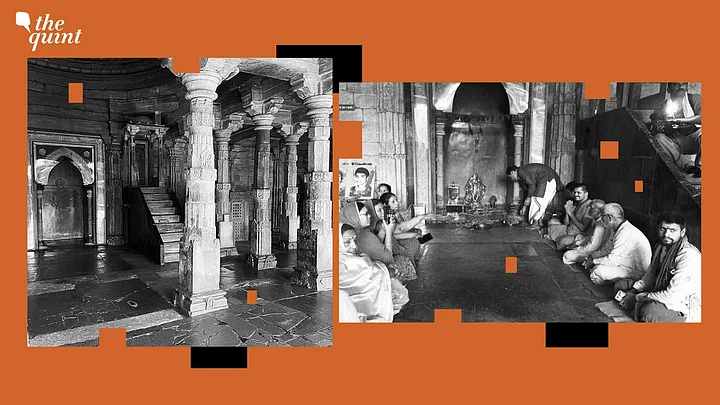
As per a 2003 ASI arrangement, Hindus pray on Tuesdays and Muslims on Fridays at the 11th-century monument in Dhar, Madhya Pradesh. Following a March 2024 High Court order for a scientific survey, the Supreme Court had in April 2024 allowed the survey but barred the release of the report or any excavation altering the site’s religious character. That restraint was later reinforced by the Supreme Court’s own December 2024 pan-India stay on all such place-of-worship disputes.

Now, for the first time since that stay, the Court has revived the matter triggered by a Basant Panchami prayer request in January 2026. Chief Justice Kant’s bench disposed of the appeal on January 22, not by overruling the stay, but by ordering the High Court to unseal the survey report in open court, supply copies to both sides, accept objections, and proceed to a final hearing.

What is striking is that the order never engages with the most obvious constitutional problem it creates: on what reasonable basis could the Chief Justice’s bench reopen indeed accelerate—the very pathway the Supreme Court itself paused in December 2024, while that stay still formally remains in force?

This is the half-life problem of a Supreme Court order. Such orders do not always die in a dramatic moment, by being overruled, modified, or expressly vacated. Sometimes they die a quick death by procedural choreography—a sudden listing, a “limited” disposal, an instruction to unseal a report and move to final hearing. These acts honour the form of restraint while hollowing its purpose, leaving the stay alive in name but dead in effect.
ADVERTISEMENTREMOVE AD

The 1991 Act Problem

The Places of Worship (Special Provisions) Act, 1991, was enacted by Parliament with a clear and compelling legislative purpose: to freeze the religious character of all places of worship as it existed on August 15, 1947, and to bar any suit or proceeding that seeks to alter that character. Section 3 prohibits conversion, Section 4 declares the continuity of religious character, and Section 7 gives the Act overriding effect.

The only significant exception carved out was for the Ram Janmabhoomi-Babri Masjid dispute (Section 5). The Act embodies a legislative compromise that sought to draw a line under centuries of historical grievances and to prevent the courts from becoming arenas for settling medieval scores. Its passage was a direct parliamentary response to the political turmoil surrounding the Ayodhya movement.

The Madhya Pradesh High Court’s interpretation of Section 4(3) – exempting monuments protected under the 1958 Act is legally permissible but functionally subversive of the Act’s spirit. 

While the text of the exemption is clear, the court has used it to achieve precisely what the 1991 Act was designed to prevent - reopening a settled historical site, privileging archaeological inference over documented living usage, and fundamentally altering the religious character as it existed on the cut-off date. 

What Happens Next

The judgment in Hindu Front for Justice thus stands as a significant challenge to the legislative framework of the 1991 Act. If this interpretation gains currency, any protected monument with a layered history could become the subject of archaeological rediscovery and judicial re-characterisation, effectively nullifying the parliamentary intent to freeze religious places as they were at independence.

The judgment is a masterclass in judicial ambition, meticulous, exhaustive, and, for many, deeply persuasive on its own archaeological terms, but a court of law does not sit as a historian-in-chief, empowered to reconstruct a thousand-year-old 'true character' of a site while brushing aside statutory protections, procedural bars, and a co-existing religious reality that outlived empires.

By elevating excavation over evidence, and scientific reports over statutory finality, the High Court has not settled a dispute; it has handed the losing community a writ of dispossession dressed as judicial clarity. The direction to provide 'alternative land' is the clearest confession of this overreach, an acknowledgment that something was taken, not merely declared.

What remains now is a constitutional showdown. The Supreme Court must eventually confront its own procedural choreography that opened the door to this judgment. The December 2024 stay was not a suggestion; it was a judicial command to pause all such disputes. If that stay can be quietly bypassed by a 'limited' disposal and an order to unseal a report, then the half-life of a Supreme Court order becomes dangerously short—outlived by a single bench's determination to accelerate a pathway the larger court had deliberately blocked.

The Bhojshala case is no longer about a temple or a mosque. It is about whether India's highest court can speak in two voices—one that stays, and another that sidesteps the stay through procedural sleight of hand.

(Areeb Uddin Ahmed is an advocate practising at the Allahabad High Court. He writes on various legal developments. This is an opinion piece and the views expressed above are the author’s own. The Quint neither endorses nor is responsible for them.)

Speaking truth to power requires allies like you.
Become a Member
Monthly
6-Monthly
Annual
Check Member Benefits
×
×