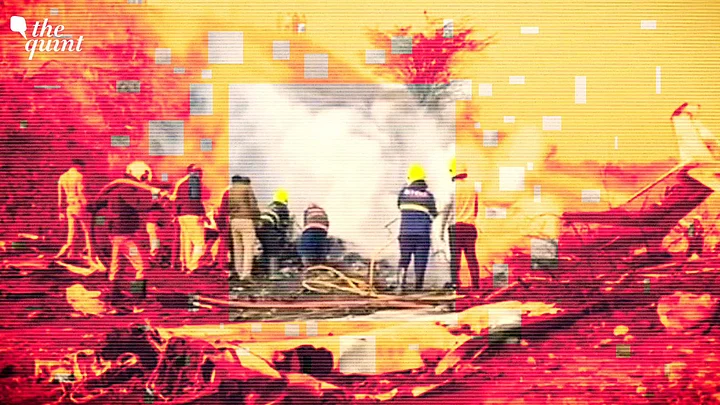
At 8:45 am on 28 January, a Learjet 45 registered VT-SSK of Delhi-based VSR Ventures crashed during the approach to land phase at Baramati airfield in Maharashtra. The aircraft had taken off from Mumbai's Santacruz airport at about 8:11 am.
CCTV footage from a camera installed at nearby Gojubavi village's gram panchayat office showed the Learjet banking steeply to the left before slamming into the ground near the threshold of Runway 11.
According to the Directorate General of Civil Aviation (DGCA), all the five souls onboard, including Maharashtra Deputy Chief Minister Ajit Pawar, his personal security officer Vidip Jadhav, flight attendant Pinky Mali, and two pilots, perished in the crash.
The flight was commanded by Captain Sumit Kapoor, a veteran with over 15,000 flight hours. First officer Shambhavi Pathak with about one-tenth of that experience (1,500 hours) was on the training path to becoming commander.
Both Kapoor and Pathak held valid instrument rating (IR)—meaning they had the requisite training for operating flights under Instrument Flight Rules (IFR).
An IR-endorsed pilot can also request for a 'Special VFR' clearance when the meteorological condition is less than needed for entering or leaving a control zone under Visual Flight Rules (VFR).
Flight Rules vs Meteorological Conditions
VFR and IFR are different sets of flight rules under which a flight is cleared to operate.
Visual Meteorological Conditions and Instrument Meteorological Conditions are corresponding meteorological conditions defined by visibility, cloud ceiling, and distance from cloud that are equal to or better than specified minima.
For a layman, think of a dividing line between the two as a visibility of 5 km below which VFR flights are suspended. In controlled airspace, the air traffic control (ATC) may allow a VFR flight to enter or depart the control zone for the purpose of takeoff or landing under ‘Special VFR’ clearance—provided the visibility is more than 1,500 metres, and the ground is clearly visible to the pilots.
An Isolated Airfield
Baramati falls under uncontrolled Class G airspace, where only VFR flights are permitted and radio/ATC clearances are optional/advisory in nature. The Baramati airfield is an isolated VFR-only airfield with no navigation or visual landing aids.
The ATC tower is manned on ‘as required’ basis by one of the pilots from flight schools based out of its spartan premises. There are no qualified air traffic controllers, weathermen, or Airport Authority of India (AAI) officials based in the airfield.
Operated by the Maharashtra Airport Development Company (MADC), there is no published area navigation or GPS-based approaches either. Under such cases, aircraft are required to operate strictly under VFR, meaning that when below 3,000 feet or 1,000 feet above terrain (whichever is higher), the aircraft should be clear of cloud, in sight of the ground or terrain below, and the flight visibility should be 5 km or more.
The tower observed visibility passed on to VT-SSK on initial contact with Baramati was 3,000 metre, clearly below VFR minima.
It's also important to note that horizontal visibility reported by the tower is an estimate—and could be different from slant visibility experienced by pilots.
An easterly approach (RW11) against a rising sun in low visibility could pose challenges in picking up vital orientation cues.
Changeover From IFR to VFR
VT-SSK would have departed Mumbai under a Yankee (Y) flight plan—or an IFR departure—enroute change of flight plan at a predetermined point to VFR, terminating in a visual approach and landing at Baramati.
While flight management systems or GPS can bring you overhead the airfield, the only safe way for an aircraft to land under such conditions would be to acquire leading-in features and the runway visually, enter the traffic pattern and roll out on final approach, all the time keeping the runway in sight.
Under some conditions, the pilot may elect to call direct finals or join the traffic pattern at some intermediate point (say, base leg), and then intercept the final approach (Mumbai-Baramati makes for an almost straight-in, direct finals for RW11, and winds were reportedly calm).
For a high-speed Learjet 45 in approach category C, any manoeuvre that departs from the above and/or a loss of visual contact with the runway almost certainly means a “missed approach” or “go around”.
That the crew of VT-SSK failed to visually acquire the runway on the first attempt to land suggests that conditions were near marginal or unsuitable for a visual approach to a VFR field. A prominent highway running parallel to the runway can also feed flight crew ‘expectation bias‘ under such circumstances.
How VFR Slipped Into IMC
The situation in the cockpit is not hard to estimate. Abandoning the mission and diverting means an unhappy, high-value client, and a possible loss of revenue. Going around means flying a traffic pattern and making a fresh attempt to acquire the runway visually.
Therein lies a serious dichotomy. The Learjet 45 is a fast jet that will eat up a traffic pattern in under five minutes. How does one execute a missed approach, fly a traffic pattern (a purely visual manoeuvre), and align with a runway that was not visible five minutes ago? What could possibly change in that timeframe? As the unfortunate accident at Baramati tells us, only fate.
It's important to recall that at such low heights, there is hardly any room for sudden manoeuvres, aircraft malfunction, or an error of judgement.
An IFR flight to an airfield with navigation and landing aids opens up a host of options to the crew. They can fly published approaches with laid down minima down to a decision altitude/height or minimum descent altitude/height, follow missed approach procedure to enter a holding pattern, ask for radar vectors, try another instrument approach, or divert after two attempts.
On a fast jet, how do you make a landing approach to a place you cannot see? A late ‘runway visual’ could mean a delayed touchdown and a possible runway excursion. Even aircraft carriers have radar controllers and visual glide path indicators to guide jets down.
Baramati had a runway owned by MADC, disowned by the AAI, milked for money and connectivity by flight schools as well as powerful politicians who saw absolutely no merit in upgrading its facilities. Now dues have been paid in lives.
Beyond Hindsight and Blame
It is easy to say in hindsight that the aircraft should have been diverted. Aircraft can eat your balance sheet for breakfast when they sit idle on the ground. The turbines and rotors have to turn if people have to earn their salaries and go home to happy families.
It is agencies such as the Ministry of Civil Aviation, the AAI, and the DGCA who must enable this basic need. But, from my experience, all they end up doing after each accident is throwing more regulations at the problem and tightening the stranglehold. When that happens, small operators and general aviation are hit the hardest.
For dubious operators with access to corridors of power, it opens new avenues for greasing palms and falling back on their “setting” with corrupt officials in the DGCA and the ministry.
One hopes that is not the case with VSR Ventures, who seem to have already washed their hands off the occupants of VT-SSK, even as the report into their 2023 Learjet accident is still buried somewhere in the ministry.
When a small, 26-year-old King Air C90 charter aircraft (VT-UPZ) undertaking a test flight crashed on 28 June 2018 near Ghatkopar—during a circling approach to land at Juhu airport, killing five—I made the grim prediction that till debris starts falling on the heads of ministers and regulators, such perilous encounters will continue. The latest, most unfortunate crash of Learjet 45 VT-SSK at Baramati and the long list of past crashes that have taken lives of politicians, ministers, and senior dignitaries from the military prove that VIP flights are neither immune to the pitfalls in the Indian aviation nor have they been the catalysts of change.
The last gate of safety under such circumstances is often the pilot. To them I wish good judgement, wise decisions in time, and the moral courage to say NO when required.
Because nobody has your back here.
(Cdr KP Sanjeev Kumar is a former navy test pilot and offshore captain who blogs at kaypius.com. He can be reached on realkaypius@gmail.com or on his X handle @realkaypius. This is an opinion piece, and the views expressed above are the author’s own. The Quint neither endorses nor is responsible for the same.)