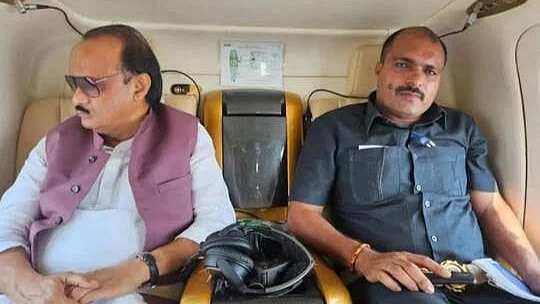
Captains Sumit Kapur and The pilots were operating a Learjet 45 (LJ45) from Mumbai to Baramati when the small aircraft plumetted just before landing at around 8:45 am on Wednesday. The aircraft was owned by VSR Ventures.
Civil Aviation Minister Ram Mohan Naidu Kinjarapu said that a proper investigation will be conducted into the circumstances that led to the crash.
"Before landing, ATC asked the pilot whether the runway was in sight, and he confirmed it was not. After a go-around, the aircraft returned to land, and the pilot was again asked if the runway was visible for landing. Then, the pilot confirmed visibility of the runway. After ATC cleared landing, it was seen that the accident had occurred," he told news agency ANI.
Who Were Shambhavi Pathak & Sumit Kapur?
According to Pathak's LinkedIn profile, she had completed her schooling from the Air Force Bal Bharati School in 2018. She then trained as a commercial pilot at the New Zealand International Commercial Pilot Academy.
She also held a Bachelor's degree in Aeronautics, Aviation and Aerospace Science and Technology from the University of Mumbai.
Among her various stints was also one as an Assistant Flying Instructor at the Madhya Pradesh Flying Club, where she held a Flight Instructor Rating (A). The Directorate General of Civil Aviation (DGCA) had also given her a Frozen Airline Transport Pilot License (ATPL).
On the other hand, Kapur was the pilot-in-command on the aircraft, and was responsible for key decision-making. He reportedly had over 15,000 hours of flying experience.
Captain (retired) Ehsan Khalid, who is a former Indian Air Force pilot and knew Kapur personally, told ANI, "It was a tragic incident. I have known the pilot since my Sahara days, almost two decades ago. He was an experienced pilot. I am told that as the plane was making its first approach, it had to go around and make a second approach. I do not know whether the first approach was abandoned and the missed approach was carried out due to bad weather visibility alone, or whether there were also technical issues with the aircraft."
"To my knowledge, no call of technical malfunction has been reported. According to the media and the DGCA, the visibility was marginal. That means it was neither very good nor very bad. If it had been really bad, the pilot would not have attempted to land," he added.
Khalid further said that the reason for the crash could be due to a combination of bad weather, technical issues, or pilot judgment error
"Marginal visibility means the situation was unclear, a kind of "go or no-go" condition. Under such circumstances, especially at airfields like Baramati, which do not have many electronic aids to support operations, the actual visibility may not have been exactly as reported and could have been lower."Ehsan Khalid to ANI
What We Know About the Crash
Meanwhile, the Civil Aviation Ministry has published a sequence of events that eventually culminated in the tragic accident. The ministry says that Baramati is an uncontrolled airfield and traffic information is provided by the instructors/pilot from the flying training organisations at Baramati.
As per the person manning the ATC, the following is the sequence of events:
On 28 January the aircraft VI-SSK first came in contact with Baramati at 8:18 am.
The aircraft's next call was at 30 NM inbound to Baramati and they were released by Pune approach. They were advised to descend in Visual Meteorological conditions at pilot's discretion.
The crew enquired about the winds and visibility and they were informed that the winds were calm and visibility was around 3,000 mts.
Next the aircraft reported on the final approach of Runway 11 and the runway was not in sight to them. They initiated a go-around in the first approach.
After the go around, the aircraft was asked about its position and crew reported on final approach of runway 11.
They were asked to report runway in sight. They replied “runway is currently not in sight, will call when runway is in sight". After a few seconds they reported that the runway is in sight.
The aircraft was cleared to land on runway 11 at 8:43 am. However, they did not give a readback of the landing clearance.
Next, the ATC saw the flames around the threshold of runway 11 at 8:44 am. The emergency services then rushed to the crash site.
They further added that the Aircraft Accident Investigation Bureau has taken over the investigation into the crash.
No Error in Aircraft, Says Airline
Amid growing calls for an investigation, VK Singh, the owner of the Delhi-based private company, has insisted that the aircraft was "very well maintained" and that there were "absolutely no issues" with its condition.
"There was no technical failure in the aircraft," Singh told news agency ANI.
The company operates a fleet of seven Learjets. When asked whether the remaining jets would be grounded, Singh firmly replied, "No."
"It's a perfectly fit aircraft. Why should I ground them? That's not my decision," he added.
Singh further pointed out that Learjets are regarded as "very, very dependable aircraft" globally, questioning, "So, why should we ground them?"
(We wish to acknowledge an error in the previous version of this article, where a photograph was misattributed to Captain Sumit Kapur. The image depicted Captain Sahil Madaan, who was not aboard the ill-fated aircraft. We have made the necessary correction and deeply regret any confusion or hurt this may have caused.)